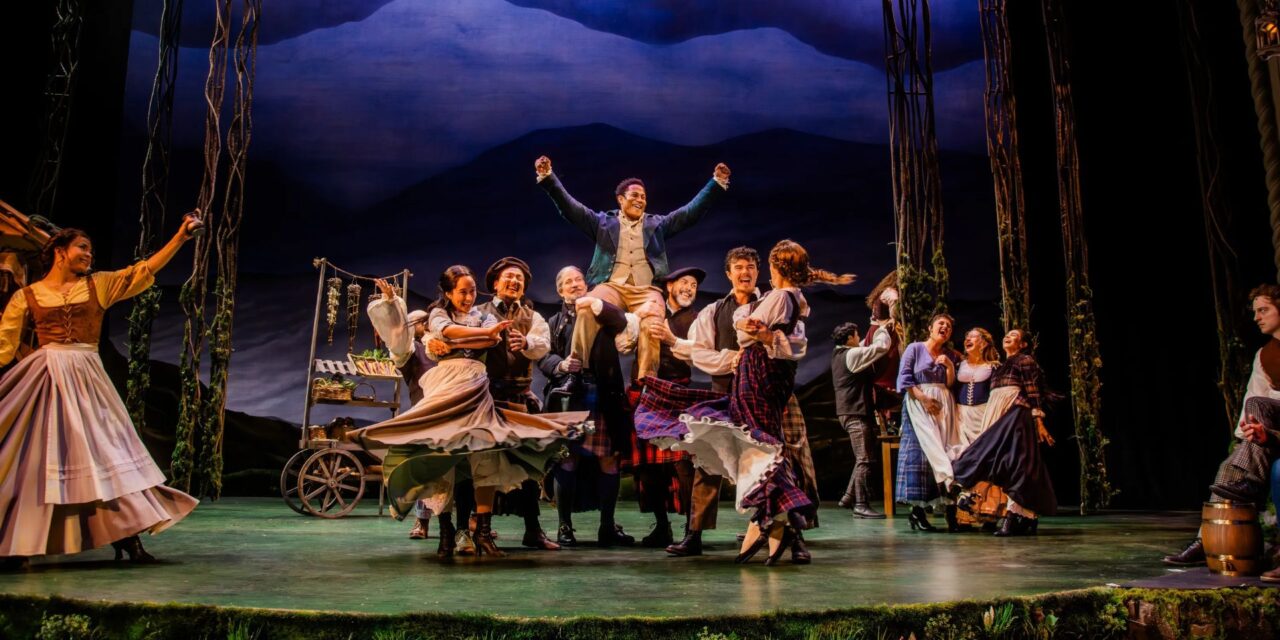
The success they later found with My Fair Lady, Gigi, and Camelot, began with Alan Jay Lerner and Frederick Loewe’s 1947 Broadway hit Brigadoon, further popularized by the 1961 film incarnation with Gene Kelly and Cyd Charisse. A new Brigadoon by Alexandra Silber “inspired by” Lerner’s original book instills more Scottish culture in reshaping the tale of an American duo who stumble into a mysterious village that appears for only one day every hundred years. This new adaptation continues the commitment of Tony-award winning Pasadena Playhouse to revive and revitalize valuable but somewhat time-worn musicals. Directed and choreographed by Katie Spelman, the production retains the songs and pays homage to the original 1947 dances by Agnes DeMille while drawing on Scottish dance to strengthen that culture’s presence in this musical.
Two days before the opening, director/choreographer Katie Spelman took time from final rehearsals to talk with dance writer Ann Haskins about the additional dance in the new production and Silber’s changes, including certain characters’ gender shifts, prompted by efforts to more accurately reflect 18th century Scottish village culture. The interview has been edited and condensed for length and clarity.

Max Von Essen and Betsy Morgan in “Brigadoon” – Photo by Jeff Lorch.
Haskins: I want to ask you about how you are using dance as both director and choreographer in this new Brigadoon, but I would like to start with how you became involved in this project?
Spelman: Well, the adapter, Alexandra Silber, is a good friend. We’ve had a long friendship and also theatrical relationship at various times as director and choreographer, choreographer and actor. She knew I loved Brigadoon very much. When she was hired to do this adaptation, she called and we talked about Brigadoon, about why I adored it, and how the dance works in it. We had a lovely, fruitful conversation. I did not know that I would be in the running to direct it, because it is such a prominent revival. Pasadena Playhouse wanted someone who was both director and choreographer, and Alexandra was passionate about having a woman director. I was available and the opportunity to both direct and choreograph Brigadoon was exciting.
Haskins: In that conversation with Alexandra, what were the things that seemed to be needed in an adaptation?
Spelman: I knew that as Golden Age musicals go, Brigadoon has a cult following, not a mainstream following. I think it should be up there with Oklahoma and Carousel. For some reason, it hasn’t been, and I think part of that is just that the book is a little dated. Not in terms of the concepts but dated in terms of how they wrote musicals then. The books for some of these other Golden Age musicals feel more timeless. Alexandra’s aim was to make it feel timeless, because the score is so timeless. Part of the reason she reached out to me is because I have a deep connection with Agnes DeMille who originally choreographed this on Broadway. DeMille is kind of my idol, my hero. Alexandra wanted my thoughts, since I had played Maggie Anderson in the last revival at the Goodman Theatre in 2014. We had a nice, long chat about it.
Haskins: Do you recall what you told her?
Spelman: Basically, what I said, and what I still say, is that there are two different kinds of synergies in the show, which is what makes it so fun and special for a choreographer. There’s the choreography of people being in a town, human behavior that’s a little augmented, as it always is in a musical. And then there is cultural choreography, such as the traditional Scottish sword dancing written into the script. And in this version, we have added some traditional ceilidh (pronounced “kay-lee”) into the script.
Haskins: What is traditional ceilidh?
Spelman: That is a third type of vocabulary which is when we transcend emotion. In Brigadoon, there’s a duet between two characters that feels like they have to talk about love on a deeper level, and choreography is the best way to do that. And then in Act Two, there is a similar moment with grief. Using a third level of vocabulary of almost expressionism digs into some of these deep feelings where words are not quite enough. In Scottish culture, ceilidh dancing essentially is social dancing. It’s not a one to one comparison, but it is kind of similar to how you and I would have learned square dancing in school. In Scotland, they grow up with these dances, and there are different varieties. If you go to a Scottish wedding or go to a Scottish Hogmanay, which is like a New Year’s celebration, someone will say, “and now we’re doing a ceilidh.” People hop up. They know the dances already. It’s a really beautiful, beautiful extrapolation of how community-based Scottish culture is, and how it is all consuming, all ages and genders. Everyone gets up, everyone dances, everyone knows the moves, and there’s a caller out there reminding everyone of the moves, kind of, sort of like square dance. It’s a really beautiful aspect of Scottish culture.

Pasadena Playhouse’s “Brigadoon” – Photo by Jeff Lorch.
Haskins: Some of what I’ve read suggested there was a feeling in developing this production, that there was a need to put more Scotland into the show, that the original was sort of Scottish-light or the cultural aspects were diluted.
Spelman: I think that is true. I think that Lerner and Loewe were brilliant. I think it was more a byproduct of the fact it was just a less international world when Brigadoon premiered on Broadway in 1947. What we knew of Scottish culture then was what they had access to, right? Now we have so much more access and are able to be so much more specific than they were.
Haskins: 1947 would have been a two years after World War II ended and a very different time without television. Would the American public know much about Scotland beyond bagpipes and kilts?
Spelman: Exactly. Alexandra’s very close to Scottish culture, because she spent so much time there. She studied there as an artist. She thought we could have more of the real Scotland now that we were updating it.

“Brigadoon” – Photo by Jeff Lorch.
Haskins: How did that come into play in terms of the choreography for this show?
Spelman: We have a full ceilidh going onstage at the end of Act One, a big wedding party, and that’s one of the places where you would have ceilidh dancing in Scottish culture. I’ve learned a bunch of the traditional dances, and Alexandra and I have gone and danced them in a ceilidh together. Also, I’ve studied with a really lovely Highland dance champion in New York to kind of tie together a lot of the cultural vocabulary that comes from ceilidh and sword dancing, and to stitch it into the fabric of the show. And we’ve extended that to music too. So there’s a ceilidh band on stage for two different sequences in the show, and a 22 piece orchestra which is really thrilling.
Haskins: Tell me about the dancers. Are they only dancers or are they also singers and actors?
Spelman: The character Maggie Anderson is mute and only communicates through movement. Jessica Lee Keller who plays Maggie, is definitely a dancer. Then we’ve got a really lovely ensemble that does it all. I am a big proponent that in musical theater dancing is acting and vice versa. They all dance and sing as well, except Maggie, of course.

Kylie Victoria Edwards and Daniel Yearwood in “Brigadoon” – Photo by Jeff Lorch.
Haskins: Did any of the dancers in the cast come with a background in Scottish dance, or have they been inculcated into this during the rehearsal process?
Spelman: Most of them have been learning with us as we go. There are two dancers in the ensemble, Spencer David Milford, who plays Harry Beaton and also one of our swings who both studied in Glasgow at the same conservatoire that Alexandra went to. So they had a lot of familiarity with it. Most of the company was learning it with us.
Haskins: So tell me how the director and the choreographer get along when you are the same person.
Spelman: Well, I get along with myself, as well as I usually do, which is intermittent, but I think it is the reason that Alexandra wanted a director- choreographer for this piece. The Lerner and Loewe Foundation felt passionately about that as well. The show doesn’t really stop. Everything moves into the next thing, all on one day. Well, most of the piece is one day. We’re moving through a celebration and then a mourning all together, and we have these three different vocabularies of dance that exist alongside each other and stitch everything together in ways that feel holistic in a really delightful way. If I were offered this job as just a choreographer, I don’t think I’d want to do it. And if I were offered this job as just a director, I wouldn’t want to do it. It moves like one thing. Everything that is directing is choreography, and everything that is choreography is directing, which is not always true for every musical, but for this specific one, I really find that to be true.

Poster from 1961 movie version of “Brigadoon” – Photo courtesy of the artists.
Haskins: Now as to the plot, I know the movie, because, as you said, it is not a frequently staged musical. In the movie, the plot follows Gene Kelly and Van Johnson who go hunting in Scotland, get lost, and find Brigadoon, a village that only appears once every hundred years. The Gene Kelly character, Tommy Albright, is somewhat dissatisfied with fast paced New York life, and finds himself charmed by the village and falls in love with Fiona Campbell, played by Cyd Charisse in the movie. When it’s time for the village to disappear, Tommy reluctantly returns to New York but later returns to Scotland because he wants to find Brigadoon again. There are several subplots about a marriage, a manhunt, and why this village disappeared. How has this version changed from the original musical or the movie version?
Spelman: Well, it has changed and it hasn’t changed, right? The skeleton of the show the Learner wrote is still there. The village fears these two men stumbling into it, and Tommy is a man who is searching for meaning and a Fiona is a woman who is holding out for the one, as opposed to settling for whomever, and expresses a kind of love that transcends time and space. There is also an element of the relationship between these two men, best friends, but who experience this town in very different ways. Essentially, we’ve updated it. These two men could be from today and stumble into a town that is all about connection. In some ways, we live in maybe the most connected age in history, but also we are all very isolated. They come into this town that has no technology but is incredibly connected. That makes for a side by side comparison of life, what life means to different people, and how these two men are affected by it. Among the things that changed, Alexandra has taken out the fact that the Gene Kelly character in the movie is engaged. We’ve taken that out of the equation. Also, they are not hunters in this version. They’re travelers. In the original Broadway show, the two friends were soldiers after World War II and being on a hunting trip would make sense. Brigadoon has gone through many iterations. There are many different versions, and a lot of directors have had different takes on it. I would say that what Alexandra has done is really dug into this town being a vibrant, wonderful place, and that this miracle, like the circumstances of how they became a town that vanishes, are very specific and were about preservation, not about isolation, but about wanting to continue to be able to pass the things that they value. For these two men from this modern age where everyone is so cynical, they realize that they have wandered into a miracle and what that does to the modern heart.

Tyne Daly in “Brigadoon” – Photo by Jeff Lorch.
Haskins: Another character, an elder in the town, was a man in the original, and now the character is a woman, Widow Lundy, played by Tyne Daly. What was behind that change?
Spelman: The reason is actually historical. Alexandra did a lot of research and looked into Scottish society in the 1700s, Gaelic society actually, since Ireland was like this too. These Gaelic societies had a lot of really powerful matriarchal figures, and that idea was missing from the equation, because it was written by two Americans in 1947 and America is a patriarchy. So the leader of the town was a man, of course. Now it feels a bit more like we have women who exist in this town and do things other than sigh. A woman owns the tavern in this version, and the tavern is the center of life in Brigadoon. And Widow Lundy is kind of a keeper of lore and wisdom in the town. We also have men who are town elders, but it’s a bit more egalitarian, which is actually true to how it would have been in the 1700s. So the changes came out of research, and then a desire for more representation of women on stage,

Katie Spelman – Director/choreographer of “Brigadoon.”
Haskins: What I’m hearing is that because of Alexandra’s background studying in Scotland, spending time in Scotland, and becoming familiar with the reality of Scottish cultural history and heritage, she has tried to tell the story from the inside, adding more Scottish viewpoint to the story, not just an Americanized Scotland perceived by Lerner and Loewe post-World War II. Would that be a fair description?
Spelman: I think that sounds like a fair description. And also I think it’s because of the access to information. We haven’t always had this kind of access to information. So Lerner and Loewe were writing what they knew, and now Alexandra is writing what she knows, and it’s just a little different. Something that’s really special about Scotland is community. It is a very community-based small country, and the idea of two modern men, strangers from the future, wandering into a place where community is the most important thing is a really intriguing story right now.
Brigadoon at Pasadena Playhouse, 39 S. El Molina Ave., Pasadena, Tues.-Wed. & Fri., 8 pm, Thurs., 7 pm, Sat., 2 & 8 pm, Sun., 2 pm, thru Sun., June 14, 7:30 pm, $63-$152. Pasadena Playhouse-Brigadoon
Written by Ann Haskins for LA Dance Chronicle.
Featured image: “Brigadoon” – Photo by Jeff Lorch.