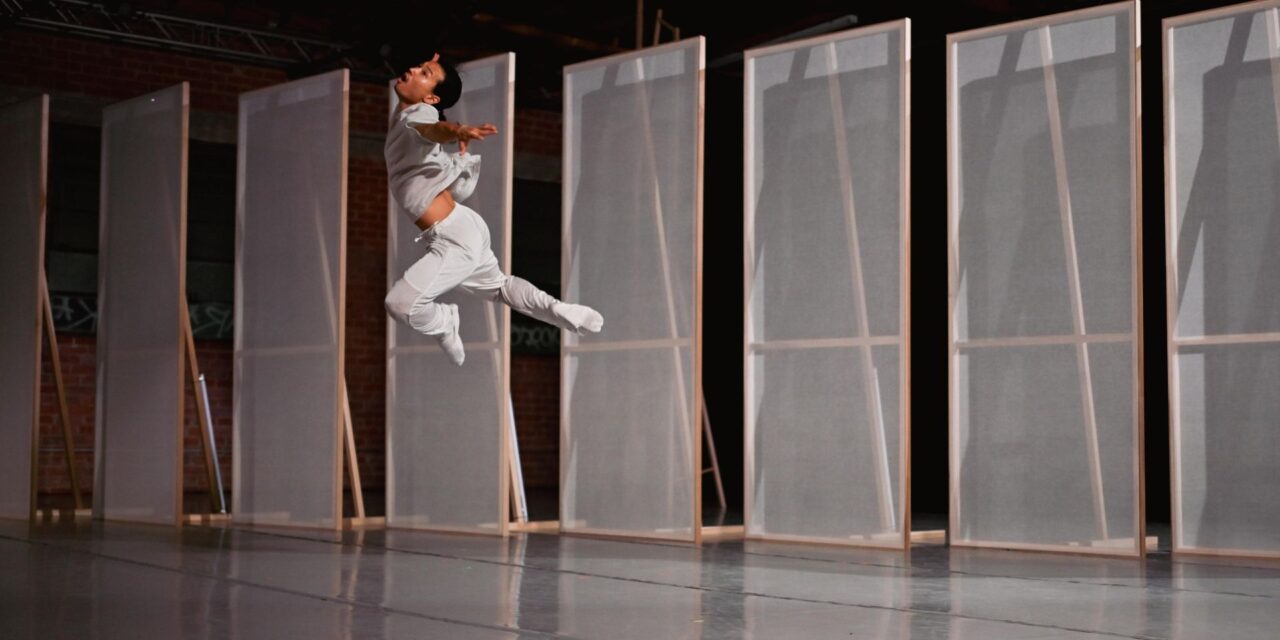
A plié requires the torso to stay upright with a strong core and neutral pelvis. The deeper the plié, the more effort the body must exert. As Shu Kinouchi performs this fundamental movement, aligned with a wall in front of him, he emphasizes strength through struggle, constantly correcting his spine in hopes of replicating the wall’s composure. There is a lesson to be learned from this wall, and Kinouchi is determined.

Shu Kinouchi in “Wall-Body” – Photo by Hope Spears.
In his latest solo show at L.A. Dance Project, “Wall-Body,” Kinouchi collaborates with designer Hiroshi Kaneko to investigate the body’s relationship to space and the walls that create it. This is the second installation in a series that began with “SHU LOVES CHAIRS,” a collaboration with WAKA WAKA. This time around, Kinouchi’s choreography, set to music by Nico Muhly and FUJI|||||||||||TA with composition by Kaneko, emphasizes the struggle of comparison and connection. Structured in two parts, each section incorporates the same choreography, but as the 12 wall panels shift in the space between them, the container of his movement impacts his execution. The work depicts our human desire for perfection, reflecting on the impact of comparison and the internal growth made when we finally look inward for the source of change.
Kinouchi’s movement vocabulary fluctuates between reckless abandon and precision. In his desire to replicate the aesthetics of the 10-foot walls that surround him, his movement embodies a level of flatness, like Nijinsky, to portray dance two-dimensionally. He quickly performs an attitude turn to ensure he lands on an image that feels strong and grand, like the walls. However, flatness isn’t his goal; it is only a byproduct of his real aspiration: structure.

Shu Kinouchi in “Wall-Body” – Photo by Hope Spears.
In the first section of the work, the 12 wall panels run diagonally across the LADP space. Kinouchi repeatedly runs up against the walls made of sheer white fabric, stopping in front of them with arms spread wide. The lighting design by Chu-Hsuan Chang emphasizes the shadows his body leaves behind. As he lifts his arms to find a moment of stillness, his shadows run horizontally across the pieces, replicating the wooden support beams on the walls. The costume design by Clay Koonar pushes this idea of embodying the wall further, dressing him in all white to blend in. Kinouchi beautifully portrays an emotional connection to the wall through his movement, finding the perfect moments to tell it, “I am just like you.”
Kinouchi’s performance is incredibly internal in the first half of the show. In one moment, most of the lights dim, and there is only a single spotlight on his back. He faces away from the audience and toward the walls. Once again, he spreads his arms by his side, but he subtly moves in this position. The muscles of his shoulders and forearms dance with a deep emotion that, in the warm light, feels like fear and surrender. It happens quickly, then he shifts to the reckless abandon that has him leaping and collapsing to the ground, pulling him away from the desire to fit in with the walls. Here, his musicality and strength come out with FUJI|||||||||||TA’s “sukima,” as the deep, syncopated synths dictate his next move. He lands in difficult positions and glides through the moments of musical flow.

Shu Kinouchi in “Wall-Body” – Photo by Hope Spears.
Kinouchi begins section two in a box made of the walls, enclosing himself. His choreography reads differently in this new world. The movements he performed away from the audience are now directed at it, his face visible through the sheer screen. The audience sees the pain and anguish on his face as he collides with the walls, pulling at his mouth and contorting his face. His movement has a new tone, exacerbated by the containment of his previously free movement that allowed him to leap across the stage.
His relationship to the walls is intimate and smart, revealing his internal struggle for companionship and the physiological ways it manifests. A light shines from behind, creating a shadow on the white fabric of the walls that feels grotesque, like a hallucination or a bad dream. His movement doubles with the shadow, but it is hard to tell where he is. He’s lost in the darkness, and he only resurfaces when he steps out of the box. To be in sync with the wall, he must first be comfortable without it.
He wanders, with his shadows portrayed on the literal walls of LADP. As he travels, he is obstructed by the set pieces, but his shadow remains. He appreciates the ghost of his body, which reminds him that he still has a place with the wall, but is also free to exist without the wall’s structural limitations. We must first know life with resistance to appreciate it without. “Wall-Body” is about trusting the walls will be there to challenge you and make the journey worth it.

Shu Kinouchi in “Wall-Body” – Photo by Hope Spears.
The two sections are essential to revealing the necessity of struggle. Kinouchi returns to the inside of the box, after a deserved moment of wandering, and settles into the final moments of choreography. Once steaming with frustration, his performance is now calm. He’s satisfied. He takes off his white shirt and pants, no longer blending into the walls and fighting for the two-dimensional aesthetic in his movement; without the clothing, he is 3D.
“Wall-Body” is a poetic portrait of human limitations, belonging and self-acceptance. After fighting to be part of the wall, he embraces his body — his humanness — and establishes how different he is from the surrounding structures. He makes an opening in the walls and perfectly fits himself into it, skin against wood, submitting to his new place by resting his forearms against the sides of two walls. His pelvis is neutral, and his torso is perfectly upright. He takes a deep breath, a stark difference from the previous sections of struggle, and looks up, tranquil — still and full of possibility.
To learn more about Shu Kinouchi, please visit his Instagram page.
To see what else is taking place at L.A. Dance Project, please visit their website.
Written by Steven Vargas for LA Dance Chronicle.
Featured image: Shu Kinouchi in “Wall-Body” – Photo by Hope Spears.