With a score Tchaikovsky considered superior to his own for Swan Lake, and choreography from a British master for a reigning ballerina at the peak of her powers, American Ballet Theatre brings the full-length Sylvia to the Segerstrom Center for the Arts for five performances led by four among ABT’s own reigning ballerinas from April 9-12, 2026.
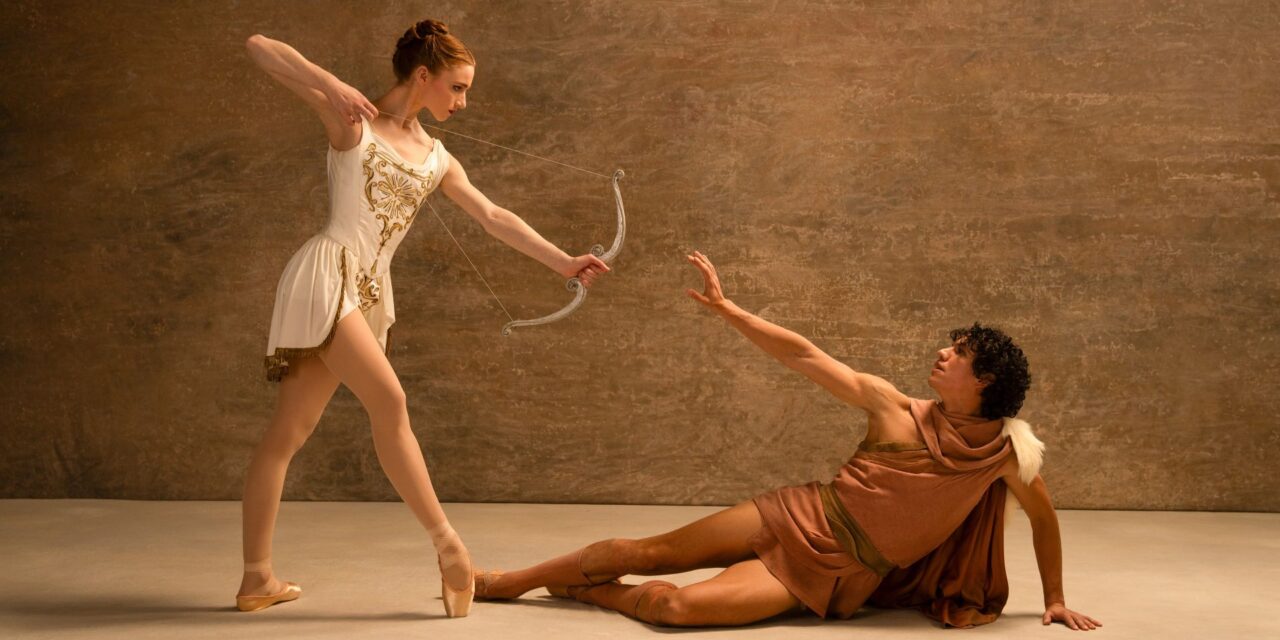
Sylvia is a fierce huntress, a nymph who has sworn off love. When surprised by a young shepherd professing his love, she shoots him with an arrow. A nearby statue of Eros, the god of love, comes to life and Sylvia’s hit with an arrow in return, causing her to fall for the shepherd while another suitor, the villainous Orion, takes a more direct approach and kidnaps her. So begins the ballet Sylvia which, in operatic style, unfolds with obstacles involving gods, goddesses, and the power of love, all drenched in technical and stamina-challenging choreography set to Léo Delibes’ luminous score that begs to be danced.
Tasked with overseeing ABT’s production, Associate Artistic Director Clinton Luckett brings a depth of experience with National Ballet of Canada with its historic ties to Britain’s Royal Ballet and his years with American Ballet Theatre. Luckett spoke with dance writer Ann Haskins about the ballerinas tackling the daunting title role, Delibes’ stature as a ballet composer, and the challenges today’s dancers confront in a role created on Margot Fonteyn at the height of her career, 15 years before she partnered with Rudolf Nureyev after he defected from Russia.
(The interview has been edited for clarity and length. The casting discussed is listed with the performance details at the end.)
Haskins: Four dancers take on the role of Sylvia at Segerstrom. Hee Seo danced Sylvia in 2016, the other three dancers, Catherine Hurlin, Skylar Brandt, and Chloe Misseldine, debuted in the title role last summer in ABT’s New York season. Before we get into the casting, please talk about the central character, Sylvia, and the range that it requires of the ballerina.

Hee Seo in American Ballet Theatre’s “Sylvia” – Photo by Marty Sohl.
Luckett: How much of the ballet’s history do you know?
Haskins: A bit, but I always like to know more from those who actually are living with a ballet.
Luckett: Well, the original 1876 ballet fell out of favor, but not Léo Delibes’ music. Ashton said that in the 1940s, he had a dream where Delibes appeared to him and implored him to save the ballet, but it took Ashton several years before he actually accomplished it when he created this role for Margo Fonteyn in 1952. I don’t know if you ever read the critic Clive Barnes’ description of Fonteyn in the role.
Haskins: No, I haven’t.
Luckett: In 1952, Clive Barnes wrote “The part has everything for Fonteyn. It exploits her imperiousness, her tenderness, her pathos, her womanliness, her bravura. It gives us Fonteyn, triumphant. Fonteyn, bewildered. Fonteyn, exotic. Fonteyn, pathetic. Fonteyn, in excelsis, the range of her dancing is unequaled. The heart splitting significance she can give to a simple movement, unsurpassed. The whole ballet is like a garland presented to the ballerina by her choreographer.” So that gives some indication of the role’s scope. Fonteyn, obviously, was one of the greatest dancers of the 20th century, and she had an incredible range, which Ashton captured in this role. That is a lot for any dancer to live up to.

Margo Fonteyn in “Sylvia” in 1952 – Photo courtesy of the Royal Ballet.
This is a little bit of background before I speak about these dancers. We have wonderful dancers today, and they all have their different attributes, and they all excel in different ways, in different parts of this role. Dancing Sylvia is a Mount Everest, and each dancer has their own way of climbing it. Nobody can be Fontaine today in that way.
First of all, it’s just a physical trial because there are three acts, and she’s on stage for a great deal of the ballet. She has two major dances in the first act, she’s on stage for the entire second act. And then, of course, she has a very difficult solo and the grand pas de deux in the third act, and then the coda in the ending. It is a sheer physical test of stamina and strength for any dancer that attempts it. And these dancers we have today are very strong and all bring their all, but it takes every ounce of their technical ability to deliver the part.
Haskins: It sounds like this was an haute couture ballet designed for one particular body at one particular point at the pinnacle of her abilities, and other people can wear it, but each has to find their own way to wear it.
Luckett: Exactly. Fonteyn was a fairly compact dancer physically, but she wasn’t the only one to dance it. It was danced by other dancers with different types of physiques in her time and in these five performances we also have a range of different bodies, sizes, types. That informs the differences, to a certain extent. Skylar Brandt is the most compact and petite of these five dancers, and she has a rock solid technical ability that allows her to navigate all the technical challenges with a lot of confidence.

Skylar Brandt in American Ballet Theatre’s “Sylvia” – Photo by Heli.
And then there’s also a range of ages we have. You know, Chloe Misseldine is in her mid-20s and the most junior person of the five dancing the role. And then, Hee Seo is the senior ballerina of the company at the moment, almost over a decade older than Chloe and has more experience to bring. So it’s not only just a range of technical differences, it’s a range of interpretive differences based on their range of experience.

Chloe Misseldine in American Ballet Theatre’s “Sylvia” – Photo by Nir Ariel.
Haskins: Catherine Hurlin, who danced the opening in New York last summer, is also dancing here. Is it true her nickname is “hurricane.”
Luckett: It is true. We hadn’t done the ballet in almost 10 years, and she was tasked with going out there and presenting it on opening night. It’s daunting for our most accomplished dancers because of all of the technical demands and also the range of dramatic emotions in play. Just doing that on opening night at the Met made it even more challenging.

Catherine Hurlin in American Ballet Theatre’s “Sylvia” – Photo courtesy of the artists.
Haskins: Do you recall anything that you perhaps said to the ones who were new to Sylvia to help them get inside her?
Luckett: Today, I think the first thing dancers want to know is what are the steps, the choreography. They want to feel that they can master the choreography technically, to have that command. Technical execution is given a lot of priority. After they accomplish the steps, then it’s the stamina, first of all to get through each act, and then to get through all of the acts, consecutively, and learning then how to pace oneself. A senior dancer has a lot of experience and knows a bit better how to pace, how to save a bit here, and then really give a lot there. Younger dancers often don’t yet have that. As you do roles like this, you learn how to pace yourself and how to ensure that you have enough strength and stamina to get through the entire evening. Guiding the younger ones to not give everything all at once is important and yet difficult in this ballet, because her first entrance and her first dance is one of the strongest, one of the most triumphant, one of the most energetic dances that she does.
Haskins: Is that with the entourage of huntresses?
Luckett: Yes, that’s with the eight huntresses, her sort of retinue. She gets a few breaks while they are dancing behind her, but Sylvia does a series of passages that are absolutely the most demanding jumping and turning that you can do. Younger dancers come on with all the adrenaline and have to do this really demanding passage right off the bat. They’re apt to just spend everything that they’ve got in the very first dance, and then literally a minute later, she has to do a whole solo on her own. Ashton said the challenge is helping them understand how to pace themselves and how to just navigate this extremely complex sequence of solos.
American Ballet Theatre’s “Sylvia” – Photo by Rosalie O’Connor.

American Ballet Theatre’s “Sylvia” – Photo by Rosalie O’Connor.
Haskins: How does the character of Sylvia change or evolve over the course of the ballet?
Luckett: In the first act, she’s quite heroic. In the second act, she’s very sad and pathetic in the beginning, and then she slowly takes control of the situation and has to put on this very seductive veneer to dupe Orion who kidnapped her. That scene has to have quite a dramatic transformation. Then in the third act, she has to be this absolutely mature, completely refined and beautiful classical paragon. The character evolves in different ways for all five dancing Sylvia. They each bring their natural personality that gravitates towards some of those different aspects.
Haskins: One of the things I enjoy about Ashton story ballets is, while everything pivots around the central characters, Ashton created a showcase for the entire company, offering the chance to get to know who else is in the company and spot promising dancers as they grow into bigger parts.
Luckett: Absolutely. There are the two men Aminta and Orion who are pursuing Sylvia, and then there’s Eros, the God of love, who is a significant figure in the ballet. And then, a lot of characters get the spotlight in the third act and characters in Orion’s Grotto in Act Two. Ashton was one of the greatest choreographers of the 20th century, probably one of the two greatest, and that’s evident in this ballet from the biggest role to the smallest role. There’s wonderful corps work. There’s wonderful character work. There’s wonderful dancing for these other characters in the story. That was the genius of Ashton.
Haskins: You have a background both with the National Ballet of Canada and ABT. National Ballet of Canada in some respects is closer to the Royal Ballet tradition and ethos, while ABT is very much an American company. Ashton’s ballets do translate, but I wonder if you find that American ballet sensibilities need to be adjusted or reined in for an Ashton ballet?

American Ballet Theatre’s “Sylvia” – Photo by Rosalie O’Connor.
Luckett: Yes, you’re making a good point. It’s an interesting thing. Of course, the National Ballet of Canada was founded by the British dancer, Celia Franca, who was dispatched by the Royal Ballet’s Nanette de Valois to found the Canadian ballet. So the tradition, the roots of the National Ballet of Canada, are deeply, deeply tied to the Sadler’s Wells Ballet, which became the Royal Ballet. I tasted all that deep British heritage when I was in Canada, first in the school, then in the company. Alexander Grant was director of the National Ballet, not when I was in the company, but prior to my joining. And of course, Alexander Grant was one of Ashton’s ‘go to’ male muses. There had always been Ashton ballets in the National Ballet repertoire, but then Alexander added even more.
Ashton’s work has translated very well to American Ballet Theater. Kevin McKenzie, during his tenure as director, added many Ashton works, including Sylvia. This production originally was a co-production between the Royal Ballet and American Ballet Theater. It was premiered in 2004 at the Royal Ballet in the centenary year, as a tribute to Ashton’s birth in 1904. We premiered it the following year, 2005 and the original designs were also recreated for this. Visually, it is an absolutely gorgeous production.

American Ballet Theatre’s “Sylvia” – Photo by Nir Arielli.
Ashton’s works have translated very well to American Ballet Theater, and we’ve had enormous critical success and also success with the public with all of these ballets. I do think that for Americans, there is a more understated requirement in the style of Ashton choreography. I guess you could use the word restrained. I don’t know if Ashton would really like that word, but from our point of view, it seems more restrained than American dancers tend to dance. But also, I think in American Ballet Theater, we’re not burdened by the history of Ashton. Unlike the Royal Ballet, we are not the gatekeepers. And sometimes, when you’re the gatekeeper, and you feel like you have such a responsibility to preserve something, it can be stifling. We are not the sole caretakers. So there’s a freedom for our dancers, not just a physical movement freedom, but there’s a psychic freedom in that they are just beautiful ballets to dance.
Haskins: Avoiding the trap of becoming a ballet’s museum?
Luckett: Yes. There is a freedom of spirit that ABT brings to Ashton ballets. A real Ashton purist from Britain might say that we don’t dance it strictly correctly all the time. But I think we infuse Ashton’s works with a lot of life and a lot of vitality. Alastair Macaulay, the very esteemed British dance critic and the chief critic of the New York Times, gave us credit on many occasions for the vitality that we brought to Ashton’s ballets.

Catherine Hurlin and Isaac Hernández in American Ballet Theatre’s “Sylvia” – Photo courtesy of the artists.
Haskins: One last thing I’d like to talk about is the Delibes’ music which will be performed live by the Pacific Symphony.
Luckett: Yes. I was going to say the most important thing about Sylvia, and the whole reason that we’re still even doing it today is because of the music of Léo Delibes. If he hadn’t written such an incredible score, the ballet would not still exist. The music is why it persists.
In the 19th century, most of the composers composing music for ballets like Don Quixote or La Bayadere or those types of ballets, composed music that is serviceable, but they were not great composers. A lot of composers in the 19th century weren’t open to ballet. Ballet was considered to be churning out music by the yard for different dances, with too many limitations for serious composers to be enticed. Tchaikovsky was obviously the greatest composer who dedicated his efforts to writing ballet scores and gave us three great ballets that we have today–Swan Lake, Sleeping Beauty, and The Nutcracker. After those, the next ones are Delibes’ ballets–Coppélia, La Source (The Spring), and Sylvia. Delibes’ teacher in the conservatory in Paris was Adolfe Adam, the composer of Giselle. I understand that Adam, who originally choreographed Le Corsair, gave Delibes, as a student, the task of writing the Jardin Animé music in Le Corsair. So perhaps because Delibes’ teacher saw value as a ballet composer, Delibes was open to the idea of writing for ballet. Thank God Tchaikovsky and also Delibes found it compelling or interesting to write the ballet scores that they did.

Clinton Luckett – Photo by Rosalie Connor.
Haskins: Anything else I did not ask about?
Luckett: Just to underscore how great Delibes’ music is. Sylvia premiered in 1876, but Tchaikovsky did not hear Delibes’ score until nine months later, after Swan Lake premiered in 1877. And then he said that if he had heard the score for Sylvia, he would never have written Swan Lake. So Sylvia is such incredible music wedded with a great choreographer’s tribute to one of the greatest dancers of the 20th century, and built a role for a ballerina that is a pinnacle for the ballerina’s art.
American Ballet Theatre – Sylvia at Segerstrom Center for the Arts, 600 Town Center Dr., Costa Mesa; Thurs., April 9, 7:30 pm (Chloe Misseldine with Calvin Royal III, Cory Stearns, Carlos Gonzalez), Fri., April 10, 7:30 pm (Skylar Brandt with Jake Roxander, James Whiteside, Takumi Miyake), Sat., April 11, 2 pm (Catherine Hurlin with Isaac Hernández, Jose Sebastian, Carlos Gonzalez), Sat., April 11, 7:30 pm (Skylar Brandt with Jake Roxander, Patrick Frenette, Elwince Magbitng), Sun., April 12, 1 pm (Hee Seo with Aran, Cory Stearns, Takumi Miyake), $59-$169.
For more information and to purchase tickets, please visit the Segerstrom Center for the Arts website.
To learn more about American Ballet Theatre, please visit their website.
Written by Ann Haskins for LA Dance Chronicle.
Featured image: Catherine Hurlin and Isaac Hernández in American Ballet Theatre’s Sylvia – Photo courtesy of the artists.