Thanks to Highways’ Executive Director Leo Garcia, and Artistic Director Patrick Kennelly for maintaining a space for new and exploratory work in this era of tightened budgets and dwindling funding. Kudos to both of them.
Keith Johnson’s “SERIES is an ongoing collection of solo works built from the same movement material, each performed to a different score and shaped by shifting emphases within the structure of the dance” (program notes). In this SERIES: Gun, Johnson utilizes six different dancers to perform the same solo to different soundscapes and music. It is an interesting exercise in how the auditory faculties of the human brain inform and help define how choreography is comprehended. Simply by changing the input of one of our senses entire narratives are augmented, lost, or created anew. The “Gun” part came about during the development of the SERIES when gun violence and fear of guns began to surface through the work. Johnson also has personal experience with gun violence leading to a uniquely sensitive perspective in how it affects individuals, society, and culture as a whole.
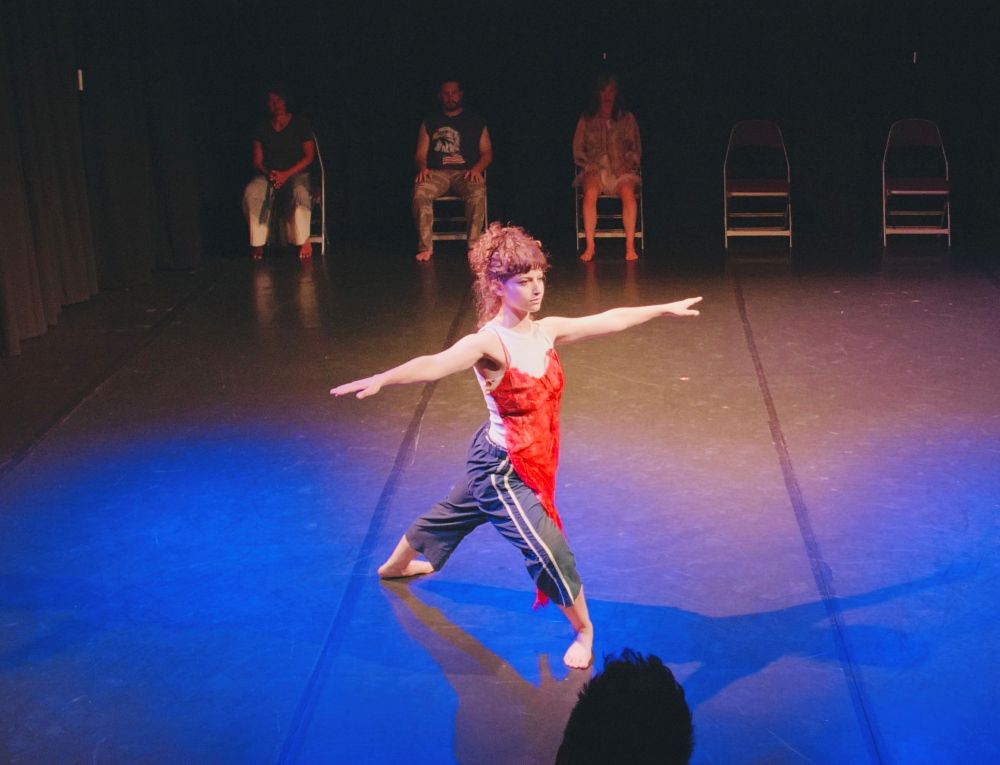
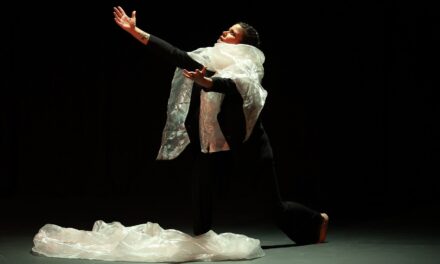
Keith Johnson/Dancers – “Gun”, Choreography by Keith Johnson – Photo courtesy of the company.
The differences between six dancers all doing the same solo lie chiefly in the interpretation of the senses in viewing different costumes, variations in bodies, variations between the sexes, variations in temperament and of course variation in soundscape or music. These variations tend to be subtle but enough to shift our attention and comprehension of each solo to register them as different, at times vastly different. The movement of the solo each performed is fairly straightforward. They begin facing the audience and then an arm bends, a leg comes around, they move across the front of the stage and then on diagonal with arms flailing and suddenly a balance in arabesque into another off-balance roll out from the form. This movement took on different connotations depending on the performer and the sound adding context to what we see. And in this case context is everything. The stage is set with six chairs upstage against the backdrop facing the audience.
“Bird”, a premiere danced by Rosalynde LeBlanc began with the voices of officers on a Police scanner radio. This immediately set the tone as serious, and one possibly fraught with the danger of shots being fired from a gun. The audience is aware that there is danger and LeBlanc shows this through the intense focus of her gaze while she scans her environment for possible threat. At times she slows the movement and her alertness turns to concern and perhaps exhaustion at being on guard. She has sharp angular movement which becomes slightly more fluid as the solo goes on. Some of her movement becomes big and expansive as she segues into the second soundscape of Rickie Lee Jones’ “Skeletons”. At the end of her solo the next dancer enters and walks ceremoniously upstage and across the back to come downstage to take the LeBlanc’s place downstage left. At this point LeBlanc walks upstage to sit in the chair furthest stage right and watches the rest of the proceedings as if a juror in court or a simple witness. This pattern repeats for all of the transitions.
Next was Andrew Merrell in “My Vietnam” (2022). This version of the solo was set to an interview with a Vietnam Veteran who is plainly speaking about the atrocities he committed in Vietnam. Merrell is wearing camouflage pants and a black T-shirt with an American Eagle on it and has long hair pulled back into a braid. He begins the solo just as LeBlanc did, however the movement quickly becomes more sinister and harrowing as we hear the Veteran explain how killing people is very much like sex. It conveys the same kind of ecstasy inherent in the act. He then goes on to detail the killing of 38 enemies and collecting their ears as trophies and wearing them on his person. In this manner the angularity of the movement became more threatening, more deliberate. The fast sections illuminated a need for alacrity in the face of survival. The slower sections showed numbness of feeling while existence continues. It must have been difficult for Merrell to rehearse that solo to that soundtrack.
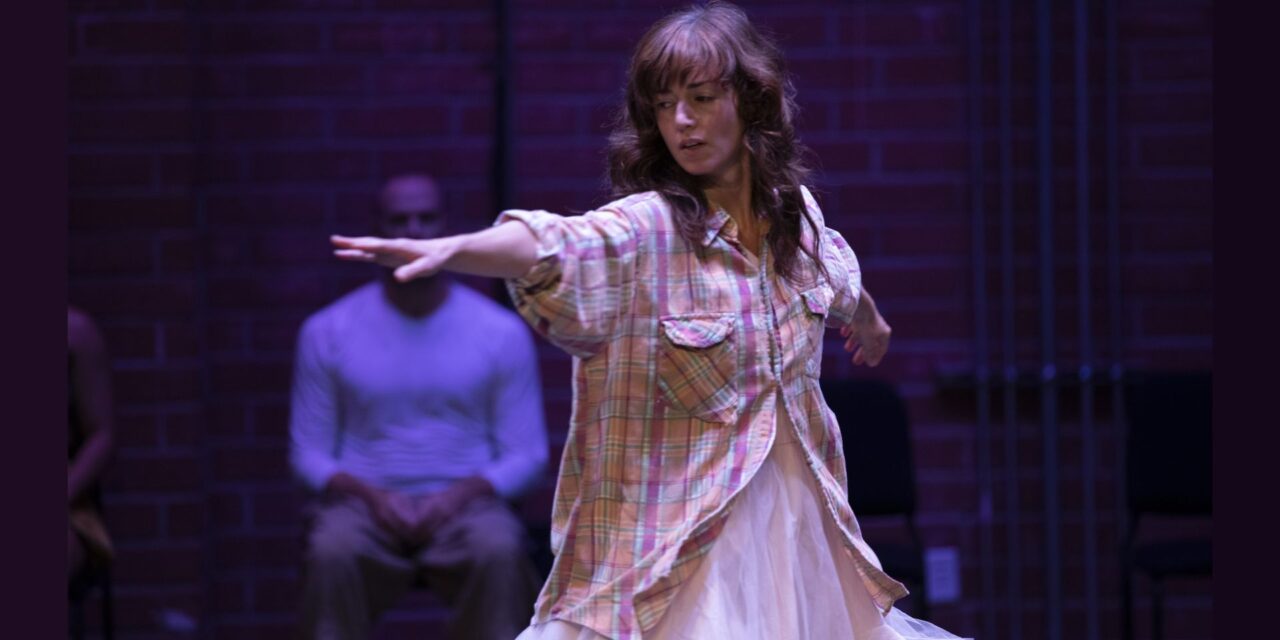
Tara McArthur danced “Roadkill” (2022) next. This was set to car sounds, driving, accelerating turning, etc. The story made this clear as a woman in voiceover describes her father driving and running into a baby deer. After that the mother deer is nearby and rams the car trying to get to her doe. The father then pulls a ’45 out of the glove compartment and shoots the mother deer a number of times over the head of his daughter in the car, who is telling this story. McArthur is dressed in a short white skirt with a flannel shirt on over it reflective of a younger teenaged girl in the car. Her movement is more delicate or seems so, and she is moving with no understanding of her father’s actions in the car. Her face betrays her confusion at her father’s actions even as she is balancing in arabesque or coming down the diagonal towards the audience. At the end the deer are not dead yet so the father drives the car over both of them.
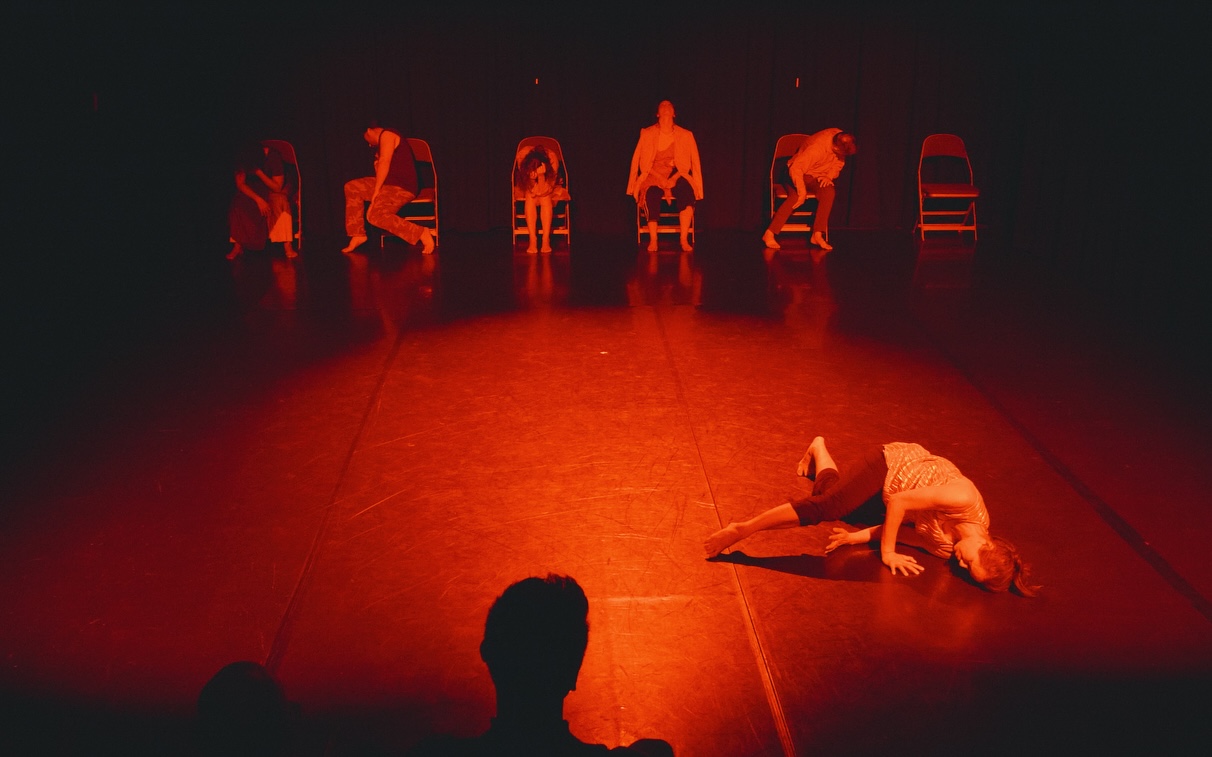
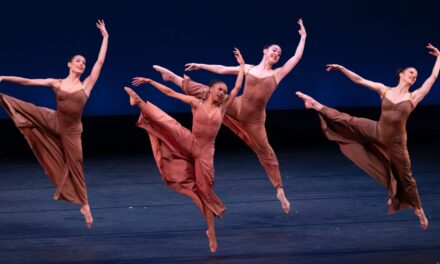
Keith Johnson/Dancers – “Gun”, Choreography by Keith Johnson – Photo courtesy of the company.
Next was Eliza Loran dancing “Bleed” (Premiere). This was set to Tori Amos “Me And A Gun/Only Women Bleed”. Loran was straight-faced and serious with a younger countenance and vibe making this aspect of the solo seem more frustrated and even a little petulant. Her movement was clear and direct accomplishing all of the requirements of the choreography while the song had aspects of a tantrum implied. She wore silver shorts with a white tank top and half of a red dress attached to the tank top in a haphazard fashion. I appreciated the difference in age between the performers as it brought out the various stories and lyrics in a very strong effect.
Brad T. Garner danced “Holy Holy Holy” (Premiere), to the Hymn of “Holy, Holy, Holy” written by Reginald Heber. This is a Catholic mass staple and is a part of other denominations’ worship as well. Here it is the precursor to a horrific confession. Garner enters and covers Loren with his coat, a gesture at once tender and also protective. She walks back to her chair as he comes downstage and launches into the solo with the fervor of a believer. His costume is gray slacks with a buttoned-down, long-sleeved shirt over a white undershirt making him appear as an Elder or novitiate. He has short cropped gray hair making him appear mature and self-possessed, in control. The movement is thorough and followed through with precision. For the second half of the solo we hear a confession from John List writing to his pastor and telling him the reasons why he had to kill his mother with his wife and two children. He thought long and hard about it and decided that they were all better off going to their Lord rather than being here on earth and suffering through his failure to find work. The solo suddenly finds its disruptive and horrendous subplot as Garner proceeds through the movement with a calm straight face betraying nothing of the voice-over’s chilling narrative. The solo becomes a series of movements to perform as on a checklist, the intent grim and determined. When he goes to the floor the movement means something different than before and we see doubt and possibly remorse but cannot be sure as it is the same choreography we have seen four times now. The premeditation and the rehearsed dance go hand-in-hand. We know the solo and how it ends and now we know how the family ends – chilling and well-acted by Garner.
Adriane Fang dancing “Now” (Premiere), was the final solo set to a soundtrack from “They Shoot Horses Don’t They?”. The sound begins with huge ocean waves crashing at the beach and the surf turning and tumbling making for a raucous solo for Fang. She is covering a great deal of space and making the movement huge and grand. She careens here and there through the diagonal and floor work of the solo. She launches herself into the arabesque balance and tilts over flipping into the next move. Her demeaner is one of resigned despair matching the voiceover from the movie. In the dialogue from the soundtrack, a woman wants a man, a friend, to kill her and put her out of her misery. At one point in the solo, the performer is downstage left and turns on the spot to kneel facing upstage with their arms open wide in a stance of supplication. It is at this point that the shot rings out killing the woman in the voiceover and also destroying Fang onstage. The lights go red and all five other performers sitting in their chairs upstage recoil from the shot. All turns into slow motion as we grasp the entirety of the scene. This is the first and only gun shot of the show. The lights return and Fang gathers herself together to end the solo.
For more information about Highways Performance Space, please visit their website.
Written by Brian Fretté for LA Dance Chronicle.
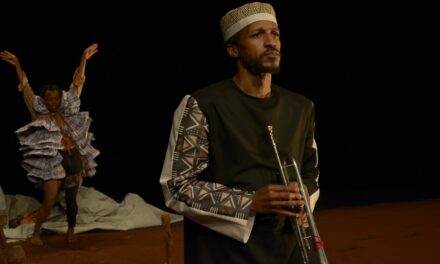
Featured image: Keith Johnson/Dancers – “Gun”, Choreography by Keith Johnson – Photo courtesy of the company.