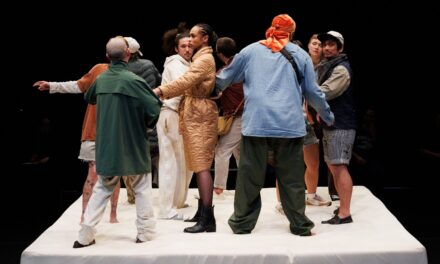
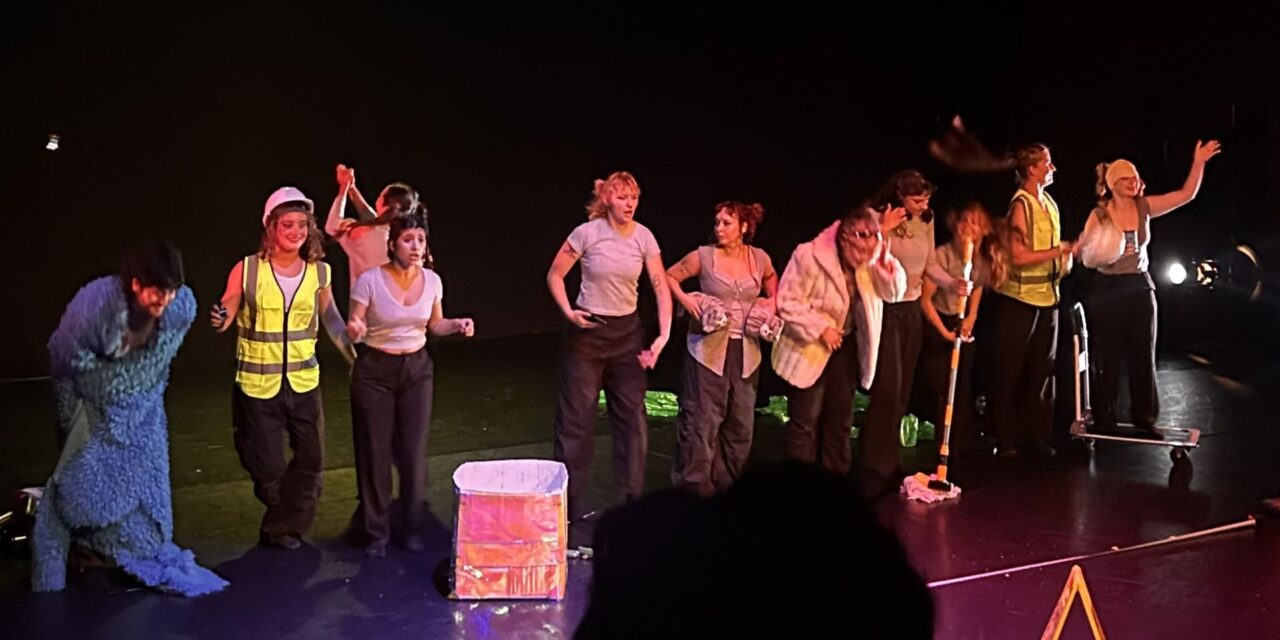
As part of the Dance at the Odyssey’s Summer Edition, I attended Maggie Ogle’s “Thresholds” on July 2, 2026. Her presentation featured a cast of eleven dancers, mostly California State University, Long Beach students or graduates. Ogle developed the first section of this piece as her MFA thesis presentation at CSU, Long Beach. The structure felt non-linear and abstract yet the seriousness and intentionality of the dancers made me sense that there was some greater arc at play, which made the work an intriguing puzzle to watch. Ogle had an almost absurd number of unexpected props but they were smoothly incorporated and felt like an important part of the performance and onstage interactions rather than additions to the dancing. “Thresholds” was also a humorous piece with moments of laughter coming from various sources: silly movements paired with deadpan faces, the appearance of a ridiculous prop, or the perfect comical timing of one last can of food rolling on stage.
The first section of the piece was titled “Part 1: Shelf Life.” It opened with a soloist, Brittany Lopez, alone onstage until a single can rolled onstage. She smoothly and creatively moved on the floor while interacting with the can. She seemed to not be sure what to do with this item, and her controlled effortless movement was punctuated by sudden stops. More and more cans were rolled out onto the stage and other dancers entered, some wearing green plastic collars. I was impressed by the seamless entrances and exits utilizing the four corner doors at this space in the Odyssey, even more so upon learning that the group had just gotten into the space that day.
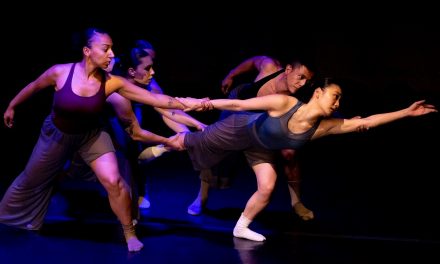
The choreography featured small tics and isolations contrasted with smoother actions. The hands and gestures in the movement were extremely detailed and the movement itself was compelling in its complexity. The dancers were so intentional with each action that it felt like each gesture might have meaning even though they appeared abstract. Because of the highly-detailed actions, there were some moments in larger group sections where things could be tightened up more. Ogle seeks to create inclusive spaces for neurodivergent dancers and spoke about how important it was to let each person find the movement themselves, but I think there is a way of finding a shared impulse to create cohesion with individuality.
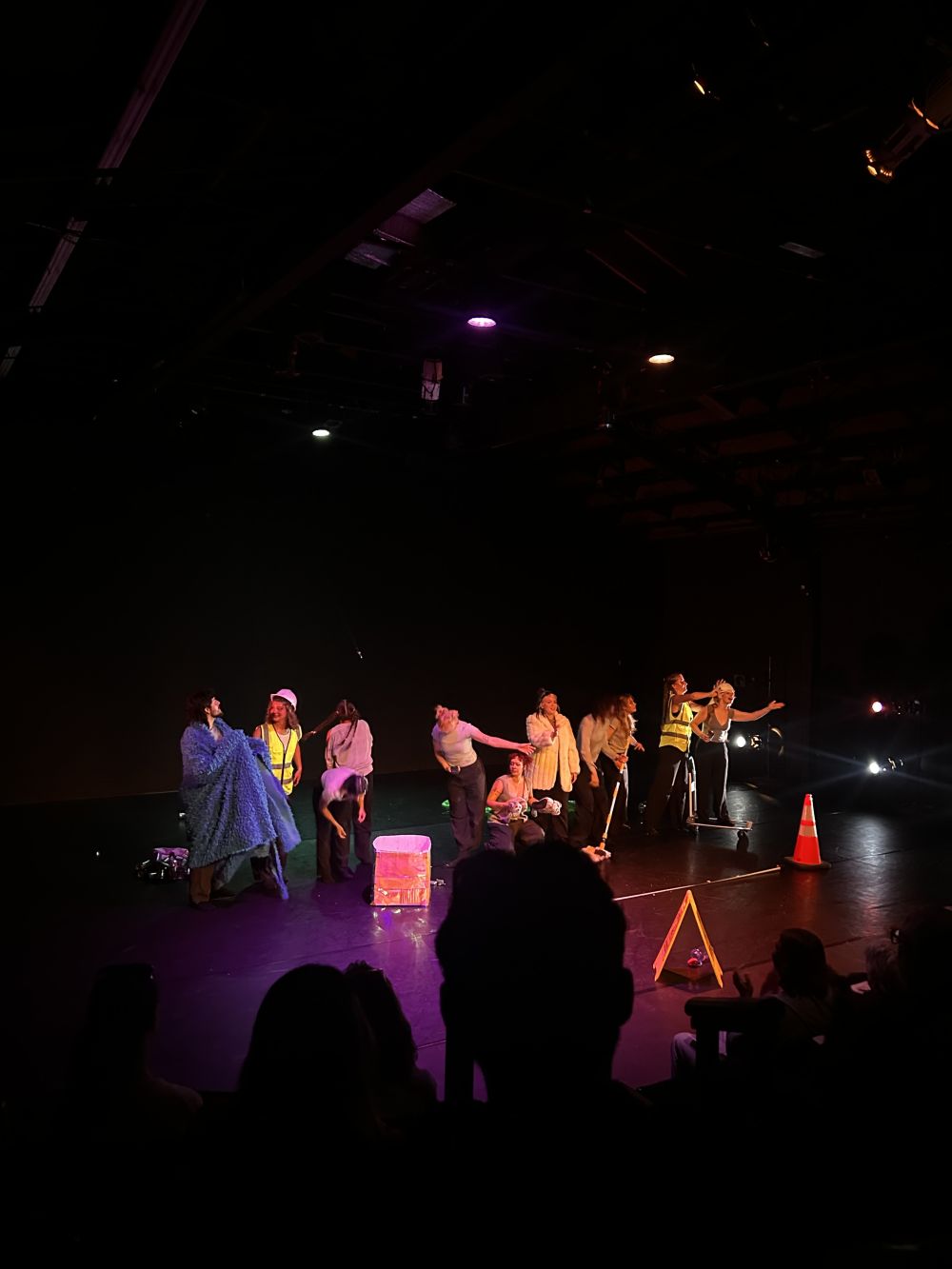
“Thresholds” by Maggie Ogle – Photographer unknown.
I really enjoyed Ogle’s choreographic arrangements. One dancer would start an idea which accumulated as others joined the action. Often, by the time the last dancer had joined, another group was breaking off and amassing around a new idea. The group felt like a collective community, like a colony of ants. They seemed to understand each other and their shared purpose, working together to organize and at one point clear the many cans from the stage. Everything from the dancing to the lighting and music would shift suddenly, giving the piece an exciting pace and frantic urgency.
The second section was entitled “Part 2: Is This Okay?” In this section, the dancers seemed to face each other and interact more. As they entered in pairs, they showed off smooth partnerwork featuring motifs of intertwining and wrapping around each other. In contrast to the first section, Ogle often featured one highlighted individual in contrast to a group moving together. It felt like a tug of war between wanting to fit in and wanting to stand out.
One of the strongest examples of Ogle and her dancers’ use of humor was a verbal and physical duet featuring two dancers acting like AI bots trying to interact with one another. They twitched and glitched as they spoke, continuing to ask each other the same questions and using repetitive spoken phrases that felt more hollow with each repetition.
After a larger group dance section to pulsing club music, one performer was left onstage surrounded by various props and looking around with dissatisfaction at the many things around her. The work ends with a can opener lowering from the ceiling and one last can rolling out. When the person opens the can, it is just filled with small holographic bits of cellophane paper. At this point, my interpretation of the meaning had something to do with scarcity versus accumulation. The first section with its dystopian edge and flurry of canned foods seemed to represent a time of scarcity. In the second section, props like a fur coat seemed less pedestrian. There was an urge to connect and fit in, but the desire to stand out and seek out objects seemed to win, as the final dancer was left alone surrounded by items. I learned during the talk back that this was not at all the story, but I loved that I could connect dots to create my own experience and story out of the abstraction.
“Thresholds” was an eclectic and thought-provoking work. Ogle did an excellent job arranging and layering movements to create a well-paced show. Her cast brought the show to life with their strong dancing and acting skills. These eleven dancers were Niko Black, Anna Boyle, Sami Cady, Elise Conlay, Mylah Elisaldez, Leah Leon, Brittany Lopez, Mia Macias, Lillian McFarren, Xene Sommers, and Nathan Waters.
For more information about Maggie Ogle, please visit her website.
To learn more about the Odyssey Theatre Ensemble, please visit their website.
Written by Rachel Turner for LA Dance Chronicle.
Featured image: Thresholds – Choreography by Maggie Ogle – Photo courtesy of the artist.