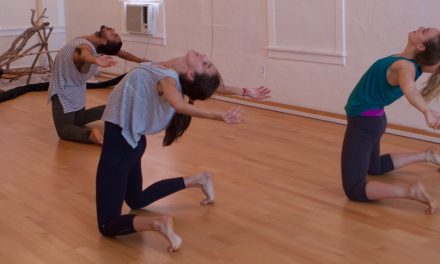
I was able to meet with Jacques on a Wednesday afternoon as he was arriving at his studio in downtown LA. He was coming from another meeting he had with a Board member of California Institute of the Arts, and arriving just as his dancers were finishing their company class before rehearsal. I managed to see one of the last combinations going across the floor which was elegant and controlled and said much about the detail necessary for his work onstage. It began with a handstand going into a pike with one leg straight and sliding to the floor in a moderated splits, then rolling over the back to seamlessly stand and dive forward into the handstand again, ostensibly to slide through with the other leg switching sides all the way across. The control necessary to accomplish this move is considerable. At this point I was welcomed by “Blue” the mascot Boston Terrier who is slated as the next Artistic Director and enjoys the freedom of the studio setting. His excitement at my arrival was an unexpected delight only to be matched by Jaques’ own gracious welcome when he breezed in a moment later.
I was using the Zoom App on my phone which I hadn’t done before as I usually conduct interviews through Zoom on my computer at home, not in person. We were astonished at the transcript appearing before our eyes as if some dark magic had been summoned from the depths and held us in thrall.
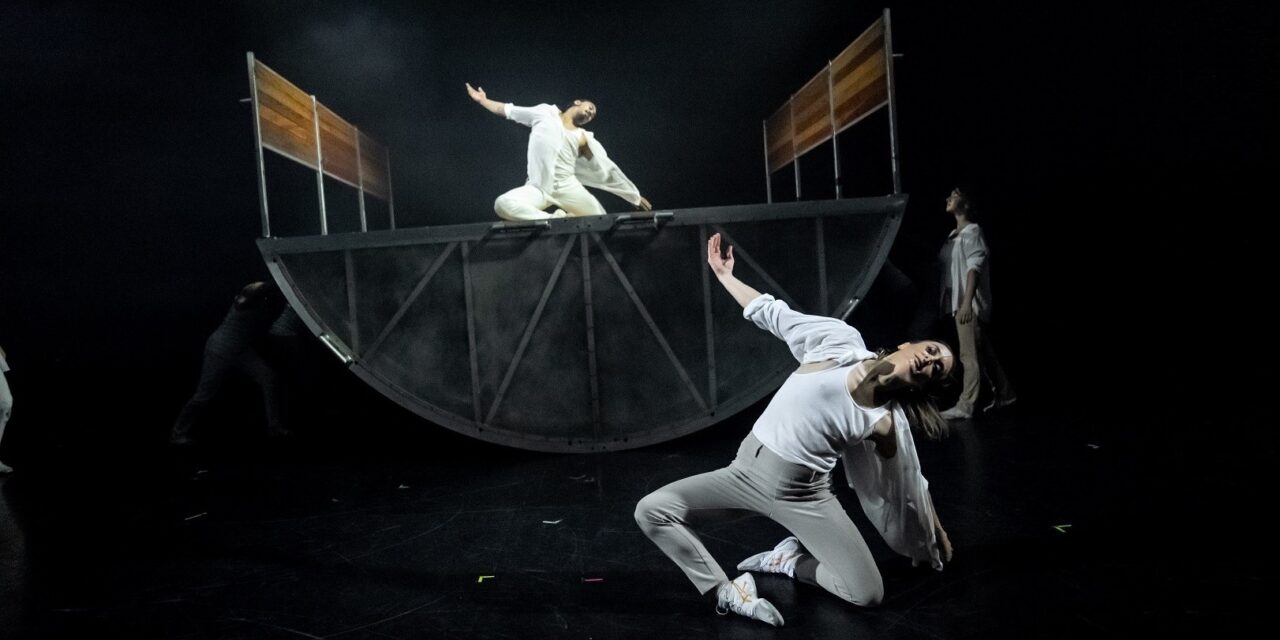
Diavolo – Architecture In Motion’s “Escape” by Jacques Heim – Photo by Cheryl Mann.
Brian: There it is – and I think it’s going.
Jacques: Hello, my name is Jacques Heim, I am the founder and creative director of Diavolo, Architecture in Motion. Oh my gosh, it did it.
Brian: Isn’t that crazy?
Jacques: It said Diavolo. When I say Diavolo it doesn’t understand my French, but how come in yours it understands?
Brian: It’s AI! It is unbelievable, isn’t it crazy? How did you come up with the concept for “Escape”?
Jacques: I’m trying to fight to do this “Escape”. This is not just another show, it’s for me to have an opportunity to hire 22 dancers. When I talk to people they say you have 22 dancers? Who has 22 dancers?! I want to give an opportunity for those young, great people to train because “Escape”, it’s a training program and an opportunity to perform. Where can you do this? They may not have the opportunity to audition for other modern dance companies to go on tour, so where do I go? What do I do? That’s why I’m doing this. Hiring 22 dancers to train them and then give them an opportunity to perform 25 shows for them to learn. Now I need the help of my community which has few people who can afford it, to donate. But it’s a struggle.
Brian: Yes, it is, especially with all of the cuts to funding.
Jacques: This is a great program and on top of that it is fun work. It’s engaging and the dancers are getting so much out of it. So I have to continue this, so who can help? People need to help, people need to come forward because Los Angeles is a great city. People say here is the thing I don’t understand, people say, but you know Jacques, in L.A. people don’t support the Arts, it’s not an Art city. But at the end of the day people are people everywhere. They will like to see great Art, great events like what we are doing in “Escape”. I know you will like it. So come see us and if you like what you see find a way to support the company that is doing this program.
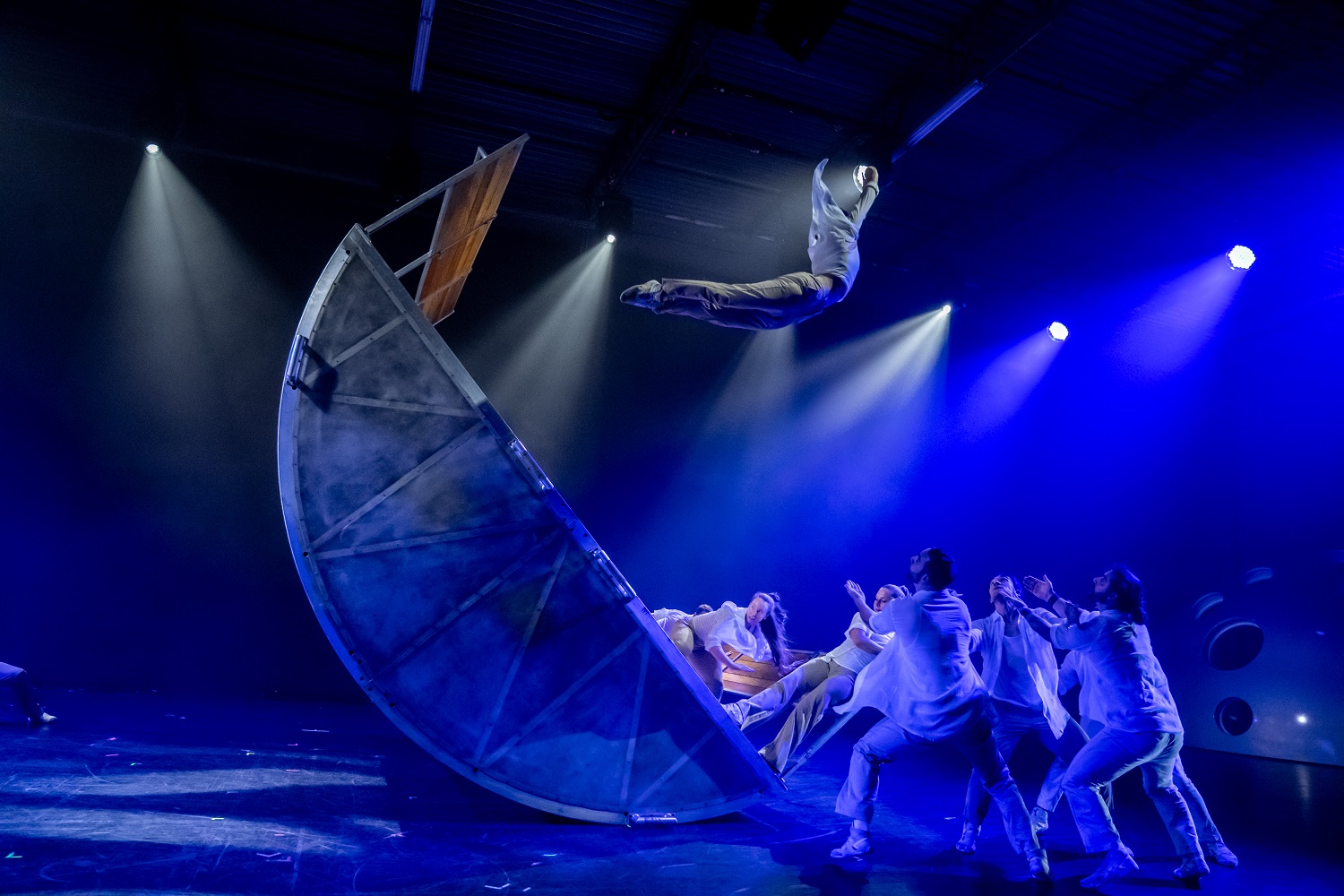
Diavolo – Architecture In Motion’s “Escape” by Jacques Heim – Photo by Cheryl Mann.
Brian: And part of that reaching out to the LA community is you doing these shows at your studio space so many more people here in LA can see “Escape”. Let me see – yes, the show opens Friday, March 27th at 8:00pm and runs Saturdays at 8:00pm and Sundays at 6:00pm every weekend through to June 14th. And your studio is “L’Espace Diavolo” 616 Moulton Ave. LA CA. 90031. This is a very convenient location just where the 101, 5, and the 10 freeways all cross downtown. You also have an easy way to donate on your website, yes?
Jacques: We do, yes. And also part of the proceeds go to our Military Veteran Program. Our Military Veterans Program started nine years ago. At that time my then Executive Director, her name was Jennifer Cheng, realized “you know Jacques, the kind of philosophy of Diavolo, and the way you direct your civilians, i.e.; dancers, would be great for military veterans”. At first I didn’t really understand. I was scared to do any workshop with the men and women of the armed forces. But then right away they said no Jacques you need to do this. At the end of the day I realized those men and women of the armed forces are great human beings like you and I. And I operated more like a Drill Sargent, like a football coach, the same way I do with my dancers. In a way I don’t have pity for them so that I can care and love and do the work. So I push them beyond their own emotional, mental, and physical limits and they actually love it, because every human wants to feel a sense of purpose.
Brian: And do you use the apparatus, the sculptures with them?
Jacques: We do, we have special structures that they use. We use exercises to elevate others and promote group coordination. This October we are trying to bring a new Veterans program but of course everything costs money.
Brian: And you can’t qualify for any government money for that program? We may – now this administration has cut all of the NEA (National Endowment for the Arts) major grants and we just have to reapply. We then spoke about the current financial climate in Los Angeles where two major dance companies have folded recently. Jacques explained that touring with the large structures he uses was becoming prohibitively expensive. Most of his time is spent in raising money. He has to do it and he is happy that it is a good cause. The crunch of raising money and keeping a company going is a question of how much time does one have? As long as people are willing to help financially. We acknowledged that running a company takes its toll after the years. You are focused on this show here, now in LA.
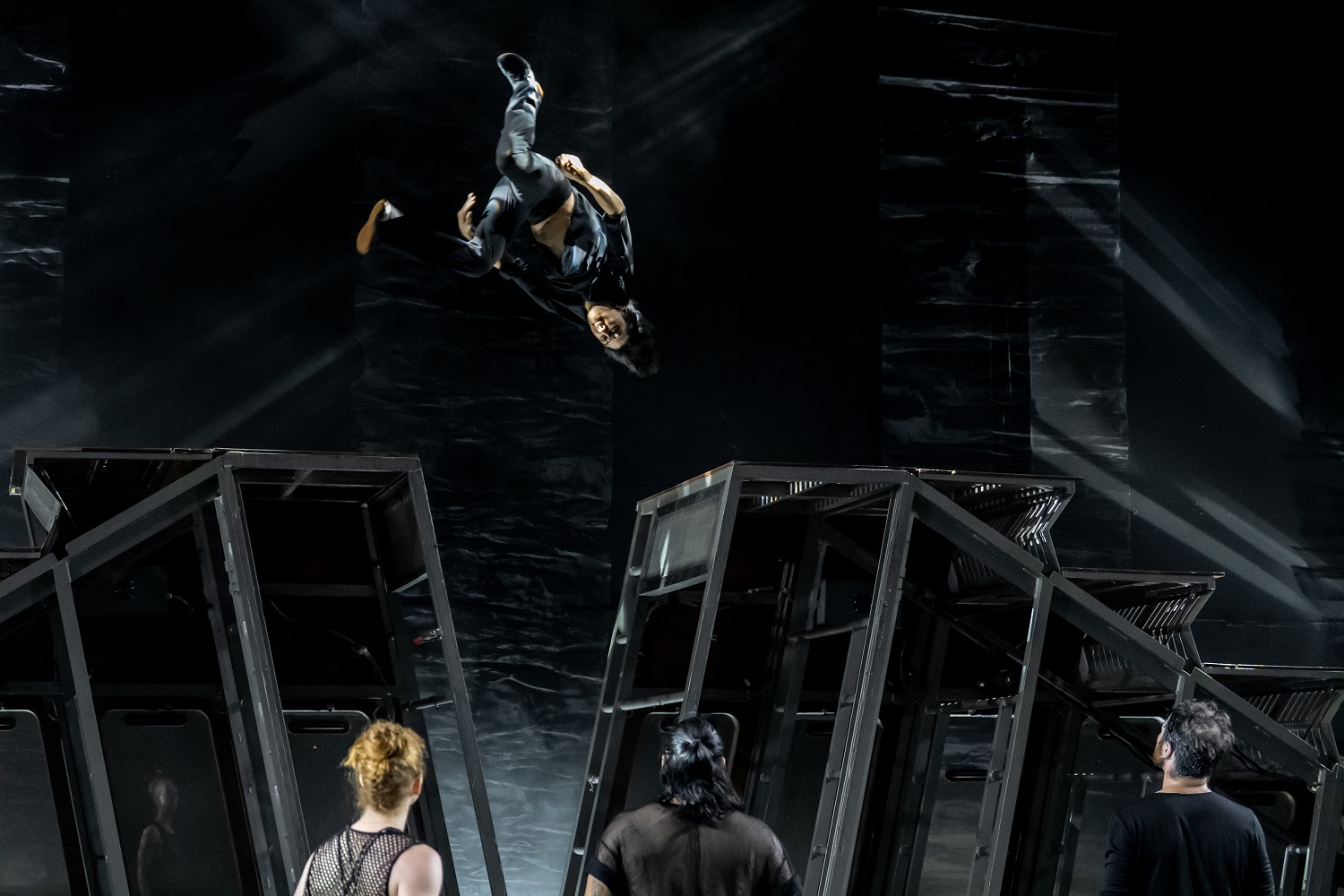
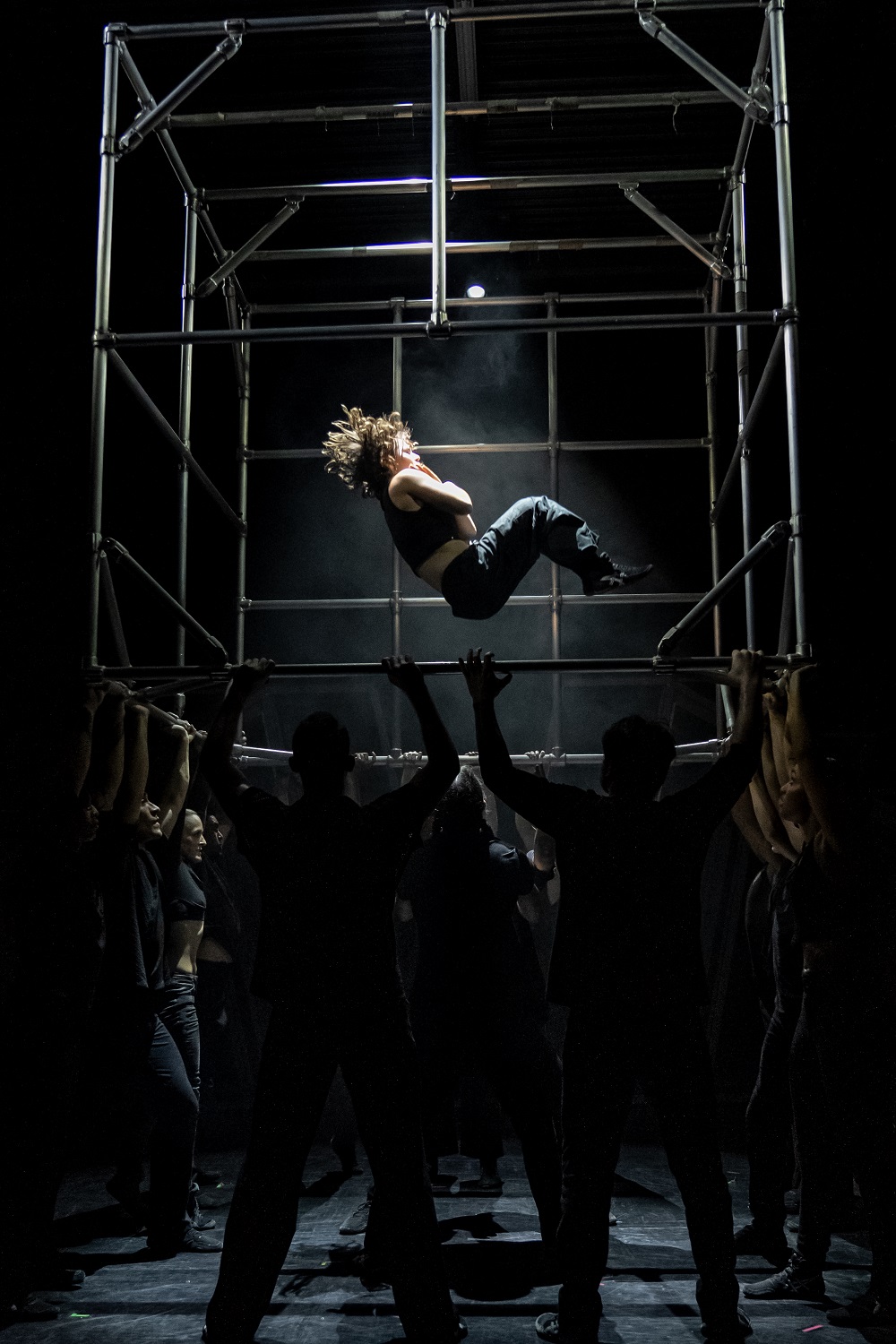
Diavolo – Architecture In Motion’s “Escape” by Jacques Heim – Photo by Cheryl Mann.
Jacques: I think it is a fabulous program. How great it is in the state of affairs of dance in this city and in this country to be able to bring 22 dancers, training them in a way that no one can train them like that, because there is nothing like Diavolo anywhere else, period. To give them a training and opportunity to perform so many shows. And then for me to bring promoters and producers here to Diavolo Studios to see “Escape” to be able to get more bigger audiences and venues for the show. We then had a conversation about promoting the show for different venues that could harbor a larger audience and shot out various ideas of where in LA it could fit. I was thinking of the large warehouse space in downtown L.A. at The Shed where “Luna, Luna” was housed. Jacques then mentioned that Kenny Ortega saw the show and was moved enough to help out Jacques and the company. Also Anita Mann had seen the show and was happy to help. In this way he is getting the word out and showing his product to some who can help him realize a larger audience.
We also hit upon the underlying themes of the show which illuminate how humans interact, cooperate and succeed where the individual cannot. This show, “Escape” happens to hit on some major tendencies of Homo-Sapiens that have catapulted them into the major primate of the planet. It is the aspect of cooperation that has enabled Homo-Sapiens to out evolve Homo Neanderthalis, among others. The architectural structures in the show are performers in-and-of themselves and the primates must deal with them onstage and in real-time. This aspect of the choreography is riveting and shows firsthand the amazing degree to which Homo-Sapiens co-operate.
This led us to a discussion of what it takes to accomplish the kind of show that “Escape” exemplifies. Meaning; how do you get dancers to do such difficult and dangerous choreography that requires such split-second timing and absolute trust? Ah! That is the rub. Jacques treats his dancers with respect, love and care. However, he does push them to realize their emotional, mental, and physical limits so they can discover what they are made of, making them more than they thought they could be. He gives them permission to succeed, to grow. And he is right there beside them urging them on. At first the dancer’s feelings of inadequacy in the face of hard, difficult work surface. After four to six weeks, they feel so alive and competent, they have grown and gotten better, acquired more movement skills. At the end of it all they have the confidence to continue their path through the art of dance and movement. Jacques would love to create a think-tank of educators, choreographers, philosophers in order to look at how this transformation takes place and enable it in other situations and institutions. The results are real.

Diavolo – Architecture In Motion’s “Escape” by Jacques Heim – Photo by Cheryl Mann.
At this point Trish, the Associate Lighting Designer enters the office with a bag of baguettes, challah and sourdough. Jacques entreats me to taste the baguette and see whether it lives up to the French standard. We tear into the baguette and render our verdict.
Jacques: Be rude, be honest. What do you think? Give some criticism. Be more French.
Brian: Are you kidding? If I were French I’d throw it across the floor!
Jacques: You should include this, this is the most important part of the interview.
Brian: For a Frenchman, yes. We then ate the baguette and segued into a discussion about teaching dance in L.A. We thought that a sense of humor was imperative when pursuing an Art form as it is better to laugh at oneself and one’s mistakes instead of crying and becoming despondent.
Jacques: You know when I was at Cal Arts my ballet teacher was Lawrence Blake. He was a great ballet teacher. I was awful. You know I was an awful dancer.
Brian: A hahahahahah….!

Jacques Heim with Diavolo Architecture in Motion – Photo by George Simian.
Jacques: No Brian, you need to put this in. I am completely honest with you. I am the most dyslexic and unflexible creative director of any dance company you will ever meet. I never had the body of a dancer. And Lawrence Blake used to insult me in a very poetic way and I loved it! I could not touch my toes, it looked like I was a French Donkey on crack! I loved going to his class because I knew he was going to let me have it. He looked at me going across the floor and he would have a smirk on his face. I had the greatest experience because he was tough, and I learned, I loved it. This is the way that works well with the Veterans program. When you are an artist, a dancer, you are a soldier. We respect you, we care about what you think. But your feelings need to be subordinate to your training, that should be how artists are trained, like in the military.
Brian: Well especially in “Escape” it comes out in the show, I saw that because if someone is off even a small bit, they will wipe out another person with serious injury. They must be that serious in the training as they are responsible for each other like in the military.
Jacques: Humor is important. I don’t take myself seriously. I take the work I do with the dancers in the studio and onstage seriously, but I don’t take myself seriously. We are creating Art and helping others to rise.
“Escape” runs from March 27th through June 14th at L’Espace Diavolo Studios, 616 Moulton Ave. LA CA. 90031
Fridays and Saturdays at 8:00pm
Sundays at 6:00pm
For more information and to purchase tickets, please visit the Diavolo Architecture in Motion website.
Written by Brian Fretté for LA Dance Chronicle.
Featured image: Diavolo – Architecture In Motion’s “Escape” by Jacques Heim – Photo by Cheryl Mann