
I was at the Paul Taylor School in the early 80’s and studied with the company members teaching there at the time; Linda Kent, Chris Gillis, Susan McGuire, Tom Evert, and Reagan Wood. They imparted an intensely physical understanding of his choreography and syntax in movement. Paul Taylor’s work is expressive, heroic, grand and detailed. It can be light or dark depending on the subject material. It is always engaging as it illuminates some aspect of human behavior. Studying at the school was an “a ha!” moment for me in my dance career. His work has lasted for a reason and not just because of the superlative and individual talent he drew to himself. I got to see him work a bit up close and his subtle comprehension of the human animal was intense and unyielding.

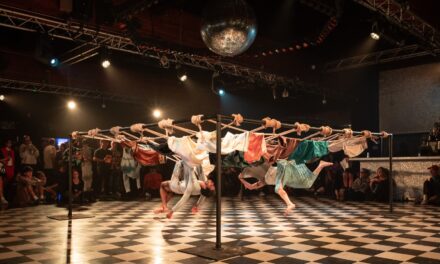
Paul Taylor Dance Company in “Under The Rhythm” Choreography by Robert Battle – Photo by Mackenzee Osborne.
It is an incredible amount of work to keep his legacy going and attend to the details and overall magnificence of his repertoire. For that we have to thank Michael Novak, The Artistic Director named by Paul to take over his company. We must also thank the long-term Rehearsal Director Bettie de Jong and thank God for the current Rehearsal Director Cathy McCann. They both understand the visceral and all-consuming aspect of Paul’s choreography and intent. Novak welcomed the audience with a pre-speech to the show along with Dr. Anne F. Hogan, the Dean of the College of Performing Arts and Musco Center for the Arts. Novak pointed out that the same ambiguity that resides in poetry also resides in Dance. Metaphor, Meter, and Images are just as important to the movement as they are to the Poem or Sonnet. This proved true in the evenings offerings.

Paul Taylor Dance Company in “Under The Rhythm” Choreography by Robert Battle – Photo by Mackenzee Osborne.
The first piece, “Under The Rhythm” choreographed by Robert Battle in 2025 and assisted by Elisa Clark was everything an opening number should be. It was jazzy, moody, had a big cast nailing the unison sections and also had extremely tight duets and solos conveying the music to emotional heights and sometimes even exhaustion. The costumes popped against the gorgeous dark lighting by Burke Wilmore. They consisted of black pants with black suspenders over a white shirt with a black tie tucked in under the third button of the shirt. All topped off with a black Bowler and accented with white Spatz. The unison opening with all of the performers in a line reminded me of “Puttin’ on the Ritz” from “Blue Skies”. It was just as effective here. Clean footwork and sharp arm movements held our attention and delight in the patterns. Costumes by Santo Loquasto who has done so many of Paul’s pieces throughout the years. A duet in red tuxedo tails to Ella Fitzgerald’s scatting was particularly effective, The gestures matched the sounds and both performers held nothing back in their effort to capture every syllable.

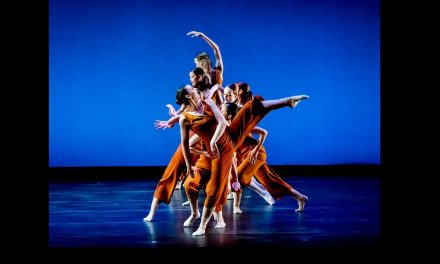
Paul Taylor Dance Company in “Piazzolla Caldera” – Photo by Mackenzee Osborne.
“Piazzolla Caldera” choreographed by Paul Taylor in 1997 was the second piece on the program and was his foray into Tango via Modern Dance sensibilities. There is a great deal of sensual tango-like relationships produced but the vocabulary was Paul’s modern movement. This worked surprisingly well given the demands of the music by Astor Piazzolla and Jerzy Peterburshsky. The male/female mating ritual was heightened here by sharp gesture and then utilized to include a third for a ménage-à-trois. In this piece the men are instigators and although excellent dancers, could use a little more obnoxious confidence towards their partners, male or female.

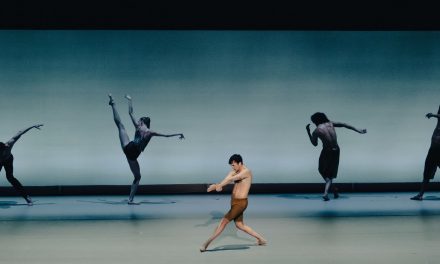
Paul Taylor Dance Company in Taylor’s “Esplanade” – Photo by Mackenzee Osborne.
The third and last piece was “Esplanade” choreographed by Paul Taylor in 1975 and recognized even then as an instant classic. It is an essay in pedestrian movement with no real dance steps but created entirely of common movement motifs people use everyday: walking, skipping, running, jumping, etc. One of the reasons this piece is so celebrated and famous is that it requires a great deal of physicality without the finesse of a trained dancer. That is sometimes difficult for those who have come through a Ballet school or other Dance program in college. It is better performed by the anybody of everyday life in the physical world of humans. There is an anthropology of movement in this piece that comes from the way a person looks at another, recognizes them and welcomes them into their presence. Without that very subtle head tilt, the back curve and trailing arm, it doesn’t work. There is a bit of the heroic and expansive as well. It is gloriously represented in the 1977 “Dance in America” series. It was also realized very well on this night.
It is a great act to continue a choreographer’s work after they have passed. Thankfully there are many who knew Paul and his personality enough to faithfully render his work for future audiences, even after Bettie and Cathy. May it be so for a long time to come.
The Company: Madelyne Ho, Devon Louis, Kristin Draucker, John Harnage, Lee Duveneck, Lisa Borres Casey, Alex Clayton, Jada Pearman, Jessica Ferretti, Austin Kelly, Kenny Corrigan, Gabrielle Barnes, Emmy Wildermuth, Elizabeth Chapa, Payton Primer, Caleb Mansor, and Patrick Gamble.
Resident Choreographers: Lauren Lovette, Robert Battle
Rehearsal Directors: Bettie de Jong, Cathy McCann
Principal set and costume designers: Santo Loquasto, William Ivey Long
Principal lighting designers: Jennifer Tipton, James F. Ingalls
To learn more about the Paul Taylor Dance Company, please visit their website.
For more information about the Musco Center for the Arts, please visit their website.
Written by Brian Fretté for LA Dance Chronicle.
Featured image: Paul Taylor Dance Company in Taylor’s “Esplanade” – Photo by Mackenzee Osborne.
Please follow us on Facebook, Instagram, BlueSky, and LinkedIn.