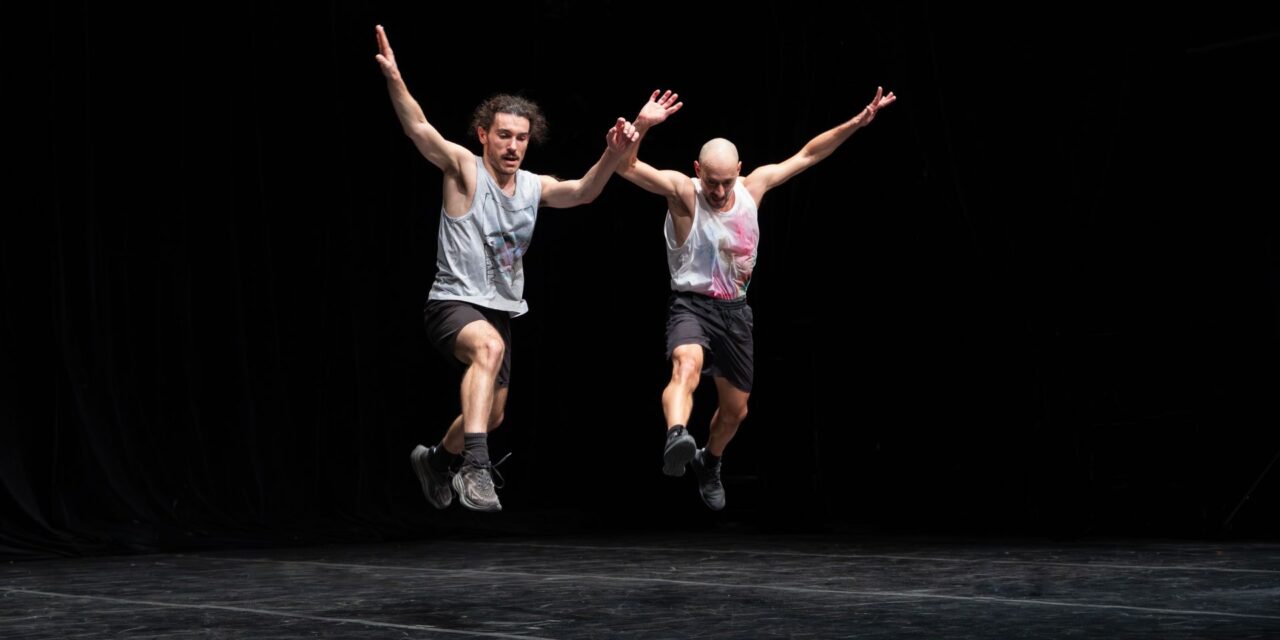
When do you give up? When is the weight too much, the energy too exhaustive? And if you fall, is it really the end?
Manuel Roque’s “Bang Bang” addresses these questions of endurance by putting his own body to the task, repeating jumps and athletic motifs for 50 minutes, counting in 11 rather than the typical 8 count. The work, performed at Théâtre Raymond Kabbaz on March 6, 2026, is about commitment and resilience. At first mundane, set to a repetitive beat, the work evolves into an exhilarating exploration of the human condition by testing the body’s limits.

(L-R) Manuel Roque and Nils Levazeux in Roque’s “Bang Bang” – Photo by Juraj Žilinčár
Roque joins Nils Levazeux on stage, beginning by simply bending their knees and squatting to the rhythm. The first moments feel more like a test of endurance for the viewer, sitting in the repetition and giving it the time to evolve. The movement itself is athletic, pulling from drills you may see at practice for a sport. These beginning moments particularly reflect on the mechanics of a simple athletic movement, whether it is a hop or the stretch of an arm. The focus is on the muscular and skeletal structures. These motifs slowly ease into a more exhaustive practice as the repetitive actions become more balletic. The hops introduce a leg extension and turn. The endurance to keep going gains a new layer.

(L-R) Nils Levazeux and Manuel Roque in Roque’s “Bang Bang” – Photo by Juraj Žilinčár.
At some point, the show gains a rhythm of its own that makes magic out of the unknown. You start to question how their motifs could evolve — how they could hop further and jump higher. They even break unison, with one person lagging a few steps behind. Roque subverts the idea of a dance move by revealing the artistic side of sport. His approach illuminates the proximity sports motifs have to codified dance. It’s subtly smart in this way.
The crux of “Bang Bang” arises out of an accident. To be specific, a cough. As they keep going through the jumps, Roque coughs, but this doesn’t stop him from moving. It at first feels comical, but his persistence shares something deeper. When problems arise, you don’t let them deter you from achieving your goal at hand. Instead, it is simply an obstacle that adds a new layer to your initial intention. The exhaustion hits, Levazeux and Roque sweat through the steps and their initial attentive look dissipates. You can see the exhaustion through their faces as their eyes grow dazed and their jaws slacken from breathing deeply. When Roque becomes aware of his body’s inherent reaction, he pushes against it, smiling. He turns the exhaustion into joy. His smile spreads throughout his entire body, and the hops that started to lose their static regain a buzz that keeps the piece moving forward.

(L-R) Nils Levazeux and Manuel Roque in Roque’s “Bang Bang” – Photo by Juraj Žilinčár.
The piece harnesses plenty of energy to the point where it becomes the norm. However, just as the high-energy movement loses its shine, Roque juxtaposes it with a moment of stillness. The aftermath of their effort remains — from their deep breaths to the sweat that drips onto the stage. Their chests rise and fall. Slowly, their quick breaths simmer to a soft sigh.

Manuel Roque – Photo courtesy of TRK.
Roque’s curation of the piece toys with tension. He smartly uses the pause as a point of conflict, asking whether this is truly the time to end or keep going. Ultimately, he decides to keep going. From this point forward, the steps become more elaborate. The hops turn into pure dance. Yet, the coughs return. It’s a comical accident that is essential and exemplifies the work’s message.
Even when disaster strikes, the world doesn’t end. The movements gain a mechanical edge. It feels like the cogs of a machine that must never end. But within it, the duo looks at each other and finds a point of connection. Here, Roque reflects on the importance of community when the state of the world is relentless. Suddenly, the raucous news happening outside the theater feels endurable with the support of those around you.

Nils Levazeux – Photo by Julie Artacho.
In the final section of the work, Levazeux and Roque return to the same squatting movement. The full-circle moment is a promise of continuation. Even when the lights dim, it is guaranteed that this movement will continue. The body will still bounce, and the world goes on. After witnessing the extraneous sides of the work, the moment of subtlety feels more complex, like a preparatory bounce before a sprint.
Admittedly, this review is late. My grandmother passed shortly after I saw the performance. I needed to step away for a moment. Returning to the work and remembering this echo — this bounce — my heart heals. Despite the chaos of life and the heartbreak of mortality, the world goes on. Following an instance of connection, of grief with loved ones, I can keep squatting, hopping and jumping into the next phrase of life.
Beneath its athleticism, “Bang Bang” is a beautiful reflection on humanity and self-love. It is okay to cough and stumble. It is okay to stand still. These moments are meant to make the calm periods more profound and the chaotic ones more endurable.
To learn more about Théâtre Raymond Kabbaz, please visit their website.
Written by Steven Vargas for LA Dance Chronicle.
Featured image: (L-R) Manuel Roque and Nils Levazeux in Roque’s “Bang Bang” – Photo by Juraj Žilinčár.