
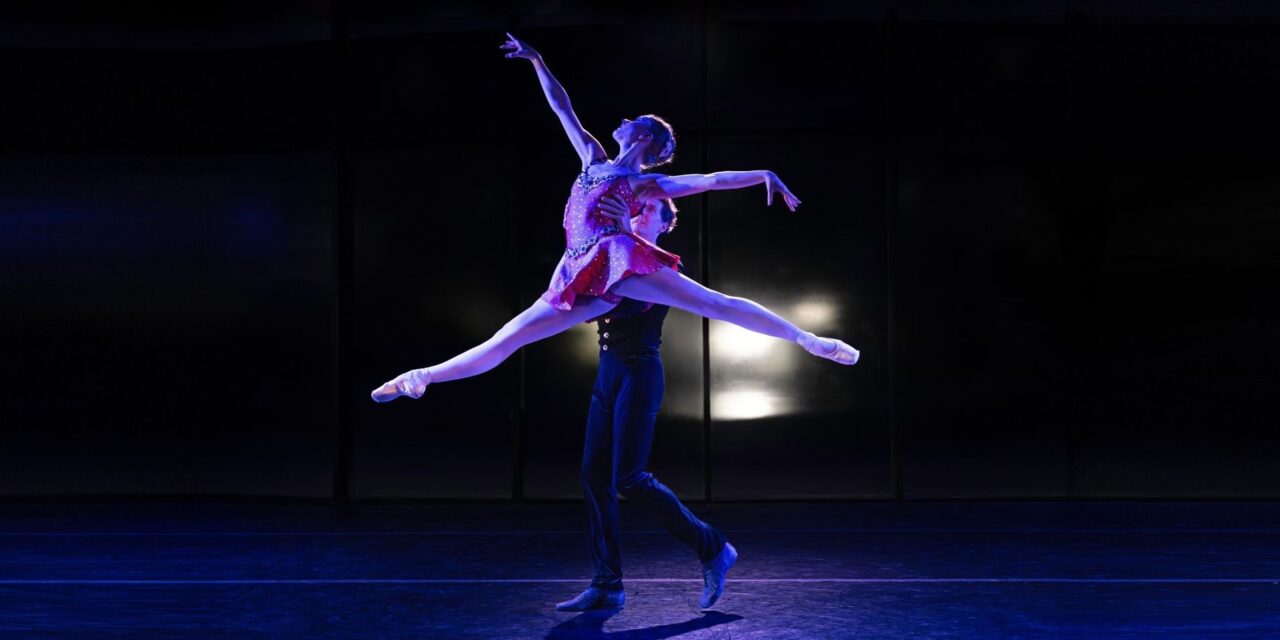
From June 4-June 20, 2026, American Contemporary Ballet presents Spectacular Balanchine, conceived by Artistic Director Lincoln Jones, and featuring dances from George Balanchine’s Who Cares?, Stars and Stripes, Western Symphony and Union Jack. Music by George Gershwin, Stephen Collins Foster, John Philip Sousa, George Frideric Handel, and Hershey Kay is arranged for ACB by James and Kathy McMillen and performed by an excellent live chamber ensemble of seven musicians: Ani Sinanyan, Alisa Luera, Tu-Ting Hsu, Clement Chow, Jesus David Milano Melgarejo, Emma McCartney and Brandon Zhou.

ACB – Spectacular Balanchine – Taylor Berwick and Maté Szentes – Photo by Caleb Thal.
With crowd pleasing tunes and short excerpts of Balanchine hits, this program runs just 75 minutes including intermission, making for an easy viewing experience in these days of addled attention spans. In ACB’s custom, the audience is seated at the level of the dance floor, with the front row only a few feet from the performers, who dance their entrances onto the marley without wings. All choreography comes courtesy of The George Balanchine Trust and is staged by Zippora Karz, a former soloist for New York City Ballet and Balanchine Trust repetiteur.
On Saturday June 6th the company performed to a full house at its home site, located inside the Bank of America Financial Center in downtown Los Angeles. Audiences enter the skyscraper at ground level, then ride down an escalator and exit into a manicured, outdoor courtyard. On one side is a desk-filled office space walled by floor to ceiling glass and fully illuminated even at 8pm on a Saturday. On the other is the entrance to the performance space, hidden from view.

ACB – Spectacular Balanchine – Taylor Berwick – Photo by Caleb Thal.
Once inside, we find a wide but shallow marley floor underneath a simple lighting grid, and risers lined with folding chairs, each decorated with a colorful paper cylinder (posters for the performance) – like a party favor gifted to the audience. As the space fills, a jazz pianist (Takumi Kakimoto) plays. Cocktail rounds are decorated with kitschy candy holders, and a bar serves wine, and water from elegant bubblers.
Altogether this scene strikes as simultaneously magical and eerie. It is likely that the venue reflects resourcefulness on the part of the organizational leadership, i.e., maximizing personal connections or financial support to secure a home for the company. And what fun to discover live dance performance in the belly of an otherwise sterile banking building. At the same time, the pre-show experience feels more like a corporate holiday party than an off-the-beaten-path cultural event; or worse – like a dystopian harbinger of what could happen if all art were to become defined by corporate interests and aesthetics. Some of us turn to the arts for a reprieve from corporatism.
Ok, about the dancing…

ACB – Spectacular Balanchine – Maté Szentes and Kristin Steckmann – Photo by Mark Harris.
The program kicked off with Sweet and Lowdown, from Who Cares?, performed by Taylor Berwick and Kate Huntington, with Hannah Barr, Tatiana Burns, Ruthie Dalby, Victoria Manning Long, Emma Maples, Vanessa Meikle, Wellie Renner and Sofie Treibitz. As an opener, this piece did not make much impact. The ensemble was smiley and polished in costumes by Patricia Zipprodt, but too tense to embody the jazzy freedom Gershwin’s music invites.
That said, the program improved as it went along. Musicality and expressiveness came online in Concert Suite, also excerpted from Who Cares? performed by Kristin Steckmann, Sarah Bukowski, Cecelia Johnson and Maté Szentes. With the women in short colorful dresses and Szentes in all black (also costumed by Zipprodt) this cast attacked the surprising accents and cheeky, pelvis-forward Balanchine vocabulary with playfulness. Cecelia Johnson stood out here, managing tricky sequential step-up turns and fouettés with ease, and male soloist Maté Szentes was a true pleasure to watch. Szentes’ dancing is generous rather than egoic, and exceptionally musical. His maturity as a dancer hints that he is older than the others in the company, although he looks young, and can still soar.

Spectacular Balanchine – Madeline Houk and Pierson Hall – Photo by Mark Harris.
After intermission we saw Western Symphony: Adagio, featuring Quincey Smith and Maté Szentes (again) in the lead roles, Stars and Stripes: Grand Pas de Deux danced by Madeline Houk and Pierson Hall and Union Jack: Wrens performed by the same ensemble that opened the evening. Musical interludes punctuated the dances, and in each work, music and dance unfolded as one unified expression. First violinist Ani Sinanyan seemed to keep an eye on the stage and gently guide the phrasing to stay aligned with the dancers.
The Grand Pas de Deux from Stars and Stripes, danced by Madeline Houk and Pierson Hall, with costumes courtesy of Pacific Northwest Ballet, stole the second act. Hall’s presence and energy were infectious, and watching his running, jumping entrances from the carpeted floor onto the stage was genuinely exciting, especially at such close proximity. Hall danced well with Houk, whose performance was poised and self-possessed. From a curatorial standpoint however, this high-velocity duet ought to have closed the program. Instead the ensemble piece Wrens from Union Jack fell flat as a finale and seemed like a compulsory “We should show the ensemble again” rather than an artistic decision to support the energetic flow of the experience.
Without explicitly stating a theme, this program, and its place in the calendar, seems to nod at the upcoming Fourth of July holiday. The selected works reflect Balanchine’s well-documented love of Americana, and the customary costumes in Stars and Stripes are designed to look like military uniforms. (Incidentally, Balanchine was known to be much farther right politically than some of his peers.) Especially in a time of war and political unrest, this programmatic choice reflects a certain orientation toward culture and public life. Although Artistic Director Lincoln Jones rejects the pressure for arts organizations to be political, curatorial decisions do reflect a leader’s worldview. This reviewer personally believes that art cannot be divorced from history and social context.
Additional Credits
Lighting: Martha Carter
Graphic Design: Start Today
Image: Ryan Ward
Western Symphony Costumes: Ruoxuan Li from the original design by Barbara Karinska
Union Jack Costumes: Ruoxuan Li from the original design by Rouben Ter-Arutunian
To learn more about the American Contemporary Ballet, please visit their website.
Written by Annie Kahane for LA Dance Chronicle.
Featured image: Spectacular Balanchine – Sarah Bukowski and Maté Szentes – Photo by Mark Harris.




Pierson Hall is a Guest Artist with ACB. He is a Principal Dancer with Carolina Ballet located in Raleigh, North Carolina.
Pierson joined Carolina Ballet in August 2022