On June 5, 2026, I attended the a/o/x series at Highways Performance Space, a performing arts program showcasing bold, genre-bending movement theater and experimental dance by Latinx and other marginalized artists. The small theater was packed, and I could not have predicted the range of work I would see that evening. Each piece seemed invested in absurdity, but the accumulation of props did not always deepen the piece’s ideas. Despite quality performance skills and intentionality by all the artists and some really unique ideas, by the end of the program, I felt overstimulated and exhausted.
Each work was abstract, and intentionally strange, with the intensity of the evening building piece by piece. My main concern was the curation and pacing of the program. As each piece grew increasingly dense through the use of props, lighting, sound, and theatricality, there was little room for the audience to breathe. It may have served the program better to arrange the pieces in a way that offered more contrast or moments of reprieve. Although I was left wanting more from the movement itself at times, the performance quality was truly great and something that I feel missing from many dance shows.

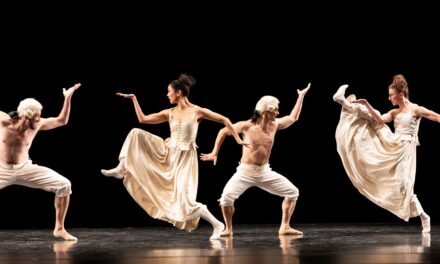
a/o/x – Gia Bella, Jeffrey Bull, Sammy Macias in “You Little Faker” – Photo by Patrick Kennelly.
The first piece, Sammy Macias’ “You Little Faker,” opened the evening’s world of absurdity and props with the dancers standing and drinking from juice boxes before throwing them into the audience and beginning the dance. Macias’ movement quality was like watching something melt and then suddenly turn to ice again. He used many subtle facial expressions, and all three dancers did a strong job engaging with the audience, which was especially difficult considering the wide and long layout of the space. The dancers were Gia Bella, Jeffrey Bull, and Sammy Macias.

a/o/x – Steven Vargas in “Shhhtrip” – Photo by Patrick Kennelly.
The second piece began with another prop driven setup. Throughout “Shhhtrip,” choreographed and performed by Steven Vargas, his prop became a subway pole, a ballet barre, a lover, an enemy, and possibly a reflection of the performer himself. The sound shifted from city noise to poetry by Charles Bukowski, to club music, to Vargas’ own dialogue, with the piece changing just as quickly from section to section.
One part featured a dialogue between two people in a relationship, which I found to be the most compelling part of the work. Vargas expertly shifted between characters with subtle movements and small gestures that were clear and effective. He also moved suddenly between many different movement styles. There seemed to be several movement motifs present, but they often became lost among the prop, the music, the shifts in storyline, and the lighting. Overall, I felt there was too much happening at once, and I found myself wishing that one section had been expanded further. I would have loved to see where the dialogue section was going, what came before it, and what followed. I did not fully understand how it related to the rest of the piece.
I also would have liked to see the work stripped down in some way, perhaps with less emphasis on either the prop or the soundtrack, so the movement could have come more clearly to the forefront. Still, Vargas’ intention, focus, and performance quality were very clear, and I appreciated the specificity of his presence.

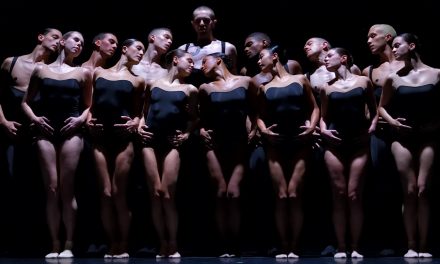
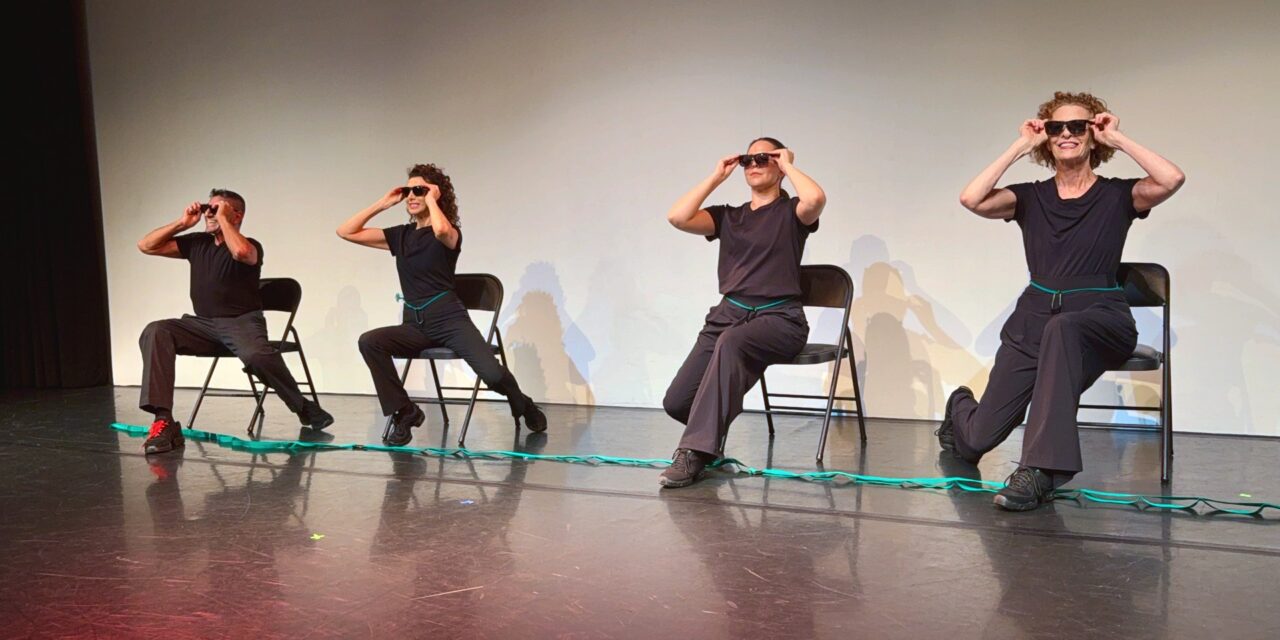
a/o/x – Ann Grimaldo, Jeff Grimaldo, Alessia Patregnani, and Isabel Van Ziji in “Moving still/still moving” – Photo by Patrick Kennelly.
After Vargas’ piece, I felt ready for something with less visual and sonic density. Instead, Naked with Shoes’ “moving still/still moving” choreographed by Ann & Jeff Grimaldo took the stage with sunglasses, a green rope strapping the performers together, and many folding chairs. The dancers stared at the audience with intense gazes as they smashed chairs into the floor and awkwardly maneuvered the green rope prop. At one point, they used the green strap as a jump rope, but instead of the dancer jumping into it, they simply stood beside it.
The piece felt as though the performers had chosen a collection of props and asked, “How can we be as strange as possible with these?” However, the dancers were very clean, committed, and maintained their performance quality throughout the entire work. The specificity of choreography led me to believe this was not supposed to be performance art, but I was not sure either of a deeper meaning of the piece. The dancers were Ann & Jeff Grimaldo, Alessia Patregnani, and Isabel Van Ziji.

a/o/x – Leopold Nunan in “minotaur.Exe.” – Photo by Patrick Kennelly.
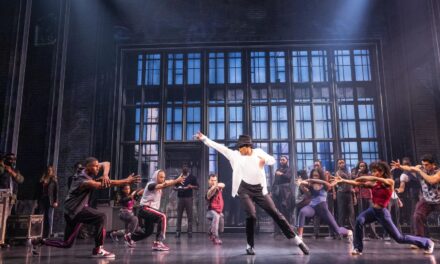
After the density of props, music, and chaotic movement in the previous pieces, I found myself hoping for a work with no props. Then Leopold Nunan entered with “Minotaur.Exe.”
“Minotaur.Exe” was not at all what I was expecting to see when I left my house that Friday night. From the ground arose a monster created by capitalism, wearing a huge muscle suit covered in trash and a horned helmet. There were strobe lights, a video backdrop that resembled a video game, and loud, wild music. Honestly, this piece needed to be its own show. Because I was already overstimulated from the previous works, I could not fully process everything being thrown at me through the voice simulator, lighting, sound, and visual design. I would have loved to experience Leopold Nunan’s work in its own full-length context.
Overall, I think the showcase was hindered by the layout and curation of the program. Standing alone, the individual works were much stronger than they felt when placed back to back in that particular order. The performers were deeply committed, and each piece had a clear world of its own, but the evening would have benefited from more contrast, pacing, and space for the audience to absorb the intensity of what they had just witnessed.
To learn more about the performance schedule at Highways, Please visit their website.
Written by Denali Huff for LA Dance Chronicle.
Featured image: a/o/x – Ann Grimaldo, Jeff Grimaldo, Alessia Patregnani, and Isabel Van Ziji in “Moving still/still moving” – Photo by Patrick Kennelly.