
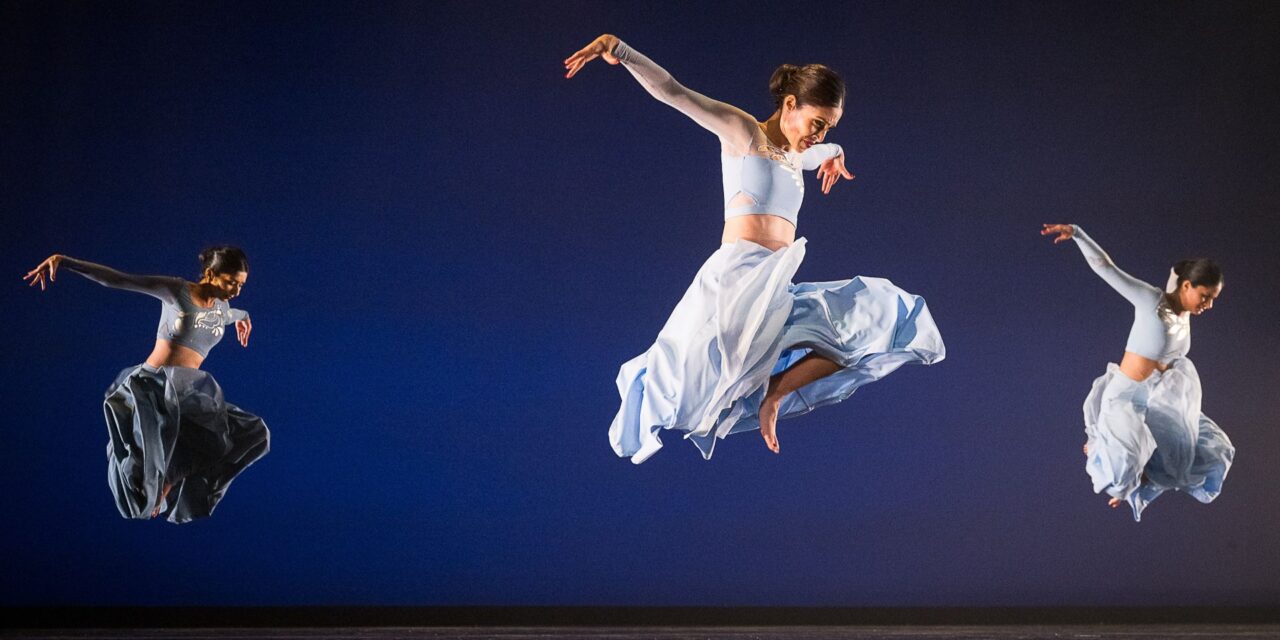
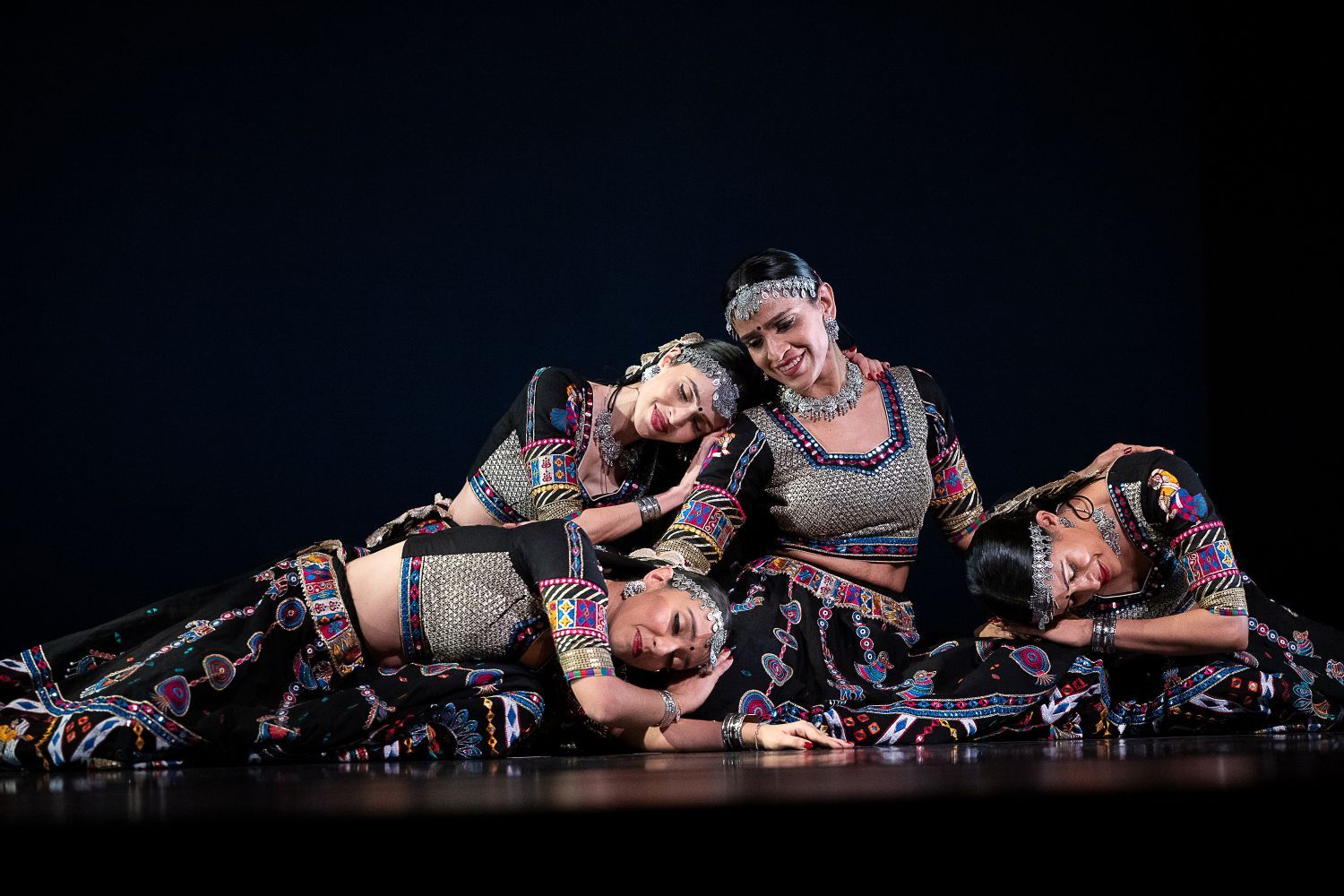
On October 24, 2026, I attended Sa Dance Company’s “RISE” at the Carpenter Performing Arts Center. Sa Dance Company is a contemporary Indian dance company, fusing together classical Indian dance styles with modern and contemporary dance. “RISE” is a four-part thematic work that follows the journey of an Indian woman through the various phases of her life, celebrating the strength and tenacity of women and highlighting both the progress that has been made and that still needs to be made.
Sa Dance Company – Photo by Christopher Duggan.
The dancing combined the signature rhythmic footwork of classical Indian dance with fluid gestural arms. The work was not just a blending of one style of Indian dance with contemporary dance; I could see elements of Bharatnatyam and Kathak (two of the eight classical Indian dance styles, though more were probably mixed in), Garba, and Bollywood. Often the fusion came through the pairing of classical dance with more contemporary Indian and Western music, including recognizable Bollywood tracks, as well as instrumentals of songs by Adele and Lady Gaga. The choreography by Artistic Director Payal Kadakia Pujji featured excellent layering and formational shifts throughout the work. Classical Indian dance is primarily a solo art form, so I enjoyed seeing the style expanded onto a larger group where rhythms could contrast each other visually and auditorily, while moments of unison could communicate intensity and unity.
Sa Dance Company – Photo by Christopher Duggan.
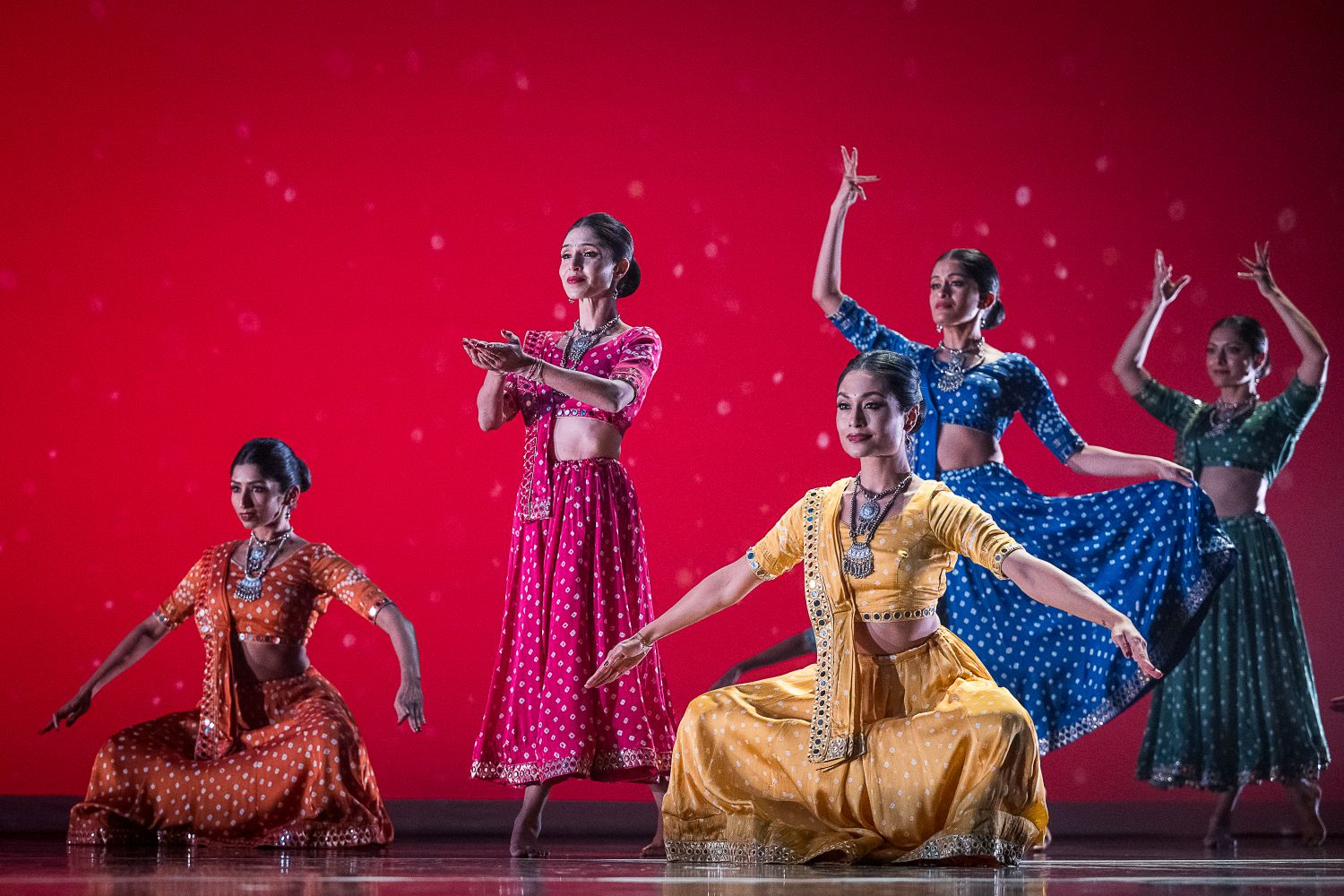
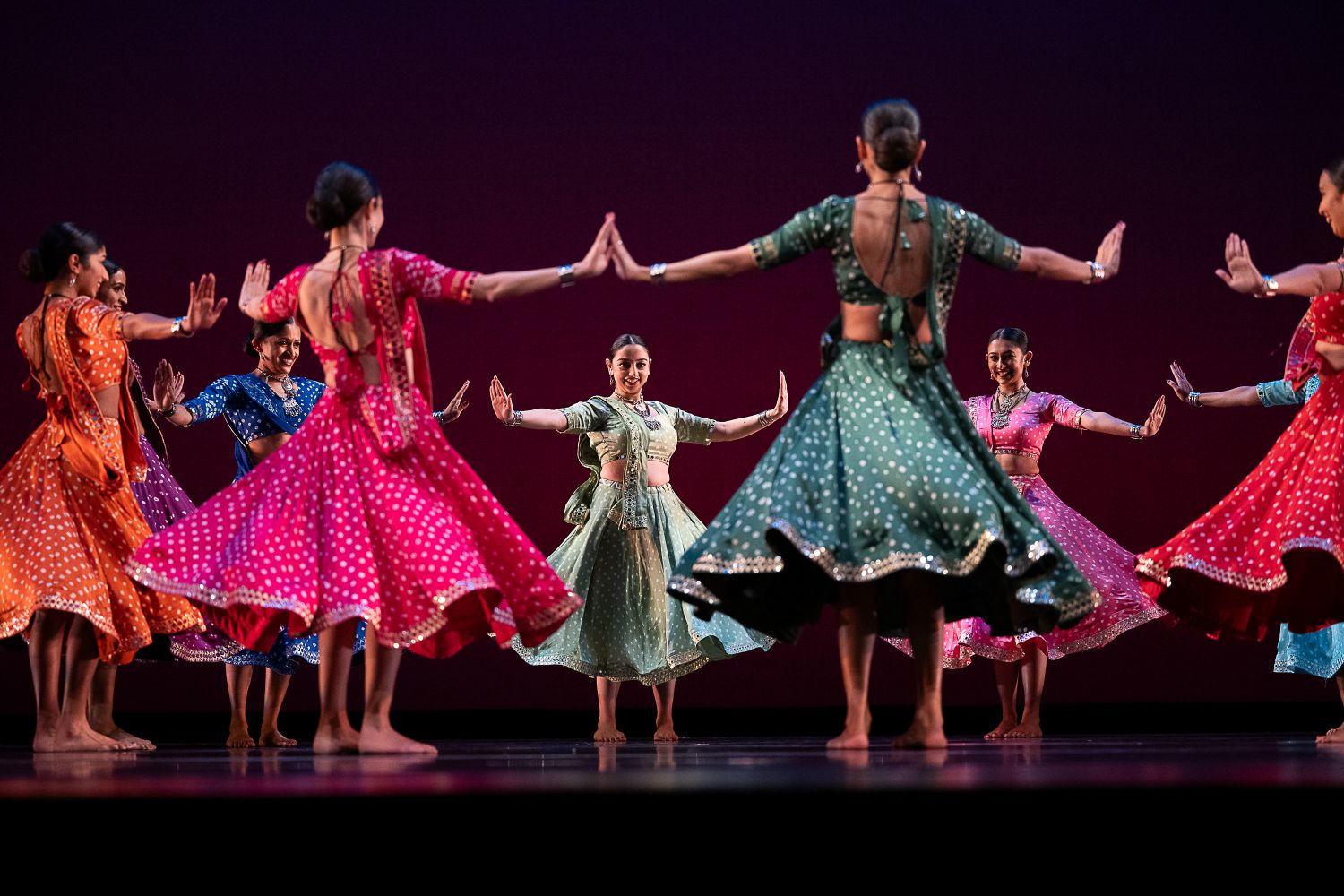
The first section, “Dreams and Duty, Duty and Dreams,” started with the sound of a heartbeat as a group of silhouettes appeared in the corner. The dancers wore bright lehengas of different colors. They walked and marched at different paces, pausing at times, down the diagonal. It felt like a representation of progress that was sometimes slower and sometimes quicker, but always pressing forward. Each section featured a few songs, sometimes blending together and sometimes with blackouts in between. This section was lighter, representing carefree youth. I understood this was the intention from the program, but would have loved to see the playfulness and lightness of youth come through more in the dancing and interactions. At the end, I did feel the storytelling when one dancer separated from the group and seemed to slow down, representing the transition to more responsibility that comes with age.
Sa Dance Company – Photo by Christopher Duggan.
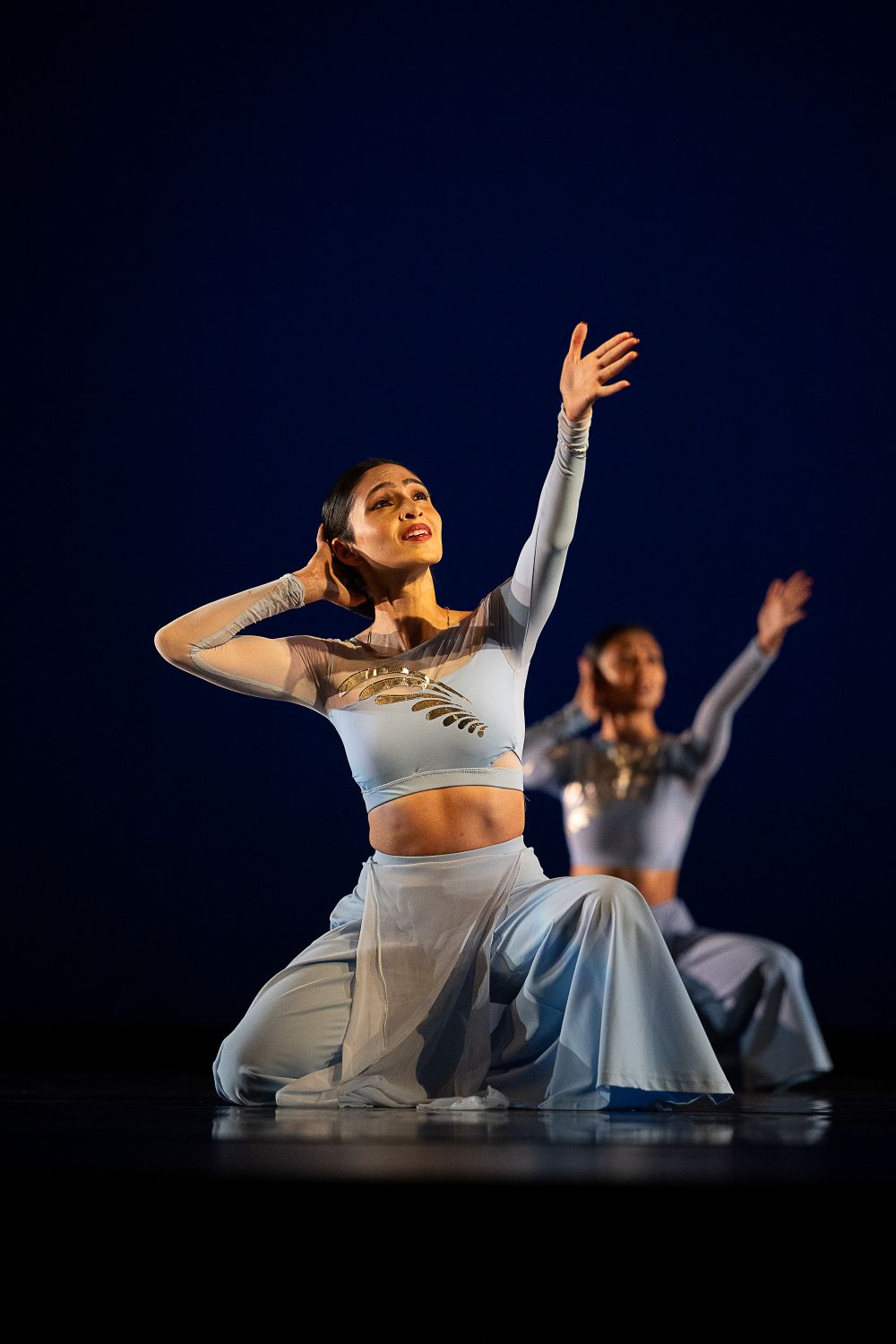
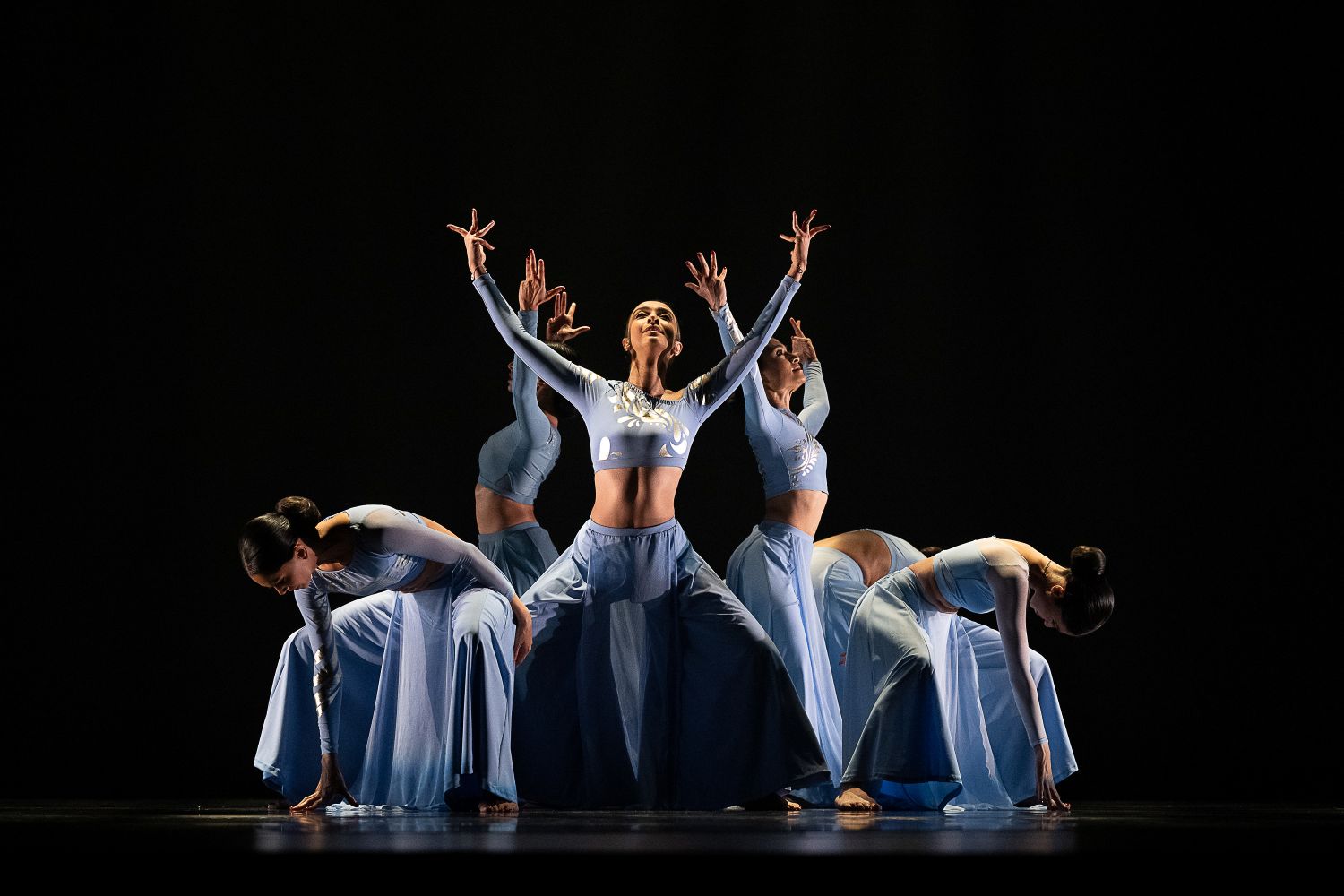
In the second section, “Unsaid Sacrifice,” the dancers were no longer individuals in their own colors but instead wore the same light blue skirts and tops. A single dancer started this section with a beautiful solo that leaned contemporary with undulations and ripples through the body and soft, gestural arms. As more dancers joined, simple effective ripples and canons communicated sorrow, though at times the simplicity of certain technical contemporary legs or jumps felt a bit elementary. One of my favorite parts was when the dancers moved to spoken word excerpts about how women are taught to disappear. The light blue costumes seemed to emphasize this point, as it gave the dancers a ghost-like quality under the soft lighting.
Sa Dance Company – Photo by Christopher Duggan.
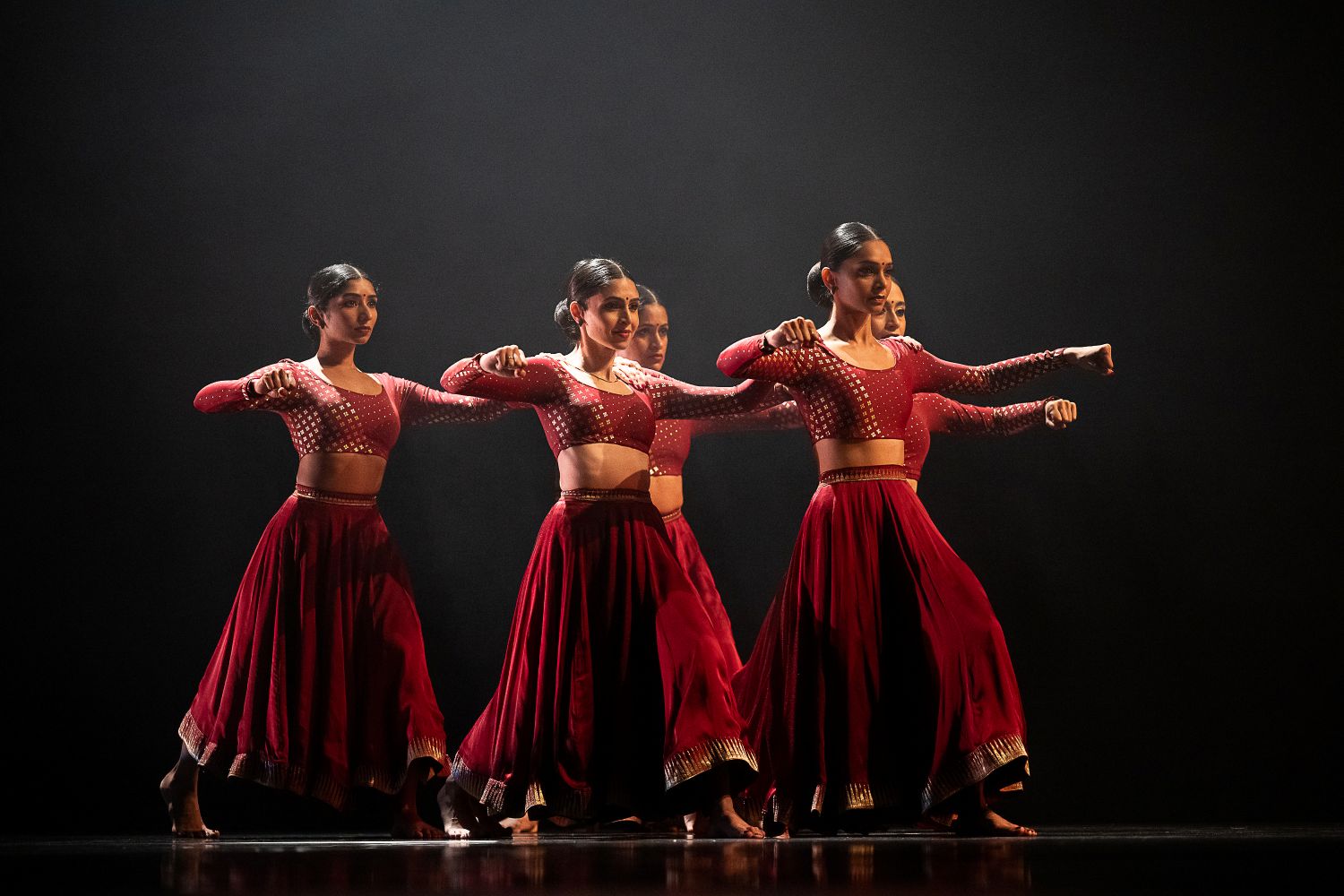
After an intermission, the third section of the dance, “Tu Jhoom – Stories of Us,” was a highlight of the evening. The dancers now wore dark red costumes; the silhouette and style remained the same as before but the new color choice brought a bold and mature energy. The soundscore to this section featured voiceovers of women speaking about their challenges and resilience. During each part, one dancer was separate from the group. The soloist often moved less than the group but brought the emotion of the story to life. The group served as the Greek chorus to the main action, adding movement with simple gestures or ripples, sometimes creating patterns in space around or in contrast to the soloist. The simplicity of the movements was striking and highlighted the stories as the star. I appreciated that the choreography stayed even more respectfully simple and somber when tough topics like miscarriage and domestic violence were discussed.
Sa Dance Company – Photo by Christopher Duggan.
The final section, “Legacy,” brought back strong stomps and sharp arms as the work came to a forceful finale. The rhythmic work, here and elsewhere, was clean and synchronized, down to the details of the wrists, which often flexed strongly or rotated and swirled as part of the arm actions. There was projected text or imagery before each section and this time we saw excerpts of letters that all had a theme of maternal relationships, which made me think of the idea of generational power. At one point, the lights rose on the audience and a voice called for aunties and grandmothers to stand, then mothers, then sisters, and then all women who had faced a challenge. As swaths of the audience stood, it was a powerful moment. During this final section in particular, there were a lot of starts and stops – endings that weren’t actually endings because the lights would come up again for a new section. I preferred when the musical pieces within a section blended more together, since the starts and stops broke things up too much. At the final conclusion, the dancers gathered in a circle in the center of the stage and knelt together as the heartbeat that began the evening returned for a full-circle conclusion.
Sa Dance Company – Photo by Christopher Duggan.
Especially coming from my own background in classical Indian fusion dance, I loved seeing this style on this scale and at this level of execution. The dancers of the cast, Roshni Badlani, Rashi Biria, Radhika Mehta Kirpalani, Nitya Srikishen Lakhi, Bhavika Kapadia Patel, Dhruti Patel, Juhi Patel, Kesar Patel, Neha Pathmanaban, Payal Kadakia Pujji, Sharanya Mukhopadhyay Sekhri, and Manisha Nair Sokka, were excellent performers bringing the work to life. “RISE” was a powerful and poignant work that celebrated Indian dance, the power of storytelling, and all women.
The Lighting Designer was Christopher Chambers and the Costumes Designers were by Shilpa Patel, Jillian Lewis, and AmbiKa “B” Sanjana.
To learn more about the Sa Dance Company, please visit their website.
To see the full performance season for the Carpenter Center, please visit their website.
Written by Rachel Turner for LA Dance Company.
Featured image: Sa Dance Company – Photo by Christopher Duggan.