Ballet Hispánico’s CARMEN.maquia arrived at The Soraya in a beautiful sea of stark white. It is based on Bizet’s opera Carmen, telling the dramatic story of a love triangle between a soldier, a bullfighter, and a Gypsy. This reimagining has enlisted Spaniards, choreographer Gustavo Ramírez Sansano, set design and construction, Luis Crespo, lighting design by Emilio Lavarías and celebrated costume designer, the late David Delfín to add to the authenticity of this production. There is music from several Bizet compositions and the Bolero and Habanera, probably the most recognizable compositions, are taken straight from the opera. Mr. Sansano has added “maquia” to the title to emphasize a battle to the death. (Note: In Spanish, bullfighting is called “tauromaquia.”)
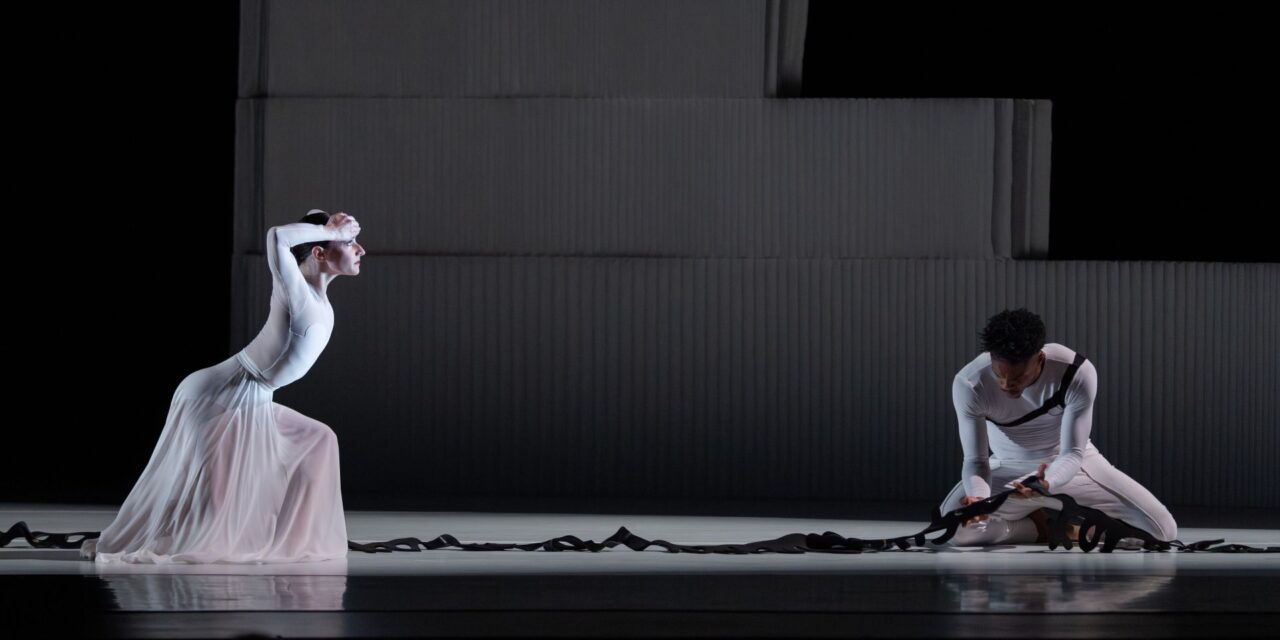
The prelude begins with a lone figure on the stage clearly consumed with angst as he paces in the shadows. The movements elicit a feeling of being emotionally trapped and a desperate attempt to gain control as the dancer reaches, shakes, contracts, and releases. The curtains slowly open to reveal a pure white set. According to Luis Crespo, the primary inspiration behind the set design was Picasso. He goes on to state that Picasso was obsessed with Carmen and her “untamable, fierce spirit who ends up being subdued by masculinity.” Huge panels hang featuring designs that focus on eyes and mouths that appear in Guernica, a large 1937 oil painting by Spanish artist Pablo Picasso and regarded by many to be the most moving and powerful anti-war painting in history. Choreographer, set designer, and costume designer were united in their vision of black and white as opposed to the Spanish clichés of red costumes with dots and castanets. This led to the connection with Picasso who created many black-and-white drawings of Carmen.

Amanda Ostuni as Carmen (in black) and Ballet Hispánico New York company dancers in “CARMEN.maquia” – Photo by Luis Luque, Luque Photography.
Act 1 begins and the dancers fill the stage, creating a vibrant community of diverse personalities. The movement vocabulary is a fascinating mix of pedestrian prancing, ballet, modern, and floorwork done with effortless abandon. The women, except Carmen, are all dressed in costumes that are flowing white skirts with a variety of tops. No two women are dressed exactly alike, and their personalities shine bright with each nuanced flick of the wrist and tilt or turn of the head. A pas de deux ensues with the two guards that have just watched the women depart. The men are so much fun to watch. There are comedic moments that arise between the acrobatics, turns, continual jumping and fast, intricate arm movements. The duet becomes a trio of men with fancy footwork. The movement vocabulary throughout the suite appears to be focused on nuance and the development of character and personality. Complicated port de bras paired with movement phrases that are extremely sharp and quick. The dancers, especially the women, function as a Greek chorus commenting on the drama as it unfolds. They are wonderfully engaging and animated in addition to being gifted artists capable of consistently demonstrating technical proficiency at a high level.

Amanda Ostuni as Carmen in “CARMEN.maquia” with Ballet Hispánico New York – Photo by Luis Luque, Luque Photography.
When Carmen arrives, the lone person on stage in black, the entire tone of the movement for the women changes. The choreography is still fast and furious but with a heightened sensuality with arms stretched wide and hips moving from side to side with a flirtatious air. Carmen, danced by Amanda Otsuni, is clearly the focal point and commands the stage with her charisma and presence. The music goes faster and faster and she never misses a grand battement, tendu, dégagé, or sharp turn of the torso. The men, especially Don José, danced by Amir J. Baldwin, are clearly enamored. Micaëla, danced by Francesca Levita, enters and the mood abruptly changes. She dances with an elegance and passion that stretches to the ends of her fingers. Her arms and legs seem to be endlessly caressing and gently holding on to Don José. The movement is characterized by deep contractions and a never-ending undulating quality that embraces the floor along a black rope. Micaëla and Don José perform an intricate floor sequence with rises and falls, from the knees to sitting, to rolling, to standing and ending in an embrace. These two artists perform the entire sequence effortlessly and with a palpable passion and deep connection to one another.

Ballet Hispánico New York Company Dancers Amanda Ostuni (left) and Amir J. Baldwin (right) in “CARMEN.maquia” – Photo by Luis Luque, Luque Photography.
A fight occurs in the factory and Carmen is arrested. It is here that we see that the dancers are skilled actors. They create a tension filled atmosphere with their movements and nuances. This is essentially mime at its best and when Carmen is arrested by Don José we see the black rope used to arrest her. Carmen’s beautiful hands tell so much of the story during this flirtatious interlude. She becomes the ultimate temptress and the choreography changes as the music changes. Both Don José and Carmen frantically catch every accent in the music with a flick of the wrist, a toss of the head, a grand battement, ronde jambe, and long, long, long developé stretching across the floor. They whirl and twirl around one another and then with one another in a pas de deux that feels like a sparring session. It abruptly ends with Carmen escaping from the cell. The set plays a crucial role creating the illusion of a cell or jail that Carmen and Don José must remain within throughout the dance. They are trapped in this small space but yet able to execute this intricate “large and grandiose” choreography using every little bit of the space available behind the white walls that surround them.
The remaining sections of the first act are characterized by the chorus of women engaging in mime while Carmen’s suitors frantically dance to be chosen and acknowledged by Carmen. The music is loud and dramatic but the men’s movements are intricate and nuanced with quick fast steps, turns, and small jumps. The music builds but the dancing does not. Escamillo, the Toreador, danced by Dylan Dias McIntyre, enters to much musical fanfare and the music continues to build. He steps in with swagger, braggadocio, and arrogance. The chorus of girls swoon and Carmen simply stares. Once again, the music, now “Stand Up and Fight!” is loud and dramatic but the male dancers’ movements never seemed to match the largesse of the music. Mr. McIntyre, a gifted artist with tremendous technique, continually, posed, preened and postured displaying his beautiful muscles and technical prowess as he hit every line to perfection. Wonderful turns, clean footwork, sharp, quick jumps, with a grand jeté and tour scattered throughout. The pas de deux with Carmen and Escamillo was quite a change of pace from his solo. It is a study in elevating pedestrian movements to sheer sensuality and seduction. Escamillo continually caresses Carmen’s entire body and when they arise from the floor the partnering is seamlessly exquisite. The energetic chorus of men and women hit the stage and fill the stage with personality and energy. This is followed by a pas de deux with Don José that shows a different side of Carmen. She is clearly smitten and the way she uses her arms and hands to capture longing is quite moving. The lifts are so interesting and unique. The entire dance is characterized by a constant push and pull that mimics the emotional focus of the story at this point.

Ballet Hispánico New York Company Dancers Amanda Ostuni (left) and Amir J. Baldwin (right) in “CARMEN.maquia” – Photo by Luis Luque, Luque Photography.
Act II is filled with duets and trios and the chorus moving through the action commenting via mime and intricate movement phrases. Each pas de deux with Carmen and Don José, Carmen and Escamillo, Micaéla and Don José, is stunning. The way the choreographer fuses the intricate movement phrases with character development is fascinating. Each gesture, toss of the skirt, flick of the wrist, turn and tilt of the head makes a character statement. The characters are given tremendous depth due to the movement and the way they relate to one another. In my opinion, the music selected for these pieces fuse beautifully with the movements and compliment the story being told. All the dancers demonstrate exceptional technical prowess and a consistent commitment to creating characters that are integral to the story. Their musicality is unparalleled as movement phrases are often punctuated with pauses and fluctuations in tempo and dynamics that every single dancer is able to hear and allow it to influence the intricate gestures that characterize the choreography. Music, theatre, dance, and art come together in CARMEN.Maquia to retell a well-known story with a fresh take on Bizet’s most celebrated opera, CARMEN. It is the story of a woman who refused to be defined by cultural values and mores past and present and it resonates as loudly today as it did when it was first presented 150 years ago.
To learn more about Ballet Hispánico, please visit their website.
For more information about The Soraya, please visit their website.
Written by Leah Bass-Baylis for LA Dance Chronicle.
Featured image: Ballet Hispánico New York Company Dancers Francesca Levita (left) and Amir J. Baldwin (right) in CARMEN.maquia – Photo by Luis Luque, Luque Photography.
Please follow us on Facebook, Instagram, BlueSky, and LinkedIn.