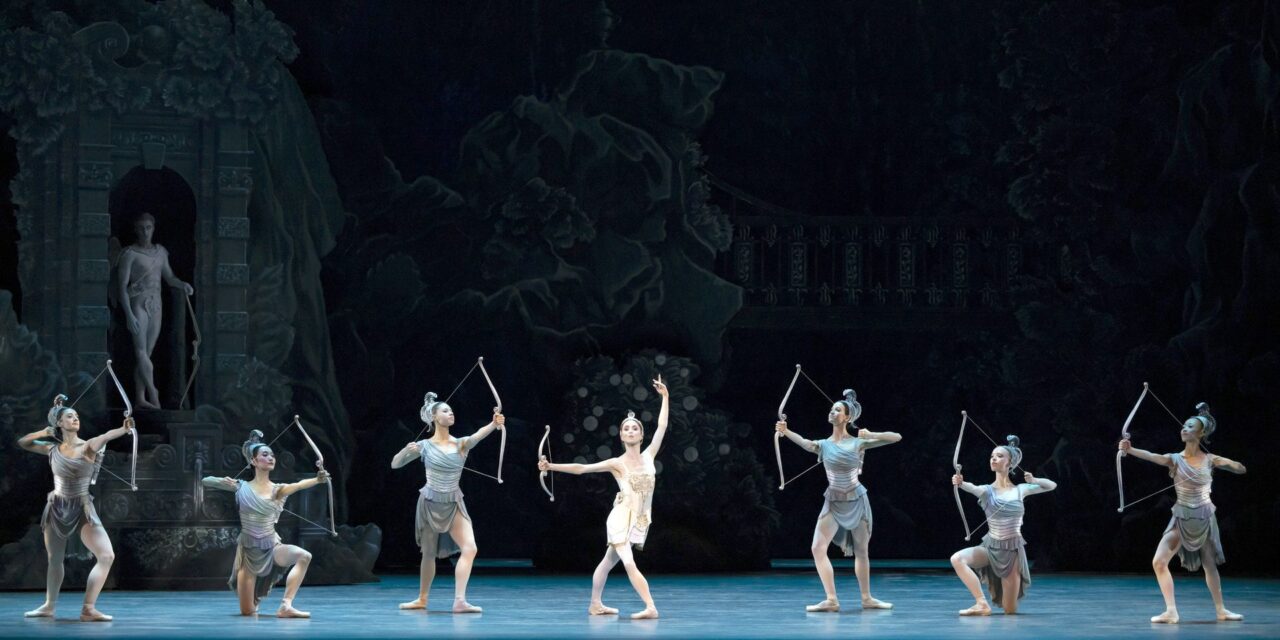
Under the astute artistic direction of Susan Jaffe and Executive Director Barry Hughson, Frederick Ashton’s Sylvia arrived at the Segerstrom Center for the Arts on April 9, 2026. Ashton’s ballet is a tongue-in-cheek mythological pageant, delightfully emblematic of his style—part pastoral fantasy, part courtly entertainment—complete with fanciful forests, Grecian temples, and even a stone god who springs to life.
The production revels in theatricality: muted pinks, moss greens, and creams offset by ornate armor, sculpted headpieces, and the ever-present bow and arrow. The original designs by Robin Ironside and Christopher Ironside, with additional designs for this revival by Peter Farmer, are complemented by the luminous lighting of Mark Jonathan, which creates a richly textured, opulent, and stylized world.

Chloe Misseldine in ABT’s “Sylvia” – Photo by Nir Arieli.
Presented by American Ballet Theatre, one of the largest and historical companies in the United States, Sylvia is a massive undertaking. With a roster of approximately 80 dancers and as many as 30 to 50 on stage in ensemble passages, the work rivals the scale of Swan Lake, Giselle, and La Bayadère. Yet unlike those repertory pillars, Ashton’s ballet is rarely seen in the U.S., making this 2025–26 revival particularly noteworthy after a long absence.
Under the guidance of répétiteur Irina Kolpakova and régisseur Susan Jones, the production carries the considerable responsibility of maintaining both structural coherence and stylistic lineage. At its best, Sylvia evokes the grand court entertainments of Catherine de’ Medici—early ballets de cour (court ballets) that fused myth, music, dance, and spectacle into elaborate theatrical tapestries designed to delight and astonish.

Chloe Misseldine and Carlos Gonzalez in ABT’s “Sylvia” – Photo by Nir Arieli.
Yet for all its spectacle, this opening night ultimately rested on its central pairing—Chloe Misseldine as Sylvia and Calvin Royal III as Aminta—and it is here that the evening revealed both promise and challenge.
Royal, a dancer of lyrical refinement and elongated elegance, offered moments of genuine beauty. His line is clean, his phrasing sensitive. Yet in partnership—particularly with the statuesque Misseldine—there were moments where lifts appeared labored, interrupting the ease of their exchanges. One recalls earlier eras—Roberto Bolle with Darcey Bussell, or Jacques d’Amboise supporting the towering Gloria Govrin—where strength and aesthetic alignment created seamless elevation. That equilibrium remains the goal.

Chloe Misseldine and Jose Sebastian in ABT’s “Sylvia” – Photo by Nir Arieli.
Misseldine presents a compelling physical instrument—striking line, undeniable presence—yet her performance suggested an artist still in development. There were visible nerves and, at times, a lack of musical responsiveness that left the role curiously uninhabited. The result was a disconnection from both phrasing and dramatic intent, creating tension between visual allure and artistic engagement. The instrument is clearly there; what remains is the cultivation of emotional clarity, presence, and musicality to shape not only the exterior but the artistic core.
Virginia Lensi, as Diana the Huntress, brought authority and propulsion to the role, commanding both its leadership and its mythic tension. The corps was beautifully turned out and clearly well-rehearsed, though in larger ensemble passages the scale occasionally tipped toward unwieldiness rather than cohesion. Still, there were flashes of brilliance: Sylvia’s eight hunt attendants burst onto the stage with exhilarating grand jetés, evoking the very stag they pursue. Léa Fleytoux and Elisabeth Beyer were particularly striking, their extensions slicing through space with amplitude and clarity.

Jake Roxander and Carlos Gonzalez in ABT’s “Sylvia” – Photo by HELI.
Meanwhile, Carlos Gonzalez proved a delight as Eros, the god of love and desire. His performance was both charming and articulate, further enlivened by a playful disguise—cloaked in grey, with darting, expressive feet visible beneath that he imbued with humor and welcome mischief.
Among the evening’s most engaging moments was the delightful “Goat” pas de deux, danced with buoyant charm by Breanne Granlund and Takumi Miyake. Miyake’s elevation seemed to suspend him midair, teasing gravity, while Granlund matched him with wit and buoyancy, creating a spirited exchange that briefly lifted the entire production into a more spontaneous register.

Scene from ABT’s “Sylvia” – Photo by Nir Arieli.
In a last-minute substitution for Cory Stearns, James Whiteside took on the role of Orion, delivering a theatrically assured performance that shaped the villain with clarity and presence. Joined by Ceres and Jaseion (Fangqi Li and Jose Sebastian), Persephone and Pluto (Zimmi Coker and Duncan Lyle), and Terpsichore and Apollo (Sierra Armstrong and Andrew Robare), the pantheon gathered in Orion’s lair in a sequence that leaned fully into theatrical delights.
Musically, the evening was richly satisfying. Léo Delibes’s buoyant, lilting score was rendered with warmth and refinement by the Pacific Symphony, whose full-bodied sound supported the choreography’s lyrical intricacies and tonal shifts.

Scene from ABT’s “Sylvia” – Photo by Nir Arieli.
Acts II and III, separated by an entr’acte, introduced the playful Bacchanalia—a vivid contrast to the earlier scenes. A swirl of color, tambourines, and celebratory movement, it unified the stage with vitality and theatrical exuberance, culminating in the resolution of Diana’s resistance and the union of Sylvia and Aminta.
Sylvia remains a rare and ambitious undertaking. Despite moments of unevenness, it demands not only scale but stylistic precision and deeply rooted musicality—qualities that cannot be conjured by spectacle alone. That ABT continues to invest in such works speaks to its artistic reach and institutional commitment. For Southern California audiences, this revival stands as both a gift and a challenge; a reminder of Ashton’s singular voice, and of the rigor required to bring it fully to life.
To learn more about American Ballet Theatre, please visit their website.
For more information about the Segerstrom Center for the Arts, please visit their website.
Written by Joanne DiVito for LA Dance Chronicle.
Featured image: Skylar Brandt in Sylvia. Photo: HELI.
Please follow us on Facebook, Instagram, BlueSky, and LinkedIn.