On April 18, 2026 the Irvine Barclay Theatre was awash with tango fans of every age. Some dressed in blacks and reds, dripping with fringe and jewels; others in shorts, T-shirts and slacks. The evening promised excitement for the gathering crowd.
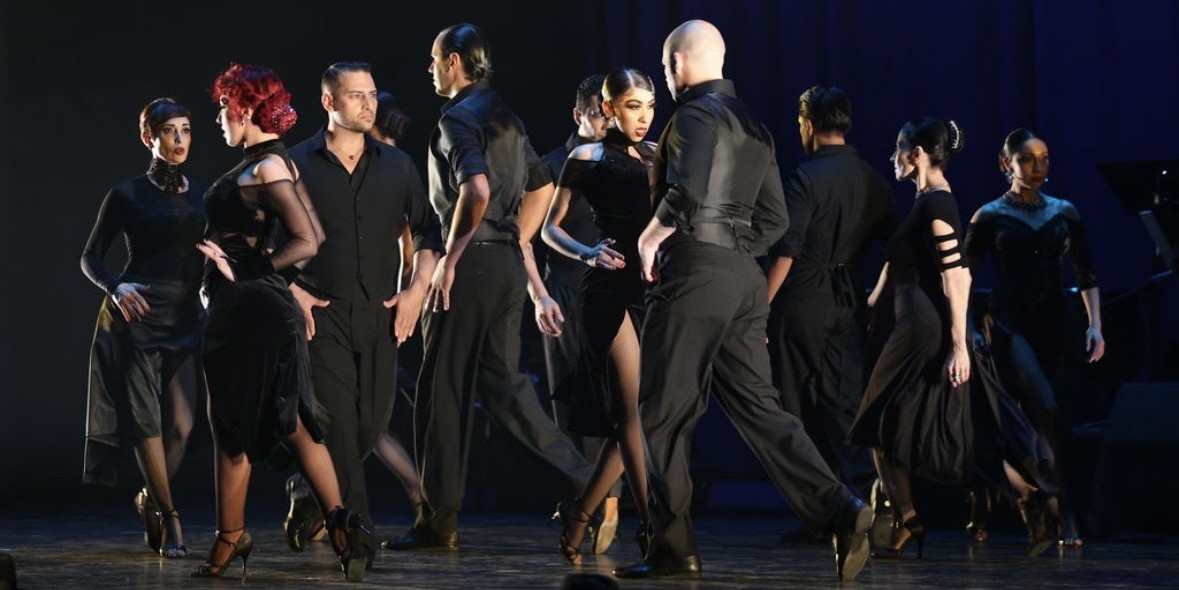
As anticipation grew, the moment the strains of the bandoneón began, Majestic Tango announced itself as an evening steeped in both musical richness and kinetic sophistication. Six couples fed onto the stage, establishing an immediate sense of community and tradition—an echo of tango’s deeply social roots.

ARTE Tango Sextet – Photo courtesy of the Irvine Barclay Theatre.
At the heart of the evening was the Arte Tango Sextet, a U.S.-based ensemble devoted to the authenticity and vitality of Argentine tango music. With Natalia Maiden and Keiko Cadby (violins), Yukie Kawanami and Alex Roitman (bandoneóns), Crystie Shum (piano), and Zoe Kumagai Elias (double bass), the musicians delivered a performance of remarkable cohesion and expressive depth. Their program wove together works by Astor Piazzolla alongside traditional staples such as Jealousy, Libertango, and La Cumparsita, with the unexpected inclusion of Roxanne offering a contemporary edge. The result was a sumptuous interplay of sound and movement—a true feast for both ear and eye.

“Majestic Tango” – Photo by John P. Tice Photography.
Throughout the evening, dancers entered in couples and ensembles that unfolded like a confection of shifting pairings and counterpoint. The execution of the boleo (swinging leg), gancho (hooked action), and ocho (figure-eight pattern), along with lifts and lunges, formed and dissolved with fluid precision, revealing not only technical command but a nuanced interplay of trust, musicality, and emotion. Each couple brought a distinct voice, yet all shared a palpable sense of sympatico; a generosity of presence that elevated the collective experience.

“Majestic Tango” – Photo by John P. Tice Photography.
Directed and created by the formidable duo Miriam Larici and Leonardo Barrionuevo, the production assembled a roster of exceptional artists: Larici & Barrionuevo, Noelia Guerrero & Martín Cardoso, Guillermina Quiroga & Mariano Logiudice, Guillermo De Fazio & Giovanna Dan, Lyliana Beltrán & Tony Flores, Cristina Larios & Raúl Navarrete, and Claudio Predieri. Across the evening, excellence was the standard—but certain moments rose unmistakably into transcendence.
Foremost among these was Quiroga and Logiudice’s interpretation of Oblivion. Here, Piazzolla’s aching lyricism found its fullest embodiment. Their dancing was exquisitely restrained yet emotionally expansive, creating a space so intimate it bordered on voyeuristic. One felt not simply as an observer, but a witness to something deeply private—an articulation of longing, connection, and loss rendered through extraordinary musical sensitivity and technical clarity.

“Majestic Tango” – Photo by John P. Tice Photography.
In striking contrast, Larici and Barrionuevo’s Roxanne ignited the stage with visceral intensity. Drenched in reds and oranges, the piece unfolded as a study in seduction and power. Larici commanded attention from her first entrance, her presence both magnetic and controlled, while Barrionuevo’s partnering was nothing short of audacious—precise, daring, and deeply attuned. Together, they delivered a performance that embodied tango’s raw fire without sacrificing refinement.

“Majestic Tango” – Photo by John P. Tice Photography.
A particularly compelling interlude featured an all-male quartet—Barrionuevo, Flores, Navarrete, and Predieri—in Kicho. This segment offered a powerful nod to tango’s origins in the late 19th-century working-class neighborhoods of Buenos Aires, where a surplus of male immigrants led men to practice together, alternating roles as leader and follower. Far from a novelty, this tradition speaks to tango’s foundations in adaptability, discipline, and social aspiration. Like the court dances of Louis XIV’s France, tango became a form of social currency—a means of gaining status, refinement, and access.

“Majestic Tango” – Photo by John P. Tice Photography.
The program culminated with Libertango and La Cumparsita, bringing the evening full circle—honoring tango’s lineage while reaffirming its enduring vitality. As the audience exited into the night, there was a palpable sense of lift, as though the performance had carried them somewhere just beyond the ordinary.
Majestic Tango succeeds not only as a showcase of technical brilliance but as a living, breathing testament to tango’s evolution—its history, its passion, and its enduring capacity to move us. Thanks to venues like the Irvine Barclay Theatre, evenings like this continue to bring artistry and vitality to the community.
Written by Joanne DiVito for LA Dance Chronicle.
Featured image: Majestic Tango – Photo by John P. Tice Photography.
Please follow us on Facebook, Instagram, BlueSky, and LinkedIn.