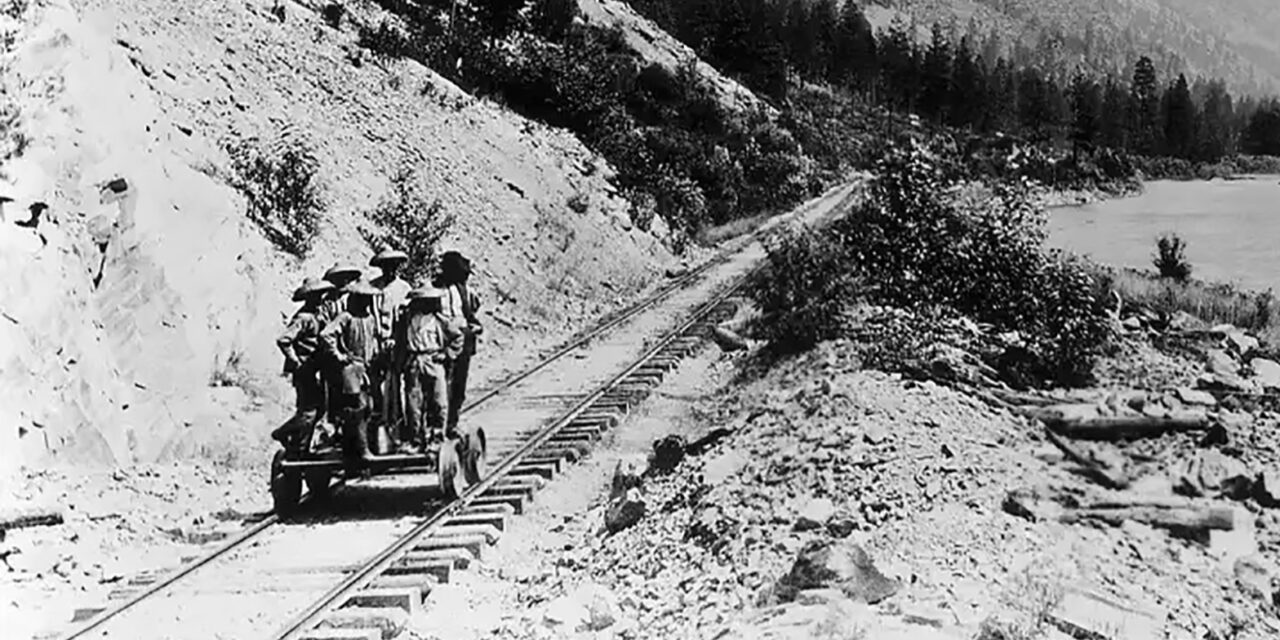
“On the railroad that helped build America, two immigrant Chinese laborers navigate survival, identity, and what it means to chase the American Dream.”
Written by multiple award winning and prolific artist David Henry Hwang, “The Dance and The Railroad” was presented by Artists at Play on Sunday Oct. 11, 2026, on the mainstage of “The Los Angeles Theater Center.” This performing arts complex is housed in the historic landmark building that was once a bank when banks were a luxurious representation of the monied few. Marble, pillars and architectural flourishes adorn the building while the soaring etched glass ceiling looms over the large and welcoming lobby. Operated by The Latino Theater Project this space encompasses, five theaters, rehearsal space and more. In keeping with the family friendly atmosphere various activity areas were set up for arts and crafts, huge Day of the Dead Sculptures stood vigil along the walls and there was bar service near the back.
The theater itself seats the audience at a high rake so the stage is below giving a clear view to all. Onstage the set by Leah Ramillano depicts a campground surrounded by small hillocks such as Chinese railroad laborers might inhabit in the California, Gold Mountains circa 1867. On stage comes Lone, the experienced worker and ex Chinese Opera student portrayed by Tony Jin. He begins with simple Tai Chi style dance movement accompanied by recorded traditional Chinese music by way of introduction to his character. His poses work well and he presents them with authority but when he needs to make a series of quarter turns his balance falters. This weakness is repeated in later movement sequences and undermines his presence as an accomplished Chinese opera student. However, in stillness he shows self-assurance which gives the dialogue a strong basis and gives him believability. Scott Keiji Takeda as Ma brings energy and humor as a naïve new worker.
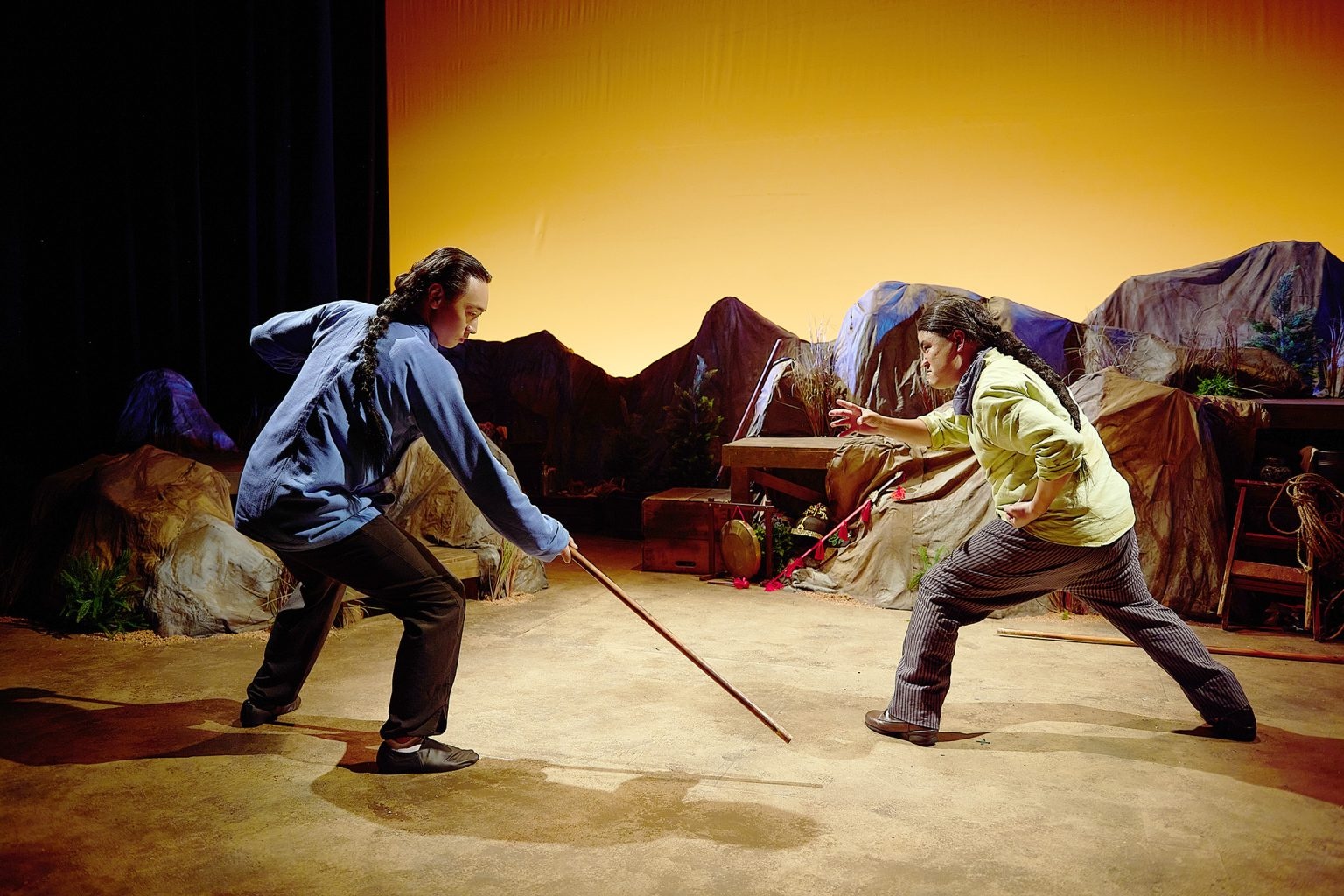
Dance and the Railroad. Photo by Michael Palma.
The railroad workers are on strike for better pay and shorter hours. Work on the railroad is backbreaking and the possibilities for more equitable conditions are bleak. Hwang uses magical realism to illustrate this historical event. Relying on his Chinese Opera training, Lone leads the naïve Ma through a series of exercises that are both intriguing and very funny. When Lone coerces Ma to imitate a duck he does so with a reluctance that has the audience laughing. His locust imitation is also funny though ultimately painful as the hours of holding a locust pose move slowly. Hwang sets these scenes allegorically to illustrate the misery these workers are subjected to. His use of the absurd, the opera and the true events of the strike make this the strongest and most relatable segment of the play. There is little to celebrate when the strike is resolved as the asked for raise is half the amount and the hours are only somewhat lessened. Time would make clear that nothing was truly gained as the Chinese workers were exploited again and again by the powers that be. In this way Hwang’s play is as relevant today as it was 45 years ago.
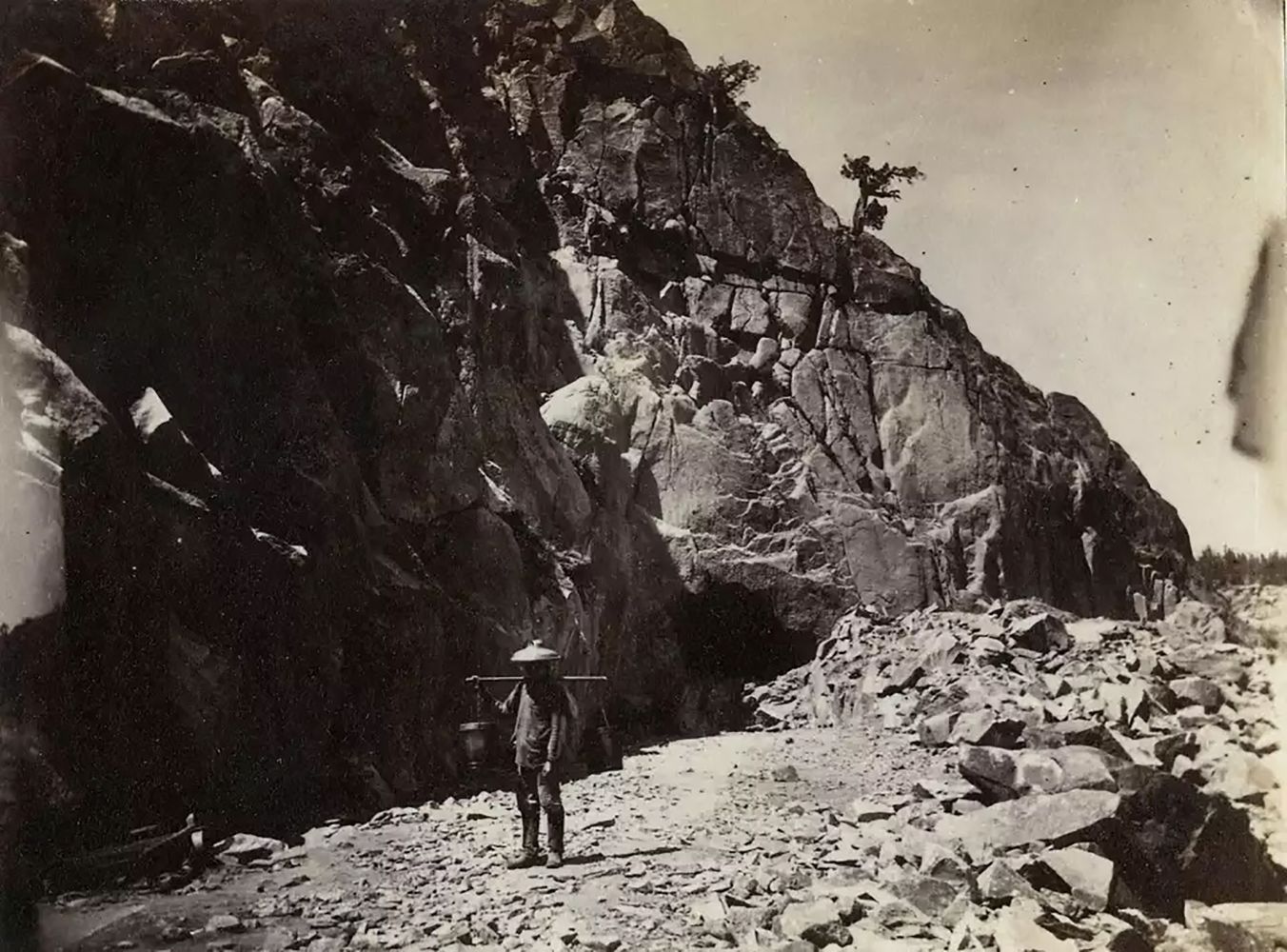
A Chinese immigrant laborer at the site of a tunnel under excavation during construction of the Transcontinental Railroad. Alfred A. Hart, Stanford University Archives and Collections – Photo courtesy of Latino Theatre Co.
Though there is little in the way of dance in this production the movement woven throughout is important and gives the play another level of interest, lifting it out of the literal into the world of imagination while also adding cultural significance. Director Katherine Chou has made good choices working within the limits of the actors while clearly illustrating Hwang’s work. Choreography by Annie Yee again is appropriate to the ability of the actors who are fully invested and work hard to bring it to life. She and Director Chou have infused physical humor into several scenes which lightens the load and brings needed laughs. Excellent lighting design is by Szu-Yun Wang with costumes by Jo-Jo Siu and sound by Jesse Mandapat.
Overall, this was an interesting and enlightening show well presented by all. Artists at Play and the Latin Theater Co. are continually creating new and important productions for Los Angeles viewers in their beautiful historic theater space. I would love to see what might evolve if a night of dance and choreography were to be curated. I’ll look forward to that.
For more information about the Los Angeles Theatre Center, please visit their website.
Written by Tam Warner for LA Dance Chronicle.
Lead image: Chinese laborers on the Northwest Pacific Railway in the 1880s. Photograph Bettmann Archive – Photo courtesy of the Latino Theatre Co.