On Friday, August 7th, 2026, I attended the culmination of the first year of MovementFest LA at LA Dance Project. Produced by Jessie Lee Thorne, Mike Tyus, and Majella Bess, this program brings together contemporary dancers from around the world while also highlighting local artists, with the goal of elevating Los Angeles as a contemporary dance destination. In the spirit of building community, drinks and tacos were available in the outdoor terrace area before and after the performances, and the festival creators encouraged patrons to stick around and build new connections after the last piece. The program consisted of seven works, five of which were presented by Los Angeles based choreographers. The other two pieces were the result of the two week intensive workshop for artists from all over. Athleticism, intimacy, and social commentary were repeated themes throughout the strong, engaging evening of dance.
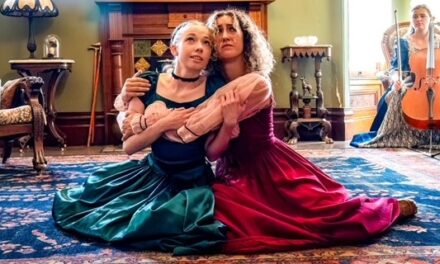
The first piece on the program was “Reservations for/from Two” choreographed and performed by Laja Field and Jessie Lee Thorne. The work took us on a non-linear journey through memory fragments and moments in a relationship. The soundscore by 17mics wove together sound, silence, and recorded voices. In one recurring scene, Field and Thorne were at a table, acting out an interaction with a waitress, who was a bit flirty (or maybe wasn’t, depending on whose eyes we were seeing the interaction through at the time). Humor was used well as their live speaking contrasted with the recorded voices sharing their inner thoughts. In sections where the dancers used the full space, they showed off smooth and impressive floorwork. I loved when they set the table on its side and used it to create different settings as the memories seemed to shift by faster. Sudden lighting changes were effective in communicating these fast shifts in time and place. In one cool tableau, the dancers lay on either side of the table as if we were seeing an aerial view. Field and Thorne were strong technical and emotional performers, giving a full-bodied intentionality to each movement.
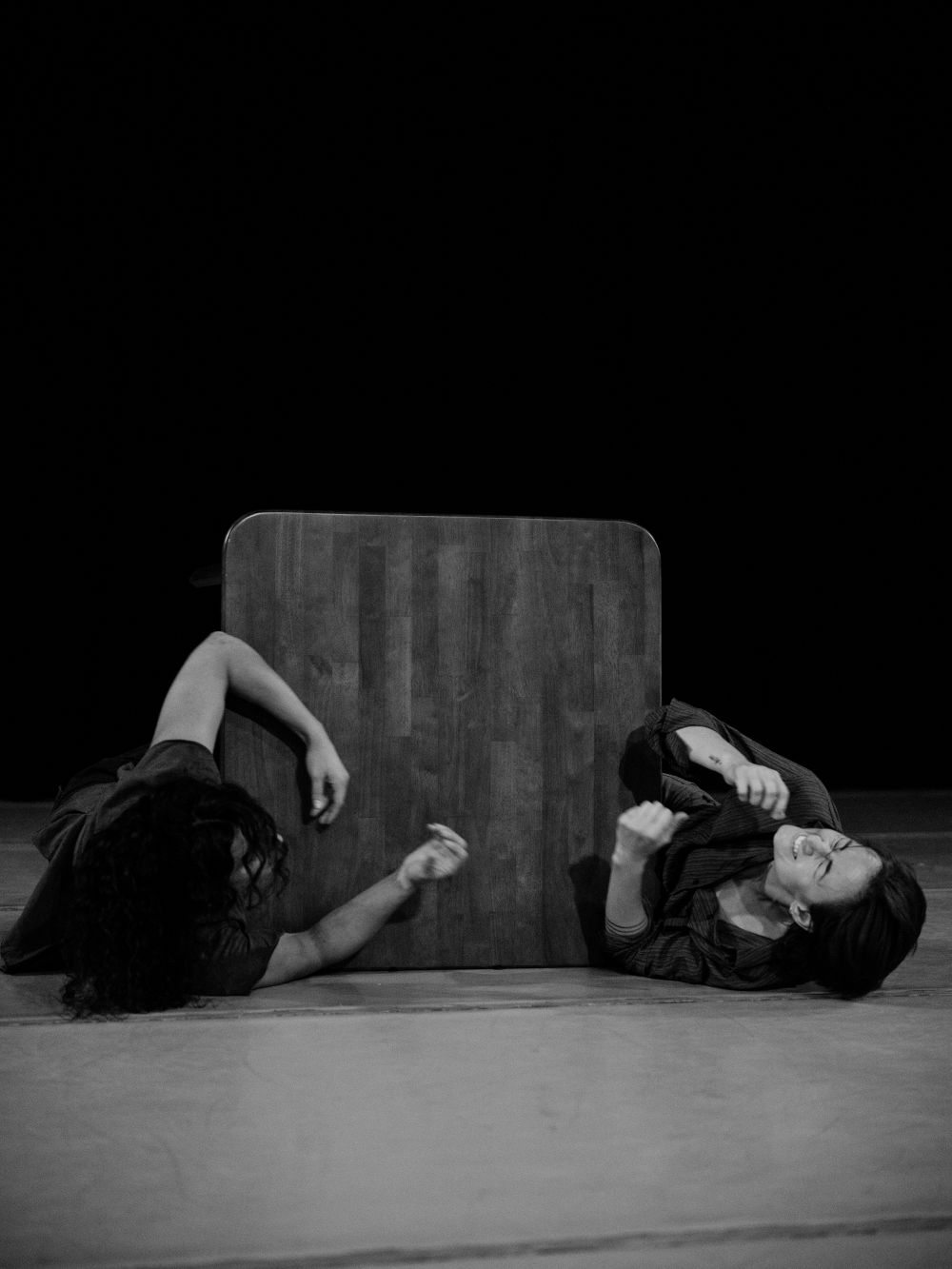
“Reservations for/from Two” choreographed and performed by Laja Field and Jessie Lee Thorne – Photo by Luca Renzi.
Next up was “Catching Ghost,” performed and choreographed by Ja’Moon Jones. This was an excerpt of a larger evening length work and was a captivating, beautiful solo piece. Jones immediately commanded the audience as he meditatively walked from the wing with a long sheer white piece of fabric stretching out behind him across the stage. This cloak pulled out a bowl of water, and as Jones spread water on his bare skin, the simple lighting, done by Alex Lemus, caught the contours of his body. He eventually transitioned into an athletic solo that filled the stage. There was something alien and otherworldly about the way he would move in unexpected directions or throw himself at the ground. The piece ended like it began, with Jones exiting in his cloak. I’d love to see the evening length version of this stunning work.
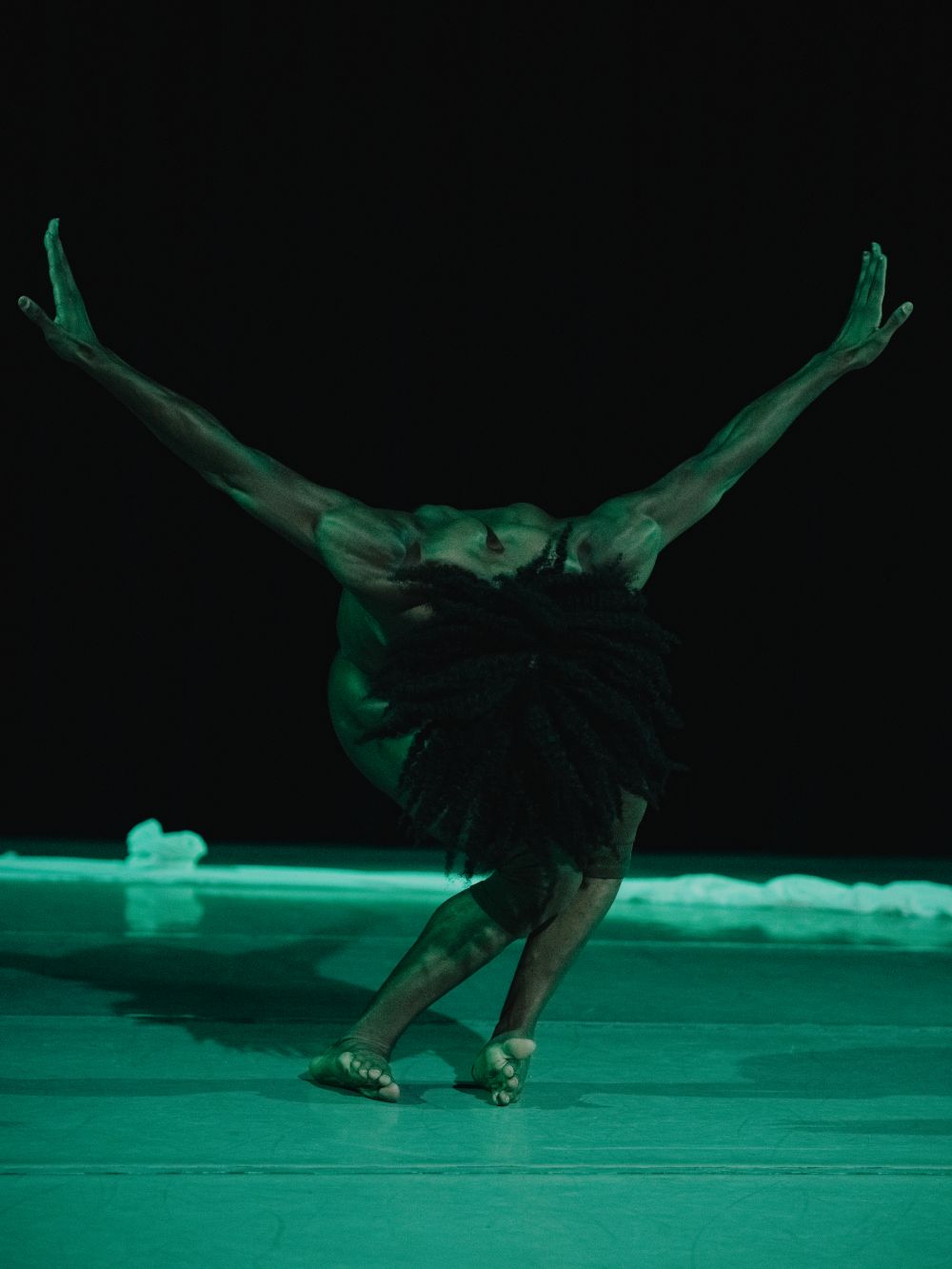
“Catching Ghost,” performed and choreographed by Ja’Moon Jones – Photo by Luca Renzi.
The third work, entitled “Prelude to the Big Bang” and choreographed by Dolly Sfeir, was one of the pieces created with the dancers of MovementFest LA over the two week workshop. The piece was danced by Marissa Mahoney, Malia Lam, Jacquelyn Tepper, Maddie Lacambra, Forest Lee, Natalia Cervantes, Alex Eto Van Duyne, Frankie Melander, and Zion Regis.
The beginning of the piece felt like there were a few too many ideas not fully flushed out, with tables, a silhouette created by dancers holding a giant swath of fabric, as well as blackout transitions in quick succession that broke things up too much for me. As the piece progressed, there were still quick shifts in formation or from group to group, but they felt more cohesive. The piece was set to music composed by Sergei Rachmaninoff, and I enjoyed how Sfeir interpreted the music in unexpected ways. The dancers would jump and thrash in clumps to the music to match the drama of the concerto – it felt like what would happen if there were raves for classical music. I enjoyed how the dancers would expand and contract in and out formations, matching the rises and falls of the music. There was a slightly broken feel to the bent arms that were often used. Often the dancers would move individually, but it felt like Sfeir had given them clear imagery so that the group was cohesive in the movement ideas they explored.
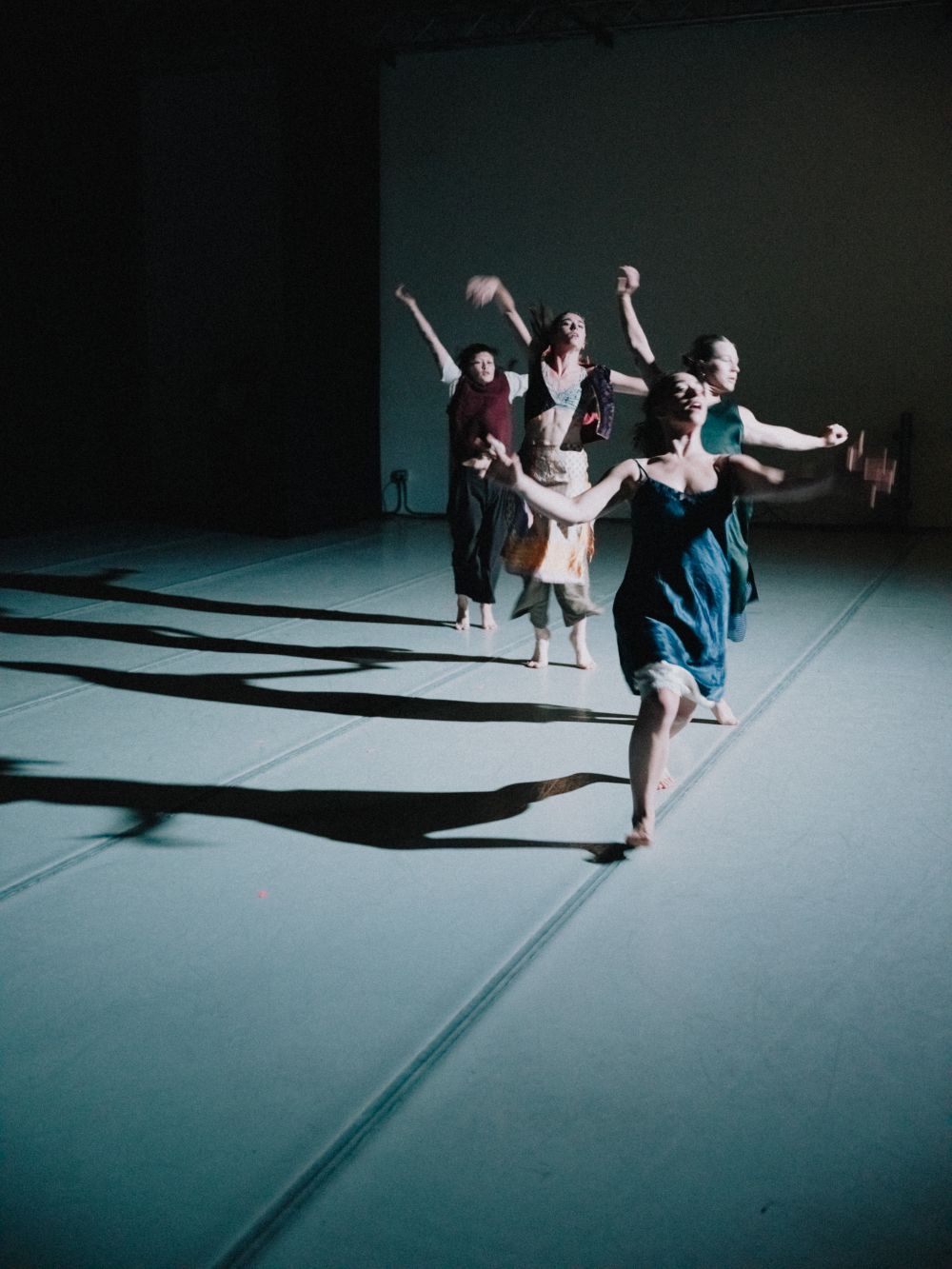
“Prelude to the Big Bang,” choreographed by Dolly Sfeir – Photo by Luca Renzi.
The last piece before intermission, “Against the Wall” took us out to the parking lot of LADP. This outdoor installation was choreographed by Majella Bess and danced by Madaline Riley, Kate Dougherty, Lydia McDonald, Keilani Mussetter, Julia McCullock, Sarah Chan, Mizuki Sako, Dahlia Levine, Connor Senning, Abraham Meisel, and José Arrieta Cuesta. As the piece started, dancers walked among the audience with lights while a voice spoke about how the revolution would not be televised. The piece as a whole seemed to be a call to action and progressed from separate groups to collective action. “Against the Wall” started in separated small groups, lit by the lights some dancers held. I was closest to a duet between two male dancers. Then, large plastic flags were brought out, encouraging the audience to gather. With the lights and wind, it was visually very cool to observe.
As one flag was laid flat by dancers and audience members, a soloist moved on top of it. She appeared to be dancing on tops of waves as she moved fluidly with smooth circular actions. As the dancers gathered by a large open area of white wall, they danced together, using the wall to create magnificent acrobatic lifts. The way the dancers would suspend and fall in and out of the wall reminded me of the flags in the wind or a tide coming in. Eventually, the audience was invited to take water balloons and join the dancers in throwing them at the wall for a fun, interactive ending. I enjoyed the work and felt like it took us on a well-paced journey, though there was a second voiceover that took me slightly out of things. The dancing on its own felt effective at conveying the message.
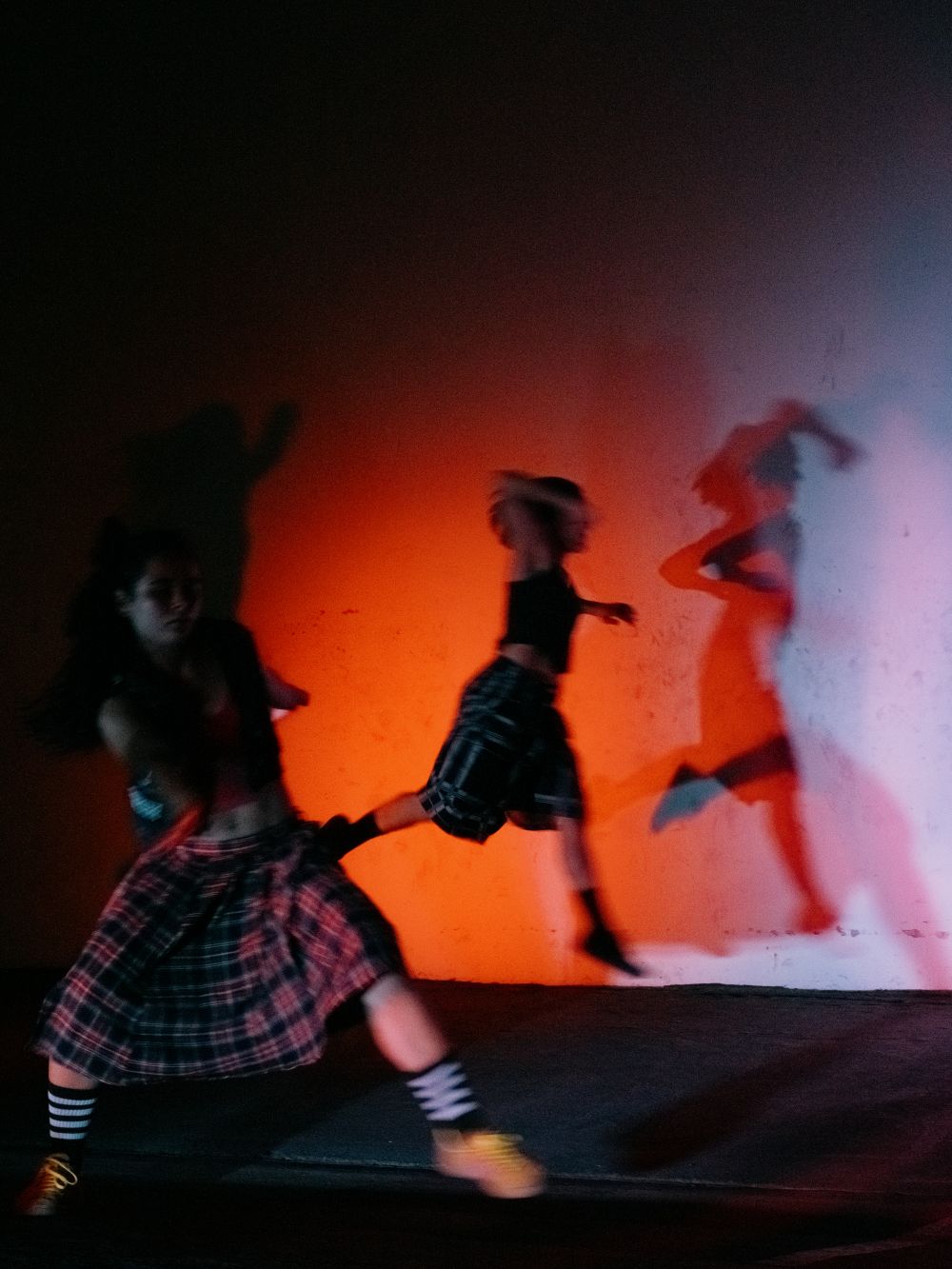
“Against the Wall,” Choreographed by Majella Bess – Photo by Luca Renzi.
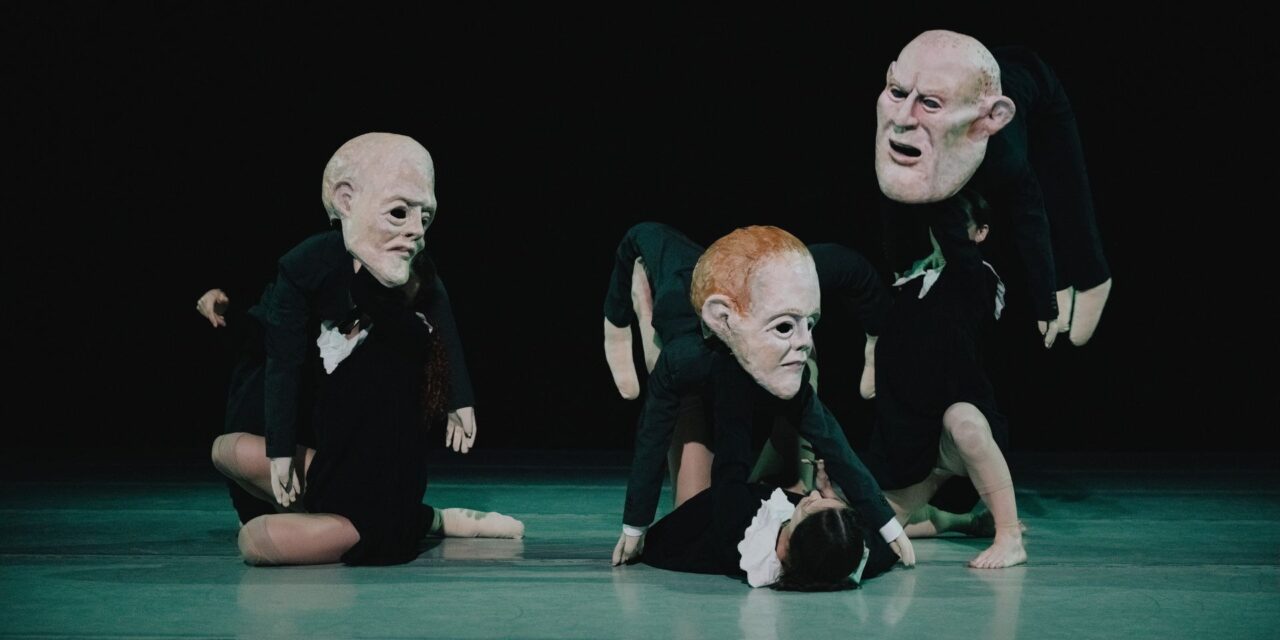
After intermission, “tell the truth and shame the devil: excerpt,” choreographed by zoe | juniper was a highlight of the evening. The commissioned score was by Xiu Xiu and featured three dancers, Isabella Caso, Caitlin Javech, and Melody Morrow, as well as three large male puppets with limp suits for bodies and giant heads. Initially, the performers manipulated the puppets with their feet to make them stand and sway. As loud pulsing techno music played, the dolls seemed to caress and crawl on their partners creating a nightmarish effect.
In the second portion of the piece, the dancers shed their black long-sleeved and collared dresses for tight white tank tops and heels. As they took control over their dolls and flung their bodies repeatedly at the floor, their actions caused audience members to cheer at this moment of revenge. The dancers played with contrast between sexiness and horror as they ripped off their shirts and slithered their bodies around while wearing the horrific heads. They moved extremely slowly in a phrase that grotesquely simulated sexual domination, before repeating the phrase in frantic hyperspeed while moving towards the audience for a grand finish. “tell the truth and shame the devil: excerpt” felt influenced by the avant-garde Butoh dance style which leans into the bizarre and often moves in ultra-slow speed to dissonant sounds. They critiqued patriarchy by becoming caricatures of its darkest desires.
“In the Space Between Falling” was a beautiful duet danced and performed by Sam Cool and Sam Fine. They interacted with each other, first at a table and later in the space, utilizing intertwining and sliding gestures. Often, it felt like they played with trial and error – they would wrap in one way, then unwind, and then explore a new pathway. It seemed to fit into the exploration of developing trust and connection that the piece explored. As they moved in the space, they executed impressive floorwork with exciting sudden moments of stillness. There was a contrast in their movement vocabulary and interactions between athletic and tender. Their synchronicity, particularly in a section as the music faded and ceased to provide timing, was impressive.
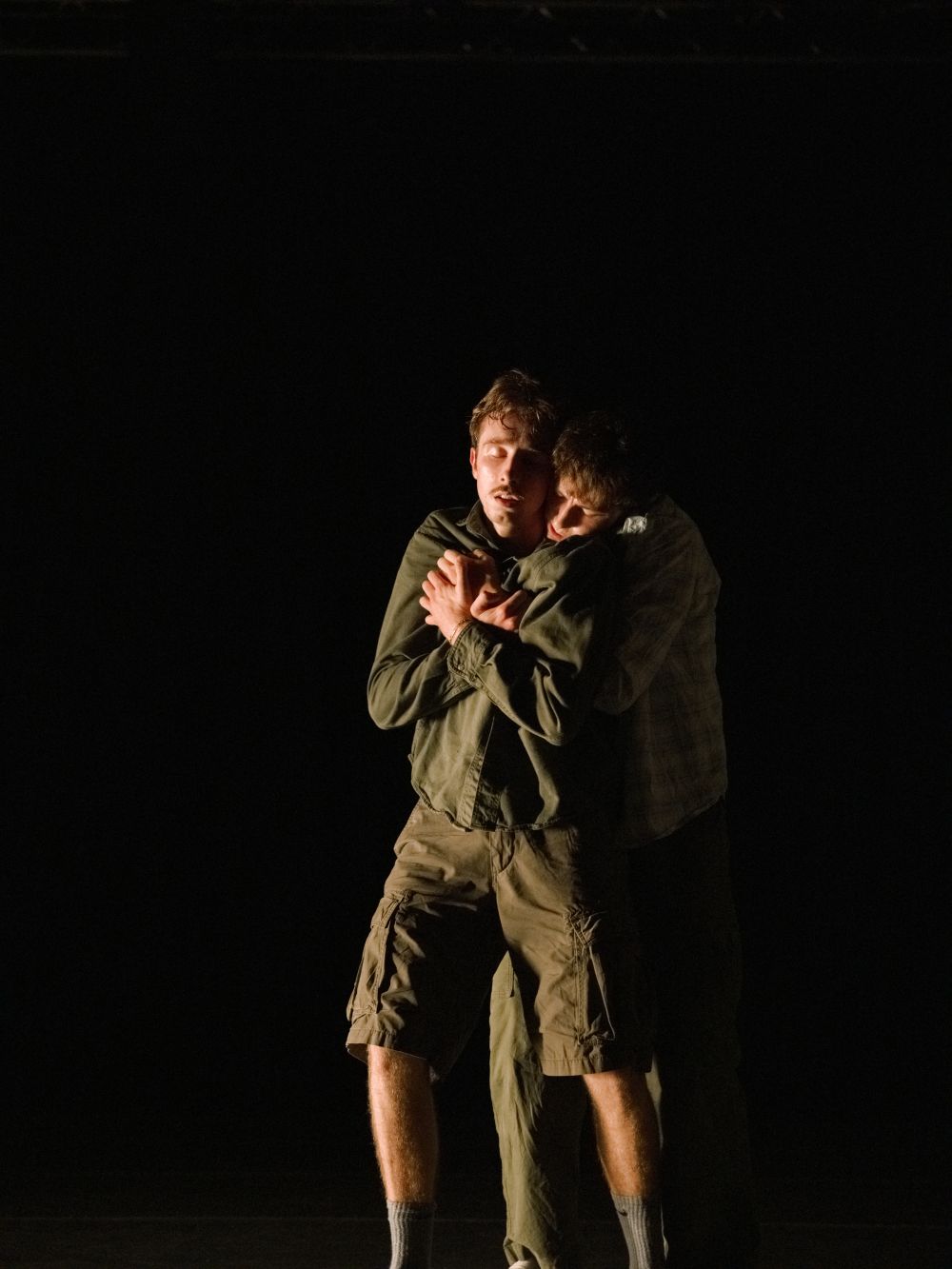
“In the Space Between Falling,” Choreographed and performed by Sam Cool and Sam Fine – Photo by Luca Renzi.
The final work of the evening, “Stroke,” was the second MovementFest LA creation and was choreographed by Mike Tyus and Diego Vega Solorza. Live cello music with electronic looping and manipulation performed by Max Judelson. The first section of the piece used the formation shifts and changes, as well as the softer movement quality, to express a sense of exploration. In the second half, which incorporated long wooden poles, the dancers were more decisive and powerful in their movements and in the patterns and pathways of their bodies in the space, as if they had found each other and assembled for a greater purpose.
While there were moments of complexity, one of the most mesmerizing moments of the “Stroke” was when the dancers executed simple gestures and circular reaches in a line, with every other dancer going the opposite way. This motif amplified as the dancers did more complex undulations, weaving through each other, falling and recovering, and moving slowly toward the audience for a hypnotic effect.
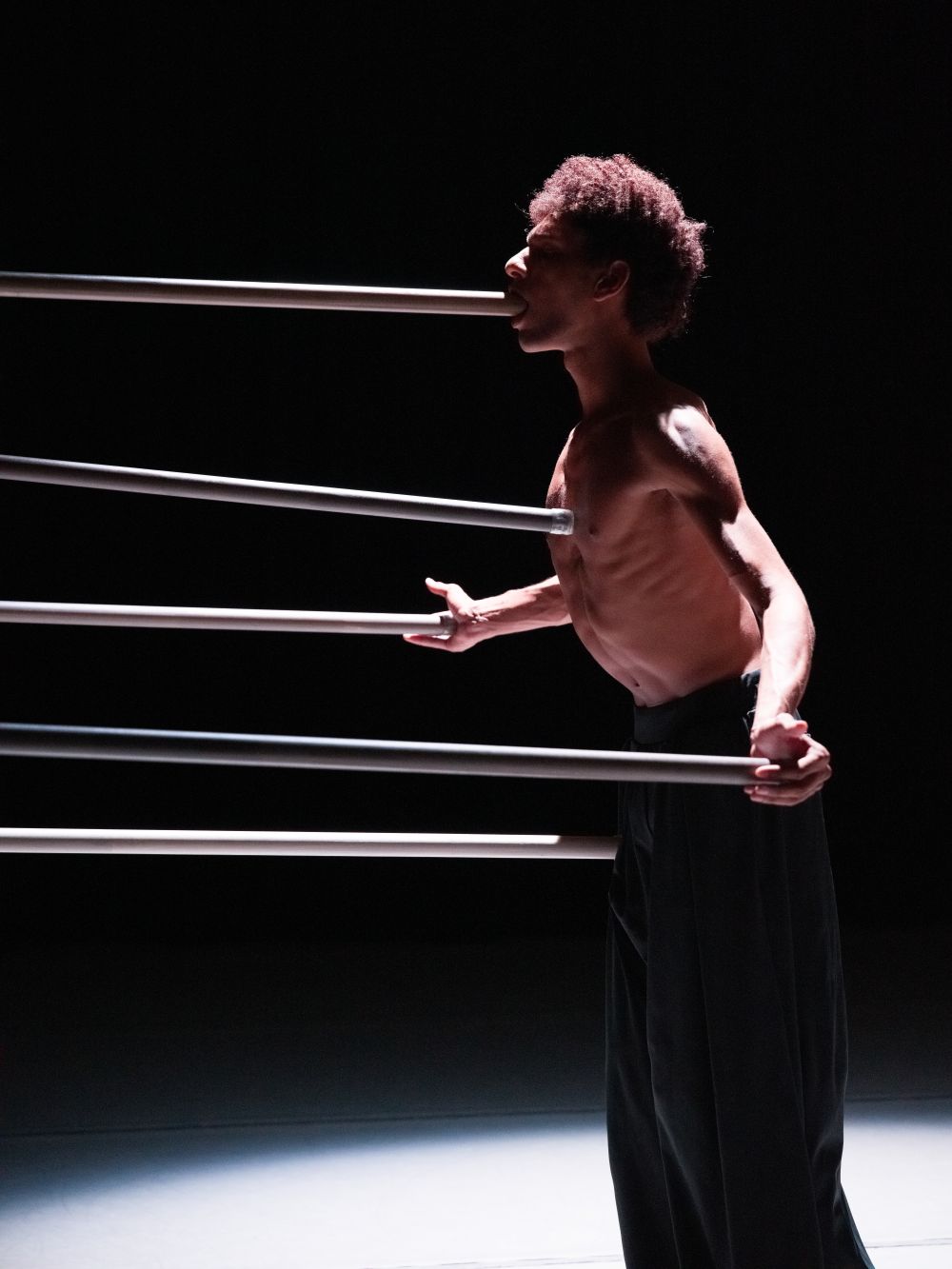
“Stroke,” Choreographed by Mike Tyus and Diego Vega Solorza – Photo by Luca Renzi.
The second half incorporated the long poles and I enjoyed the various ways the dancers explored these props. In one moment a dancer was surrounded by two squares of poles, held by dancers. As she traveled, the dancers holding the poles shifted the ends up and down and it looked like they were weightlessly orbiting her. In another moment, two dancers were pinned in space by the poles, and we watched them walk while reacting and interacting with these pressure points. I enjoyed the finale section, where the dancers used the poles percussively as they moved with intensity and tension to match the music. In some moments, the poles amplified slight differences in timing, however given the time frame of rehearsal, these moments were impressively rare. I would enjoy seeing this piece developed further – it felt like we had gathered and built an army, and I wanted to see where they would go next. The piece was danced by Meena Manoj, Chloe Rauch, Robert Cizak, ava desidero, Amelle Amirouchi, Ava Burkin, Sugar Stanley, Nia McKnight, Ava Carpinello, Oryx, Anna Schlueter, Caiyel Thomas, Desha Silberstein, Sage Melton, Jada Folarin, and Jagger McCloud.
MovementFest LA is presented and produced in partnership with LADP Presents, the programming arm of L.A. Dance Project dedicated to supporting non‑repertory work, community programming, and collaborative initiatives. Through this partnership, LADP provides venue support, technical resources, and institutional and marketing infrastructure that help bring the festival to life. (LADP press statement)
For more information about MovementFest LA, please visit their website.
For more information about L.A. Dance Project, please visit their website.
Written by Rachel Turner for LA Dance Chronicle.
Featured image: “tell the truth and shame the devil: excerpt,” Choreographed by zoe | juniper – Photo by Luca Renzi.