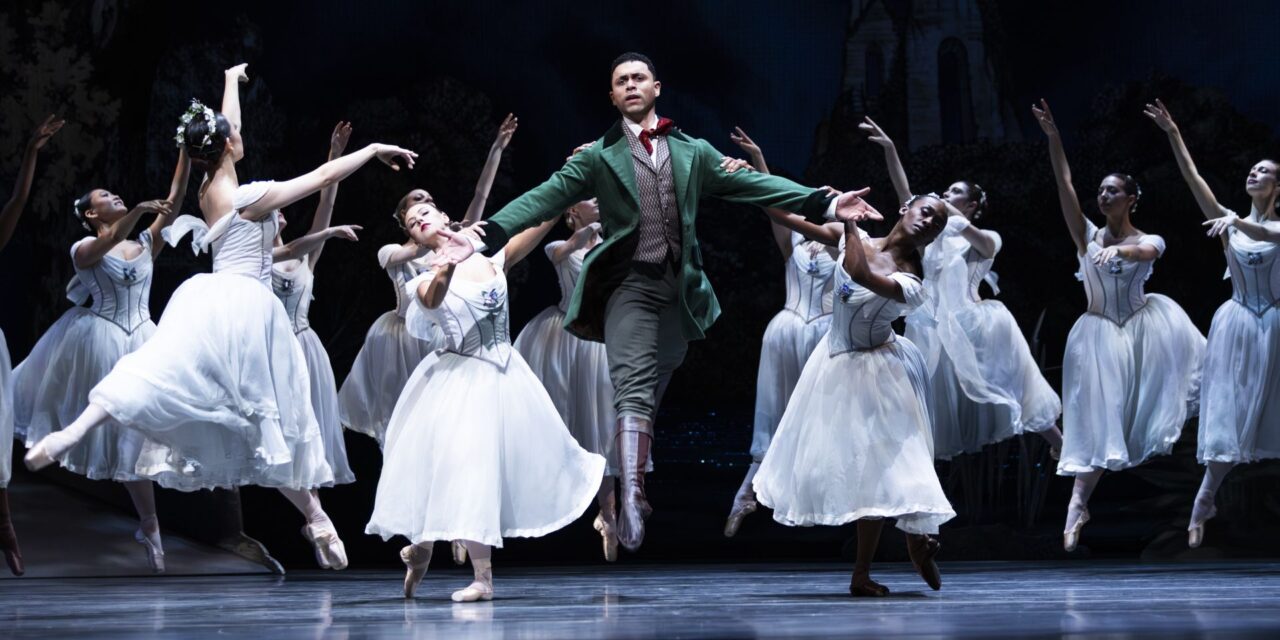
From its first pastoral sigh, Pacific Northwest Ballet’s Giselle unfolds with a breadth of beauty and clarity, reclaiming this Romantic classic in its full ethereal dimension. Rooted in the original choreography of Jean Coralli, Jules Perrot, and Marius Petipa, and artfully expanded by Artistic Director Peter Boal, the production transports us to the mid-19th-century world of Carlotta Grisi and the Paris Opera.
Guided by the scholarship of Doug Fullington—one of the few fluent in Stepanov’s notation—and Marian Smith, musicologist and scholar, the production achieves rare historical precision. Their work restores gesture vocabulary, clarifies mime, and challenges the received versions of the ballet we think we know. The result is not simply reconstruction, but reanimation—an immersive return to the past that briefly eclipses today’s cacophony.

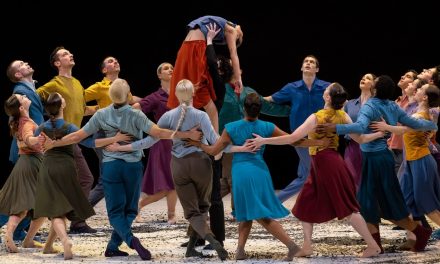
Pacific Northwest Ballet principal dancers Elizabeth Murphy and Christopher D’Ariano as Giselle and Albert, with PNB company dancers in Peter Boal’s acclaimed staging of Giselle – Photo by Angela Sterling.
Act I unfolds both as idyllic and quietly foreboding, framed by Jérôme Kaplan’s evocative sets and costumes. The pastoral village—washed in wheat, blue, and muted gold—stands in subtle contrast to the ominous realm of the fabled Wilis. Adolphe Adam’s lilting yet dramatic score, conducted with sensitivity by Emil de Cou and the PNB Orchestra, underscores the emotional contours of this Slavic legend, drawn from a poem by Heinrich Heine. At its center, Elizabeth Murphy’s Giselle, delicate and ethereal, emerges as a portrait shaped more by lyrical restraint than dramatic volatility.
Christopher D’Ariano’s Albrecht, a Duke, disguised in rustic peasant tones, approaches the role with refinement rather than danger. His courtship unfolds through soft phrasing and technical excellence instead of layered tension—elegant, though at times lacking the urgency that propels the drama forward. The familiar flower game, “He loves me, he loves me not,” lands with quiet inevitability, though without the deeper sense of dread that can foreshadow the ballet’s tragic turn.
The full corps, beautifully rehearsed and working almost as one, establishes itself early as a defining strength. Village dances unfold with relaxed musicality, unhurried and spacious, allowing the choreography to breathe. A particularly buoyant pas de deux emerges amid the festivities which has a story in itself. Clara Ruf Maldonado and Kuu Sakuragi deliver crisp beats, fleet footwork, and finely articulated turns, injecting the scene with welcome brilliance. The peasant corps responds organically, at times forming windmill-like patterns before resolving into sculptural groupings that frame the central couple.

Pacific Northwest Ballet principal dancers Elizabeth Murphy and Christopher D’Ariano as Giselle and Albert, in Peter Boal’s acclaimed staging of Giselle – Photo by Angela Sterling.
Murphy’s Act I strength lies in her vulnerability, supported by an unforced technique. Comparisons to iconic Giselles—Alicia Alonso, Natalia Osipova, even the dramatic ballerina, Nora Kaye—inevitably arise, though Murphy does not attempt their amplitude. Instead, she leans into simplicity, crafting a Giselle defined by softness rather than volatility. While this lends an appealing sincerity, it also tempers the emotional stakes; her unraveling, though thoughtfully shaped, does not fully rupture the world around her.
The dramatic turn is precise. The hunting party’s entrance—bold in red—fractures the pastoral calm. When the powerful presence of Dammiel Cruz-Garrido as Hilarion, deeply in love with Giselle, exposes Albrecht’s deception, the atmosphere tightens. Giselle’s descent from naiveté to disbelief and finally madness is restrained yet profound. Her disorientation is revealed with gestures that repeat then fragment, and the flower’s verdict haunts her final moments. By the time she collapses in her mother’s arms—tenderly portrayed by Elle Macy—the tragedy feels inevitable.
Act II then shifts into a stark, moonlit forested world. The Wilis gather like mist, their synchronization chilling in its precision. Here, the production finds its strongest visual and structural cohesion. Under Myrtha’s command, they operate less as individuals than as a single, implacable force.
Melisa Guilliams’ Myrtha is commanding and incisive, her authority expressed through expansive jumps and unwavering stillness. At her side, Moyna (Juliet Prine) and Zulmé (Ashton Edwards) form a formidable second tier, leading the Wilis with unified purpose in their vengeful mission. In contrast, D’Ariano’s return as Albrecht, though sincere and technically clean, lacks the amplitude of desperation that defines the role at its highest level. His grief registers, but remains contained within a limited emotional range.

Pacific Northwest Ballet principal dancers Christopher D’Ariano and Elizabeth Murphy as Albert and Giselle, in Peter Boal’s acclaimed staging of Giselle – Photo by Angela Sterling.
Murphy’s Giselle in Act II continues her commitment to lyricism. Her phrasing is gentle, her presence elusive—appearing, dissolving, and returning. Yet the role’s technical demands occasionally reveal strain. The classic central extension wavers for just a moment, breaking the illusion, then is recovered to move on with emotional clarity.
The Wilis’ vengeance drives the act with increasing force. Hilarion’s fate is relentless, and Albrecht’s entrechats, clean and constant, signal the characters fatigue and dance to his death. Yet the ballet’s emotional core resides in Giselle’s intervention. She cannot overcome Myrtha, but is able to delay the inevitable. Love, here, does not conquer death—it merely softens its terms.

Pacific Northwest Ballet corps de ballet dancer Melissa Guilliams as Myrtha, in Peter Boal’s acclaimed staging of Giselle – Photo by Angela Sterling.
As dawn breaks in stillness, the clock strikes four. The Wilis vanish, and Giselle fades with them—her final farewell marked by a quiet descent into her grave. Albrecht remains as his squire, (Jory Luther,) and fiancée, (Lily Wills), join him; she reaches toward him as he reaches toward the grave, a gesture of quiet resignation rather than cathartic release. It marks a subtle departure, where Albrecht often collapses onto the grave, shrouded in his black cape—an image so memorably realized by Erik Bruhn in a final, dramatic farewell.
Pacific Northwest Ballet’s Giselle succeeds through clarity, musicality, and deep respect for the work’s historical architecture. Yet its dramatic and interpretive restraint at its center keeps the production from achieving the full emotional devastation the ballet can deliver. What lingers is not overwhelming tragedy, but a refined, carefully rendered meditation on love and loss—graceful, intelligent, and ultimately held at a distance.
For more information about Pacific Northwest Ballet, please visit their website.
Written by Joanne DiVito for LA Dance Chronicle.
Featured image: Pacific Northwest Ballet soloist Dammiel Cruz-Garrido as Hilarion, with PNB company dancers, in Peter Boal’s acclaimed staging of Giselle – Photo by Angela Sterling.