The car engine hums, and the radio static hisses in the background. In the audio soundscape, a voice pierces through the car’s rumble. The voice talks about someone they grew close to and who is no longer there. There is an empty seat in the car and in their heart.
Indigo Dance Company’s “Don’t You Remember?” at Highways Performance Space on March 20 and 21, 2026, grapples with the emotions tethered to a person who is no longer there. The contemporary project-based dance company, led by Dani Burd and Madi Thomas, approaches this feeling of loss with direct and abstract movement. The choreography by Burd, Thomas and the company’s movement collaborators (Abbey Raymond, David Bernal Fuentes, Elsie Neilson, Gia Bella, Mara Hancock, Jen Vieweg, and Sammy Macias) showcases each dancer’s artistic style in a movement collage. The final product has some hearty moments, but the narrative sometimes gets lost in the abstraction. The road ahead of the car seems foggier than promised.

Indigo Dance Company in “Don’t You Remember?” – Photo by Madison Stonefield.
Following the immersive moment in the car, the doors open and the roof lifts. The dance utilizes the remnants of this metaphorical car to branch out separate scenarios associated with a drive without a loved one in the passenger seat. At times, the unified movement phrases and colliding bodies feel far too distant from the original narrative. Although abstraction is definitely welcome, it still requires a grounding truth. Here, it is a loss, but the person is a bit ambiguous. Did an accident happen? Was it a breakup? Did a best friend move across the country? The show demands that the quiet part be said out loud. Without it, the abstract movement loses its texture. For example, an emotive connection between two dancers on stage loses its prowess. Is this hug one with someone who passed away or someone who broke the other’s heart? The distinction is important because the different hugs hold different weights. Without the truth of the situation, the abstraction fully dissolves the narrative (and the car).

Indigo Dance Company in “Don’t You Remember?” – Photo by Madison Stonefield.
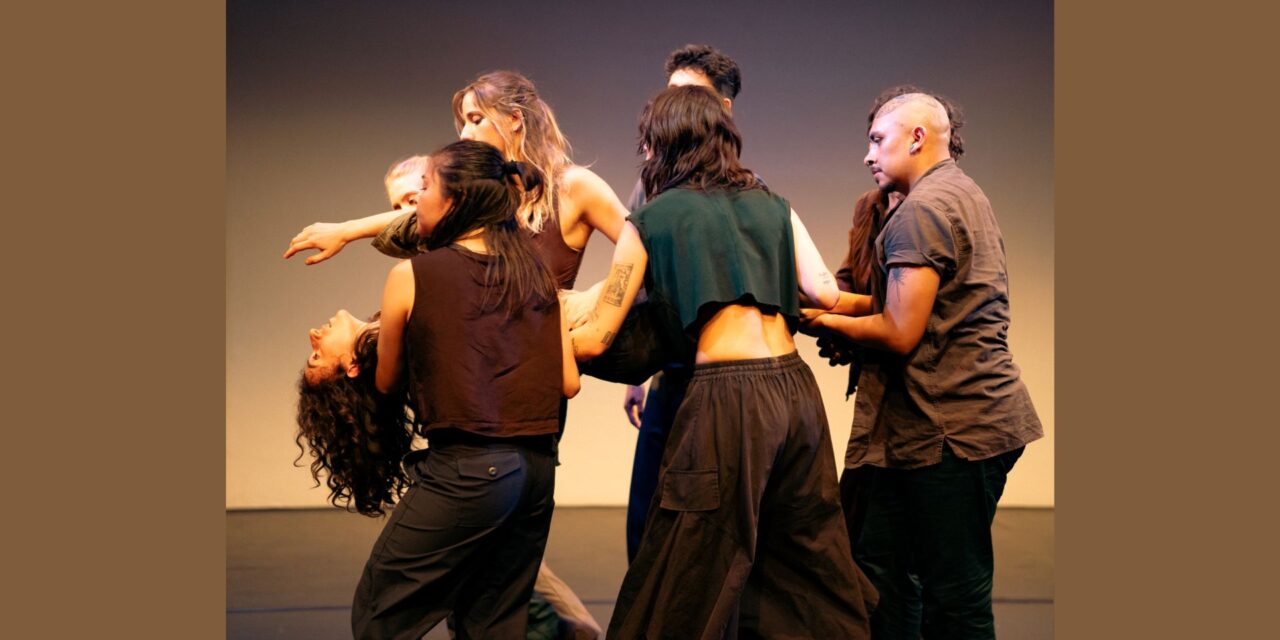
Despite the ambiguity, “Don’t You Remember?” utilizes innovative theatrical conventions that give the work shape. In one section, Raymond lunges diagonally, attempting to reach something—or someone. The other dancers keep her from making any progress, turning their bodies into obstacles she must climb and claw out of. Meanwhile, the ensemble’s formations are said aloud. One member at a time shouts, “Backward,” “Forward” and “Expand,” dictating the choreography. The work gains an exciting layer from moments like this one.
In addition to the car, the piece also introduces a phone motif. Throughout the show, people speak into a mock phone in their hands. These Easter eggs pay off in a scene where Macias struggles to talk on a phone call. Other dancers scatter around him, asking, “Are you okay?” His acting performance is mesmerizing and grounded. His vocal variety provides new interpretations of his emotional reactions to each question. His movement also varies, as he shifts from contemporary to popping.

Indigo Dance Company in “Don’t You Remember?” – Photo by Madison Stonefield.
The overall choreographic aesthetic is complex, revealing the sophistication of Indigo Dance Company’s work. Since their model is collaborative, the movement language lets the dancers embrace their individual styles. This approach creates a stark difference between the show’s unified phrases and the sections where the dancers peel away. Once unified with the same levels, steps and intentions, the dancers separate and reconnect to their own stylized movement, creating a dramatic transition into a new phrase. The dancers soon develop their own characters for the audience to follow.

Indigo Dance Company in “Don’t You Remember?” – Photo by Madison Stonefield.
Macias and Bella’s characters are particularly magnetic. The final section of “Don’t You Remember?” centers on Macias and Bella dancing and lip-singing to a live performance of “Angel from Montgomery” by John Prine and Bonnie Raitt. They have fun. Bella has a strong presence, connecting with the audience and turning the dance stage into a music festival set. She hitches onto each word and brings them to life with exuberant swings of the arms. Macias takes a more subtle approach, sauntering around Bella while upholding the same amount of intensity in his eyes and soft popping movements. Together, they sway their hips in unison and play around. The section is full of energy, emotion and fun.

Indigo Dance Company in “Don’t You Remember?” – Photo by Madison Stonefield.
Here, the car returns into view. A single spotlight is portrayed against the back wall, like headlights. When their fun comes to an end, they slowly walk toward it and then in opposite directions. A true separation. After such a high-spirited duet, this somber reality sinks in and clutches onto the heart.

Indigo Dance Company in “Don’t You Remember?” – Photo by Madison Stonefield.
“Don’t You Remember?” is a strong meditation on separation helmed by high-caliber dance elements. However, the show misses a detail of truth needed to ground its abstraction with the same weight presented at the beginning and end. The rattle of the car engine is still there; it just needs a nice rev.
To learn more about Indigo Dance Company, please visit their website.
For more information about Highways Performance Space, please visit their website.
Written by Steven Vargas for LA Dance Chronicle.
Featured image: Indigo Dance Company in “Don’t You Remember?” – Photo by Madison Stonefield.
Please follow us on Facebook, Instagram, BlueSky, and LinkedIn.