On a warm, breezeless evening in Los Angeles’ Arts District, a line gathered outside DIAVOLO | Architecture in Motion’s L’Espace. An intergenerational crowd—artists, supporters, families, and the simply curious—waited to enter a world where risk is not merely spectacle, but a shared language. The occasion was ESCAPE, a private benefit supporting the company’s educational and military veterans’ programs, framing the evening within a larger ethos of resilience and collective responsibility.
Founded in 1992 by Jacques Heim, DIAVOLO has long occupied a singular space in contemporary performance, fusing dance, architecture, and acrobatic daring into a kinetic vocabulary that feels as engineered as it is choreographed. Known widely through America’s Got Talent and high-profile appearances such as the 66th Annual Grammy Awards, the company has mastered spectacle. Yet ESCAPE reveals something more essential: the invisible architecture of trust that sustains that spectacle.

Diavolo’s ESCAPE – Train – Photo by Cheryl Mann.
Upon entering the cavernous, heat-laden soundstage, audience members were immediately immersed in DIAVOLO’s world. Performers mingled freely, inviting interaction with their apparatus—steel jungle gyms, collapsible staircases, modular cubes—objects that would soon transform into instruments of both risk and design. Tentative at first, audience members were encouraged to engage physically, guided by dancers whose hybrid discipline draws from gymnastics, breaking, and contemporary movement. The boundary between observer and participant dissolved, reinforcing a central premise: risk, when shared, becomes connection.
This ethos underpins DIAVOLO’s work. The performers function as a living safety net, relying on acute spatial awareness and precise cueing. The true architecture here is not the steel, but the trust that binds bodies in motion.

Diavolo’s – ESCAPE – Train – Photo by Cheryl Mann.
Following a brief and disarming welcome from Heim, the performance opened with Emrose Seidenberg, a diminutive, flame-haired figure contained within a metal cage. What began as controlled exploration escalated into a breathtaking display of velocity and control. Seidenberg propelled herself across rotating bars, threading her body through shifting geometries with astonishing precision. Each airborne release carried palpable risk; each catch was exact. The audience’s audible gasps were not incidental—they were earned.
Equally striking was the ensemble’s role. Positioned with exacting timing, they served as both partners and protectors, forming an invisible grid of support. Here, DIAVOLO’s choreography reveals its rigor—intricate, disciplined, and visually compelling. Their staging rivals that of companies devoted solely to dance, yet DIAVOLO expands the form by integrating danger as an essential compositional element.

Diavolo’s ESCAPE – Train – Photo by Cheryl Mann.
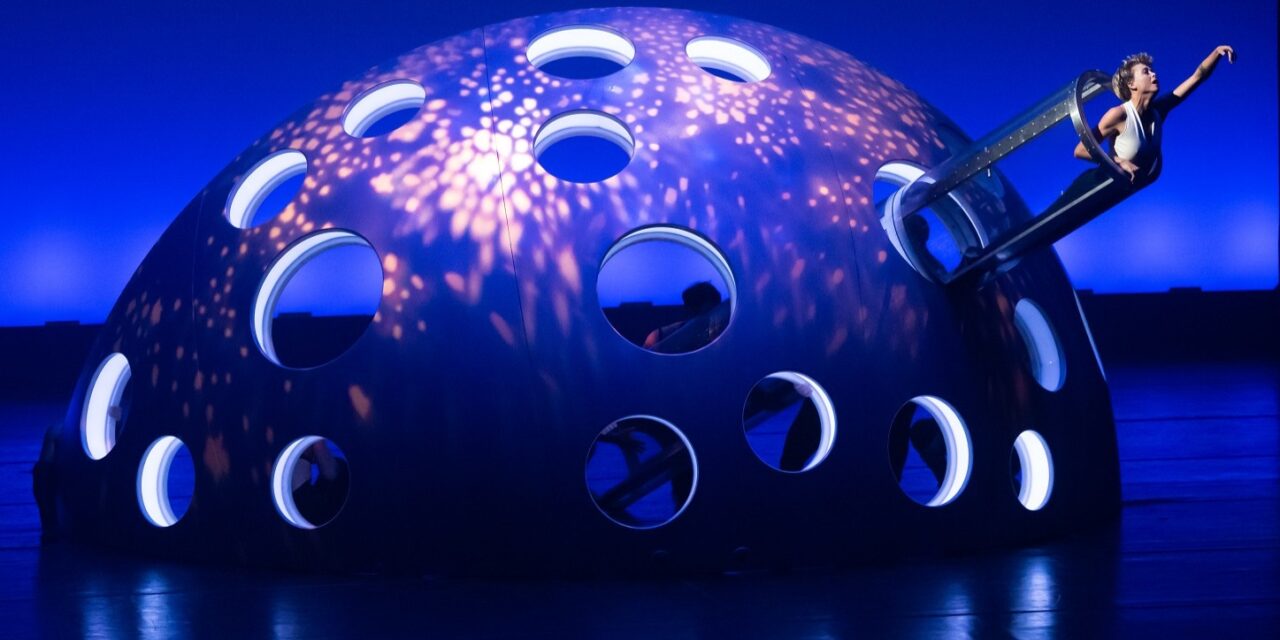
The work transitioned into a modular landscape of windowed cubes, where dancers appeared and vanished through apertures, punctuating the space with bursts of breath, impact, and exertion. The visual environment—industrial gray haze illuminated by saturated reds, blues, and stark whites—suggested a world oscillating between confinement and release. At moments, the density of imagery approached overload, yet the structural integrity of the work held firm.
This sequence expanded into large-scale ensemble architecture. Stacked cubes became a shifting staircase, then a train-like formation advancing toward the audience, its neon-lit edges framing fleeting human silhouettes before releasing them into cascading movement. The imagery, while direct, remained effective: emergence, transformation, dissolution.

Diavolo’s ESCAPE – Ramps – Photo by Cheryl Mann.
After intermission, the evening shifted tonally with the entrance of champion roller skater Chance Becker. His gliding presence introduced a welcome lyricism, carving fluid arcs through the smoky space. Where earlier sections interrogated risk through impact and velocity, Becker reframed it through continuity and control, offering a nuanced counterpoint that broadened the work’s emotional range.
Among the evening’s most resonant moments was the “Door Duet,” performed by Madison Moser and Aaron Franco. Here, DIAVOLO’s vocabulary distilled into something unexpectedly intimate. A single hinged door became both barrier and partner, facilitating climbs, suspensions, and precarious balances. Moser and Franco shaped the duet into a dialogue of resistance and reliance, their physical exchange grounded in emotional clarity. In this moment, DIAVOLO’s language approached a form of contemporary partnering that, while far from classical ballet, echoed its core principles of trust and shared weight.

Diavolo’s ESCAPE – Trajectoire – Photo by Mattia Di Niro.
Throughout, the company demonstrated a remarkable unity of purpose. This was not ensemble work in a conventional sense, but a continuous negotiation between risk, form, and collective responsibility. Each performer operated with precision while remaining acutely responsive to the shifting demands of the group. The stakes were immediate, tangible, and shared.
The evening culminated in DIAVOLO’s signature work, Trajectoire. Centered on a massive crescent-shaped structure resembling an ark, the apparatus tilted and shifted precariously under the performers’ weight. Bodies slid, collided, and launched across its surface with breathtaking audacity. Without warning, dancers hurled themselves into space from its highest point, defying gravity and expectation alike.

Diavolo’s ESCAPE – Wheel – Photo by Cheryl Mann.
And yet, ESCAPE ultimately succeeds because it does not rely on spectacle alone. DIAVOLO reframes risk not as individual bravura, but as a communal act—one predicated on trust, timing, and mutual accountability.
If there is a critique, it lies in moments when visual density competes with clarity. Yet even in these instances, the company’s commitment to its central principle remains unmistakable. Trust is not an accessory to the work—it is its foundation.
In an era when scale often substitutes for meaning, DIAVOLO offers a more compelling proposition: that the most daring act is not the leap itself, but the collective agreement to catch.
Cast: Dancer/Acro/Breakers, Skater, etc.
AJ Guevaa, Aaron Franco, AJ Guevara, Caribay Franke, Chadwick Gaspard, Chance Becker, Claire Schick, Co-el Rodriquez, Daemion Marcuz, Emily Grable, Emrose Seidenberg, Evan Hernandez, Gabriela Collazo, Isabella Reveles, Juesta Lewis, Jose Arietta Cuesa, Karah Haug, Kate Dougherty, Madison Moser, and Kittrel Poe.
Ryan Ruiz (Assistant Choreographer & Rehearsal Director)
Kate Dougherty (Associate Choreographer)
Caribay Franke (Project & Production Manager)
Co-el Rodriguez (Education Programs Director)
For more information about DIAVOLO | Architecture in Motion, please visit their website.
Written by Joanne DiVito for LA Dance Chronicle.
Featured image: “Voyage” – DIAVOLO Architecture in Motion – Musco Center for the Arts – Photo by Doug Gifford.