
On May 22, 2026, Highways Performance Space presented BEHOLD!, showcasing five different works exploring themes of queerness and highlighting artists within the LGBTQ+ community. Highways Performance Space has uplifted emerging artists in alternative, boundary breaking work for the past 37 years which is a testament to their success as an arts and culture hub for the Los Angeles community.

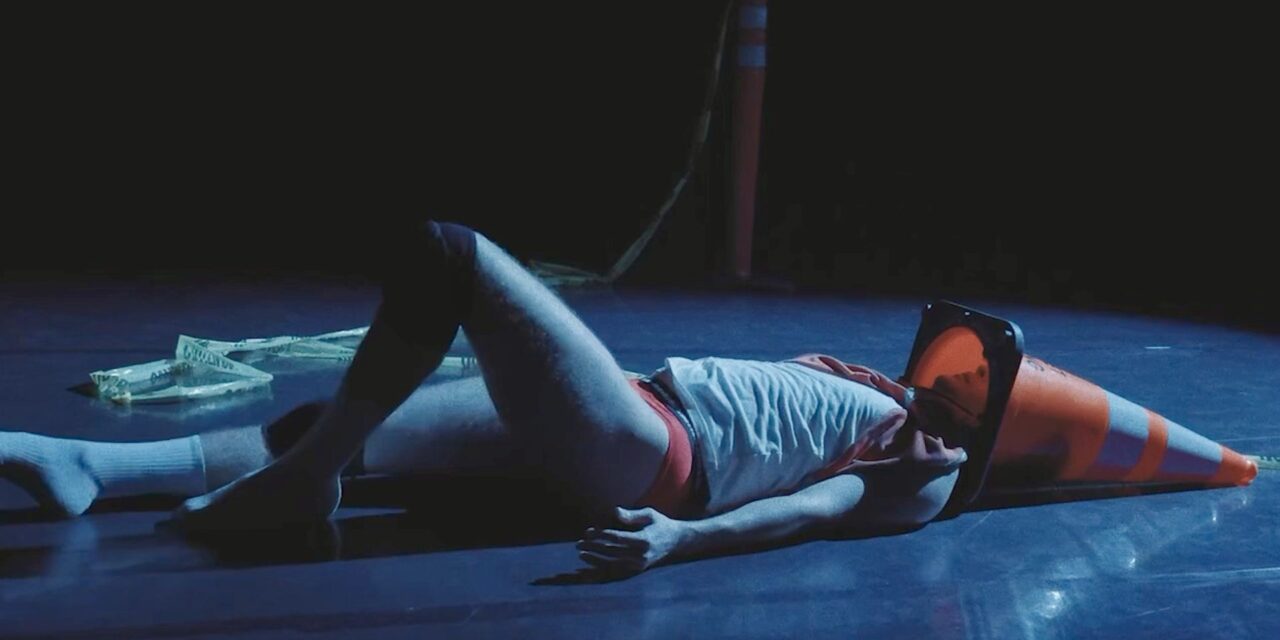
BEHOLD! – Avery Polster in “Hit and Run” – Photo by Patrick Kennelly.
Upon entering the black box style theater, caution tape and traffic cones create a triangular boxing ring, thematically alluding to the precarious nature that breaking stereotypes and boundaries might come with. The solo accompanying the set was titled “Hit and Run,” choreographed and performed by Avery Polster. The dancer began within the boundary set up on stage, moving within the confines of literal and metaphorical caution. Conceptually, I had high hopes for the arc of this work but was soon taken aback by the sudden and explicit sexual imagery created by the dancer and the traffic cone. Art of any medium is a reflection of one’s human experience. And while sex is innately human, its presence will inherently either blossom or bare its teeth in the seams of the work. This solo lacked clarity as to why these explicit images were repeatedly created, and simultaneously, had me questioning why a content warning wasn’t issued in the program regarding this work.

BEHOLD! – “careful where you step” by Eva Watson – Photo by Patrick Kennelly.
The following piece was the clever and dynamic work titled “careful where you step” by Eva Watson. The dancers, Divya Ahuja, Baylee Ferrera, and Alondra Perez moved with bug-like instincts to a soundscape that reflected the buzz of an insect. Comedic elements of tongue-in-cheek spoken word complimented the mature and grounded movement that came from the dancers and choreography. Details such as a hand fluttering to reflect an insect’s wing, or the bug-like glasses the dancers wore gave an intelligent and quirky touch to the piece which kept me engaged and wanting more. I’d love to see this work expanded upon in any capacity as the research and direction feels clear.

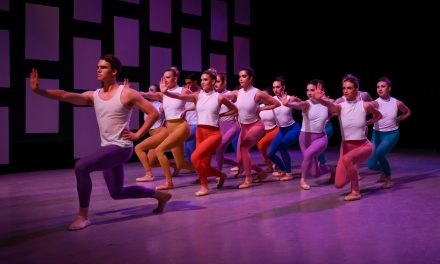
BEHOLD! – Amina Yufanyi, Celine Kiner, Isabelle Boyer, and Beth Huelsenbeck in “WYRD” Choreography by Keli Gunn – Photo by Patrick Kennelly.
“WYRD” choreographed by Keli Gunn in collaboration with the dancers Amina Yufanyi, Celine Kiner, Isabelle Boyer, and Beth Huelsenbeck began with spoken word of intimate internal thoughts such as, “I just want everyone to know how much I love her.” Two dancers dressed in white and two in black, represented a duality of what I perceived to be a yin and yang like energy of masc and femme. Each dancer wore a harness which alluded to restraint in every aspect of identity. The dancers weaved in and out of duet and group work with fluid transitions and the choreography highlighted the use of each dancer’s strengths. There was a clear internal battle with the dancers as they concluded the work by exclaiming, “I am gutted and overstuffed all at once.” A somber, yet universal reality for many within the queer community.

BEHOLD! – “Ghost Riders” Choreographed and performed by Bruna Gill and Jules Mara – Photo by Patrick Kennelly.
Following Gunn’s work was “Ghost Riders” choreographed and performed by Bruna Gill and Jules Mara. Adorned in hats with delicate lace veils and gloves that extended the natural length of the dancers’ fingertips, the costume design which was also created by Gill and Mara brought this work to another level of excellence. The dancers moved in and out of the floor with ease while the tension built physically and emotionally. At one point, the performers in a pedestrian state, removed their accessories one by one, allowing just the blank canvas of themselves to be seen by the other. This moment was intimate, raw, and gloriously human. It was an image that I held onto for the rest of the night.

BEHOLD! – “Have you ever felt queer” Choreographed and performed by Maiana Abramson – Photo by Patrick Kennelly.
The evening closed with “Have you ever felt queer?” choreographed and performed by Maiana Abramson. Abramson entered the space with demand, fiercely strutting all the way downstage. Her presence was strong and her movement dynamics reflected this as well. Fluctuating between being sultry smooth and explosively strong, the ride of this piece was easy to follow as a viewer. Abramson explored the journey of queerness from adolescence to adulthood and how growing up is often just growing into the self that’s been there from the start. Her choreographic choices made this thematic message very clear. The highlights of the work was surely the opening and closing of the piece, both driven by stage presence and the willingness to be fully seen, for all that she is. Despite this work being strong, I do wish that the program order had varied from both opening and closing the show with solos.
As a queer artist myself, it’s refreshing to attend evenings that are dedicated to representing the LGBTQ+ community. Highways Performance Space fearlessly provides space to innovative and underrepresented communities of artists and it was a pleasure to attend a show in their venue once again. I look forward to seeing what each of these artists create next and to what Highways Performance Space presents in the future.
For more information about Highways Performance Space, please visit their website.
Written by Rebecca Lee for LA Dance Chronicle.
Featured image: BEHOLD! – Avery Polster in “Hit and Run” – Photo by Patrick Kennelly.




Rebecca Lee’s review did recognize the strength of several works in the evening, and she gave specific credit where she felt the artistic direction, performance, and thematic clarity were successful.
Regarding Avery Polster’s “Hit and Run,” she acknowledged the strength of the visual environment: the caution tape, traffic cones, and the sense of boundary, risk, and containment established within the space. She seemed to understand the conceptual frame of the piece and entered it with high expectations.
Where I part ways with her is in her response to the explicit sexual imagery and her suggestion that a content warning was needed. Highways has presented work engaging sexuality, the body, queerness, and transgression for nearly four decades. Within that context, the imagery she identified was not unusual or unexpected. Her response seemed shaped by a limited understanding of the sex-positive and body-positive performance traditions in which Highways has long operated.
While I respect her individual response, I do not believe her review fully accounted for the artistic, cultural, and historical context in which the work was presented.