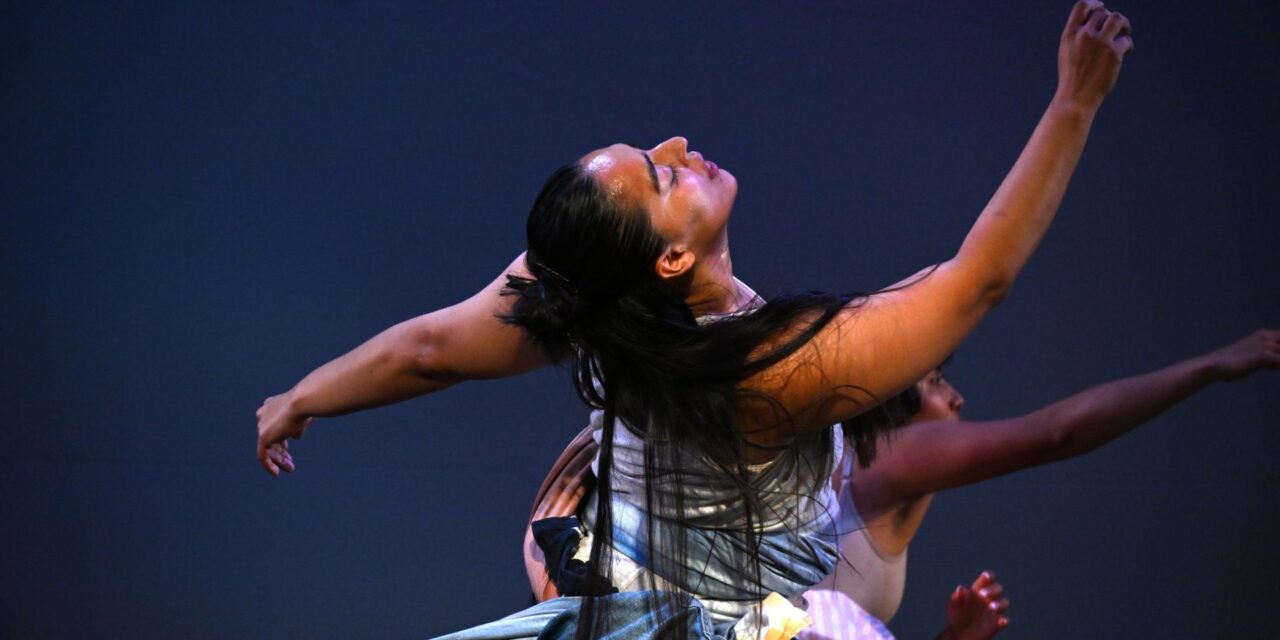
On the evening of June 12, 2026, I journeyed to Sierra Madre Playhouse to see CONTRA-TIEMPO showcase an early version of their new show, “Roots of Loving Us,” set to premiere in San Diego in October. The work presented felt pretty early in the process, so some of what I comment on might be things the director already has plans to work out. It was billed as a 60 minute performance, but what was shared was just about 40 minutes including some longer transitions and mid-show talking. The remaining time was dedicated to a small talk back to hear from the audience.
The first section featured the four dancers, holly johnston, Ruby Morales, Maria Garcia, and Amainary Contreras, each wearing slightly different colored costumes and giant headpieces. The headpieces were the size and shape of umbrella tops and covered the dancers’ heads. They were intricately decorated with layers of fabric and colored flowers, alluding to nature. The dancers walked down and around the aisles of the theater, circling the audience. I loved this slow introduction and immediate breaking of the fourth wall by entering our space, and the headpieces designed by holly johnston were visually striking.
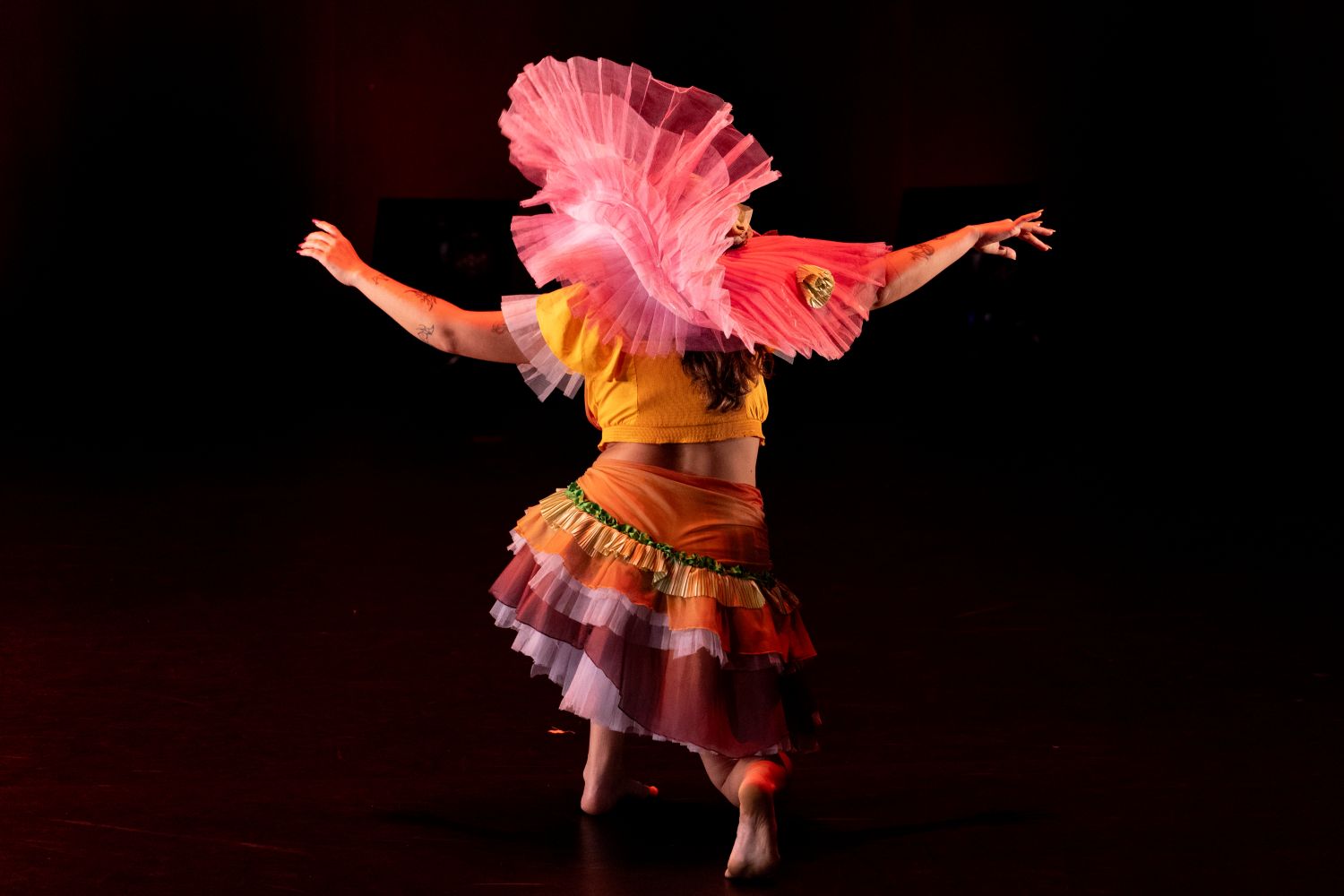
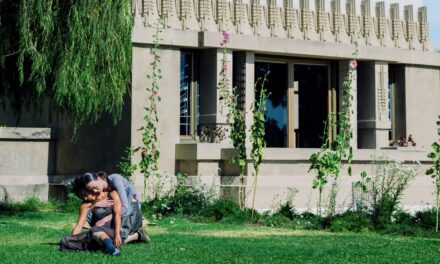
Contra-Tiempo – Dancer: Maria Garcia – Photo by Bailey Holiver.
Next was a duet between two of the dancers. At the start, one walked while the other, on the floor, held her ankles and seemingly holding her back. Much of the duet was separate, though at times their pathways seemed to carve out each other’s negative space. Both dancers used similar vocabulary including sweeping gestures, moments of suspension and release, and circular floorwork. In the silence, I loved the sounds of them sliding on the floor. The duet repeated a second time, this time with music. At times, one of the dancers sang along with the music to her partner, adding an enjoyable layer. I could see the origin of the timing the dancers had during the silence, but while setting the duet to music and removing it may have been part of the process, as a viewer it didn’t necessarily add much to see the material repeated. I didn’t see much difference in the performance or relationship between the dancers to explain the repetition.
The next duet was backed up by a projected video, by Meena Murugesan, of dancers on the beach, moving in the sand. The two dancers on stage were connected by a rope harness and they would counterbalance and pull away from each other in a variety of lunges, eventually crawling and circling while still attached. The sound featured echoing voices and singing, and I enjoyed the juxtaposition of the sound, film, and live dancing. The concept with the harness was a strong starting point for movement generation, but it didn’t really go anywhere and became less interesting to watch.
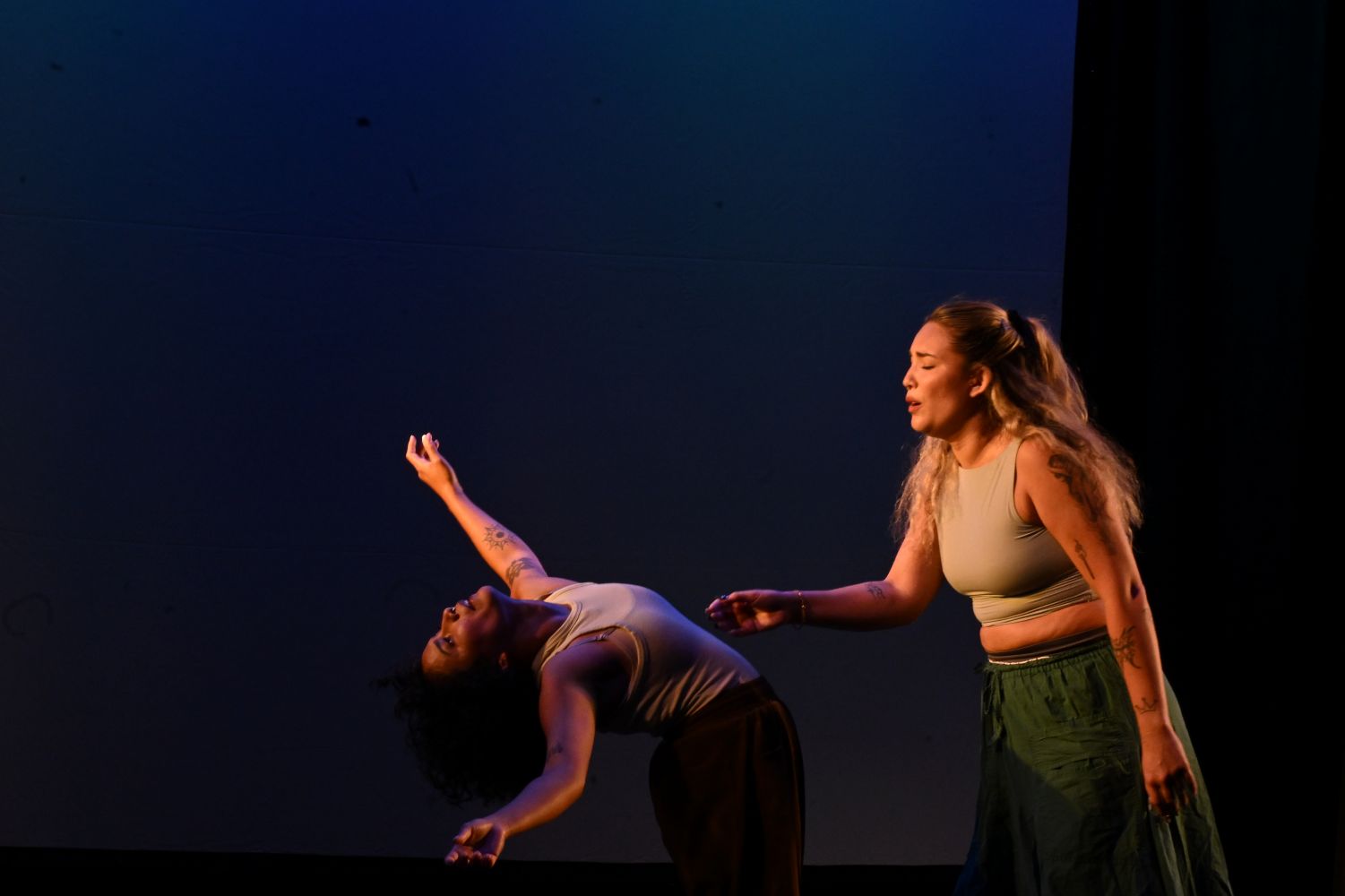
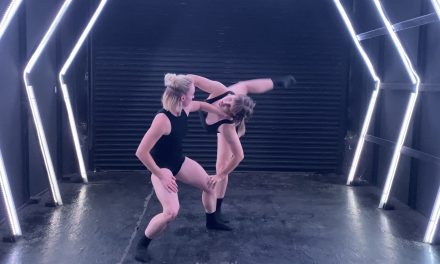
Contra-Tiempos – Maria Garcia and Ruby Morales in “Roots of Loving Us” – Photo by Jasmine Stanley-Haskins.
As this section ended, without much transition, one of the performers stopped and spoke to the audience. She introduced herself as holly johnston, the director of this work, and she talked about themes of the evening and what we were about to see. johnston is adopted and hoped to explore ideas of care, family, and love. “Love is like gravity” she said, “it is a force not a feeling,” meaning that it exists even when you don’t do anything. She also hoped to show the struggle and trial and error of love. As part of the process the dancers shared some of their identities and origins, and she explained that the next section incorporated their stories with her responsive movement.
This identity section incorporated a mix of live spoken word with pre-recorded speaking and music. johnston’s movement alongside the dancers entering and spacing was nicely done, filling the space and offering enticing visuals. However, I struggled to hear the dancers speak over the recorded voices and sounds, and what they said got lost. As CONTRA-TIEMPO works towards their full performance, I think this section is worth developing and extending.
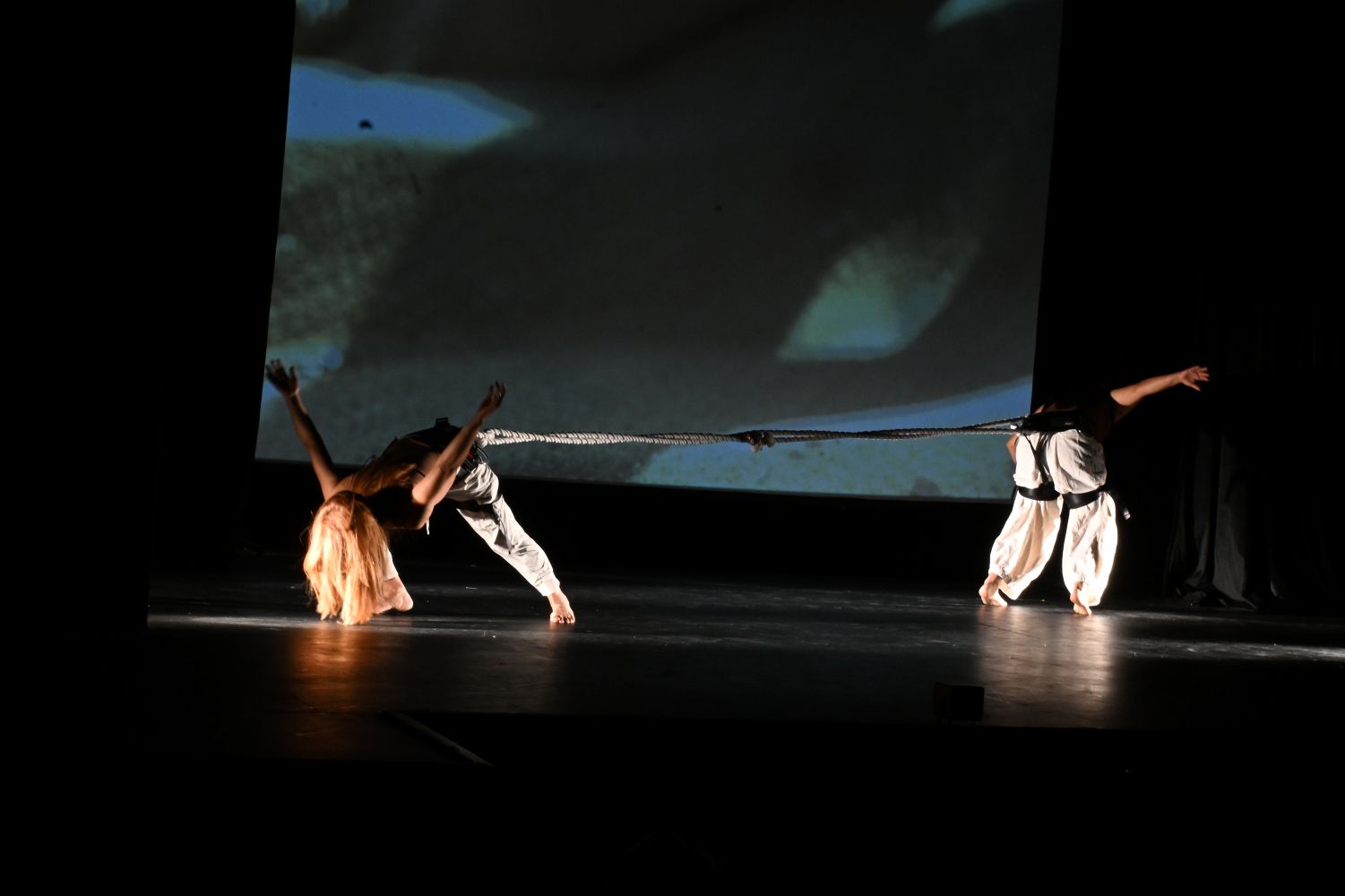
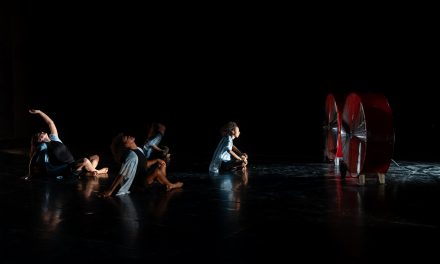
Contra-Tiempo – Amainary Contreras and holly johnson in “Roots of Loving Us” – Photo by Jasmine Stanley-Haskins.
The next work started with two dancers on stage, each harnessed into the end of a thick rope made of neutral-toned fabrics. They pulled against the ropes, leaning and moving slowly across the stage. Visually, this was compelling to watch, and the ropes were a beautiful prop, designed by Roulin Zhao. As the dancers moved, their anchors started to appear onstage. They were held by the other two dancers, seated and countering their weight to hold them up. The props were identified in the program as “umbilical cords,” an idea that was well brought to life. At times, the cord held and supported the dancers, preventing them from falling. In other moments, the cord was what prevented the dancers from moving forward. The same urge to hold and protect our children can feel like an anchor at times to a child ready to take on the world.
After they made it across the stage, they switched roles as the song repeated. I understood the idea here: at a certain point, the child begins to take care of and worry about their parent. As far as a performance, it was less interesting to see the same thing happen again. I loved the concept but would love to see it progress past the initial image.
Before the last section was another slow transition. The costumes the dancers wore were always similar loose pants and fitted tops – sometimes in brown or beige tones, sometimes in blues or greens. Changing into different costumes seemed to add transition time, but the use of colors in the costumes didn’t make much difference. There wasn’t any theatrical lighting used, so in a full production, lights could be used to change the appearance of the costumes while keeping the show flowing.
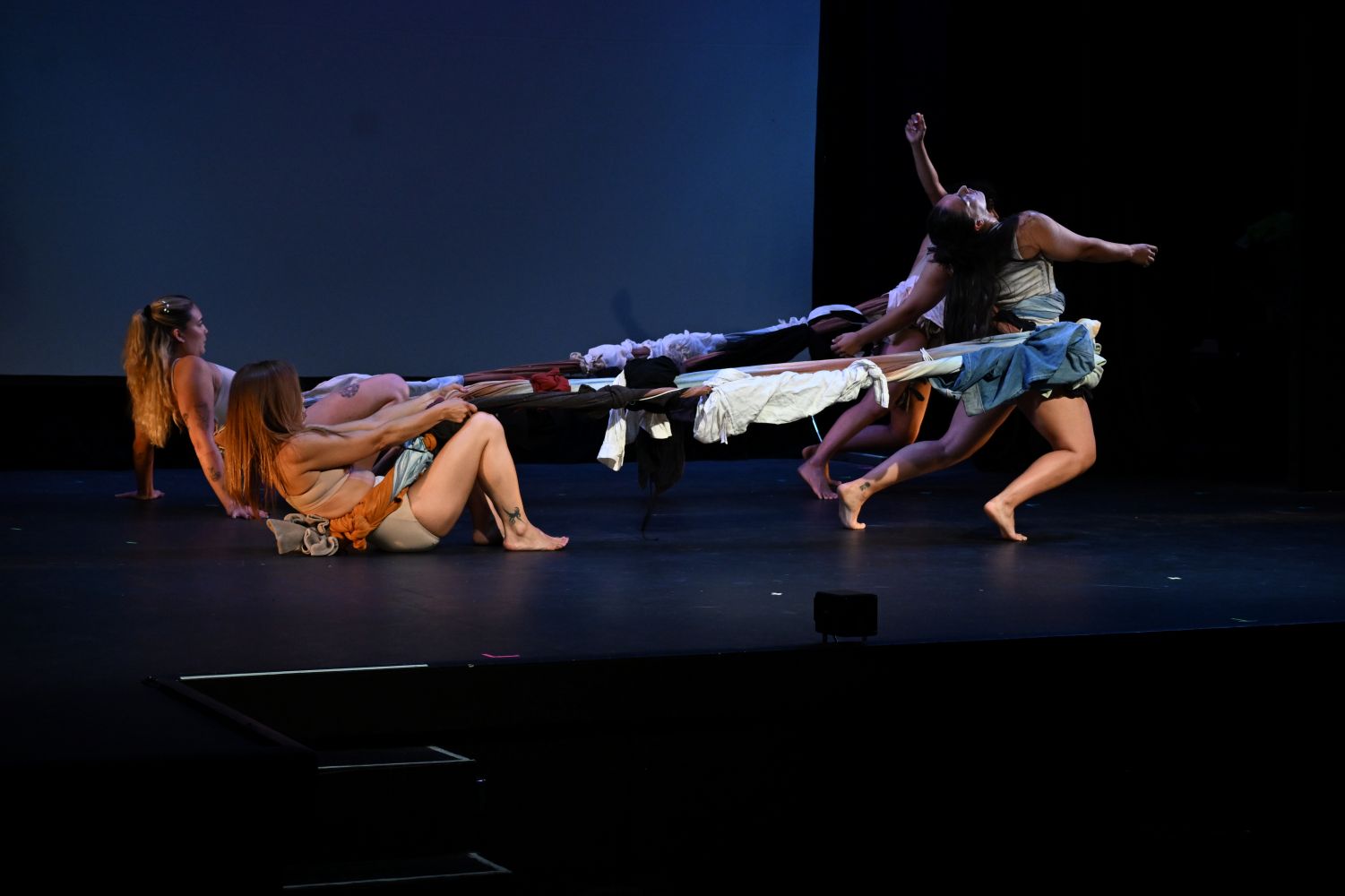
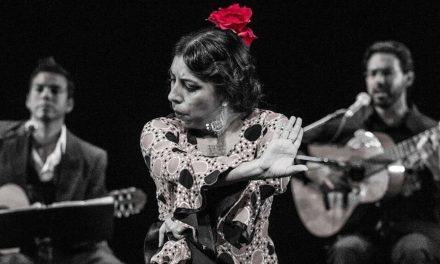
Contra-Tiempo – Amainary Contreras, Ruby Morales and Maria Garcia, holly johnson in “Roots of Loving Us” – Photo by Jasmine Standey-Haskins.
In the final section shared, the dancers let loose more and seemed to show more Afro-Latine movements and rhythms, part of CONTRA-TIEMPO’s dance language. The big sweeping modern-dance influenced circular reaches became smaller isolated circles of the hips or shoulders. This section in particular felt like it needed theatrical lights and colors to bring it to life. The dancers entered and exited for individual moments that overlapped, and eventually all danced on stage. At times they would see each other and smile or connect, and it would be interesting to consider developing making this choice happen at a certain point, showing individual growth that led to the ability to look outward. I enjoyed the movement individually but felt like, especially if this piece is the finale, it could use a bit more choreographic structure leading up to the ending for clarity.
The work shown was very much in progress but had some intriguing visual moments and ideas. The props were excellent and led to interesting movement prompts or challenges for the dancers to navigate. I think there is work to be done with the overall arc of the performance and especially with transitions. There were parts that went on longer than I felt necessary, but also parts where a lot happened and once and could be spread out to be more easily digested by the audience. The program notes that the piece brought ideas of somatic healing together with dance, and I think it would be meaningful to think about creating a seamless embodied experience for the audience with these practices in mind.
To learn more about CONTRA-TIEMPO, please visit their website.
To see the full season at Sierra Madre Playhouse, please visit their website.
Written by Rachel Turner for LA Dance Chronicle.
Featured image: CONTRA-TIEMPO – Amainary Contreras in “Roots of Loving Us” – Photo by Jasmine Stanley-Haskins.