The University Theater at Dominguez Hills is not a warm space. It is a vast concrete block structure reminiscent of a World War II bunker. That being said, the audience is raked, giving an excellent view of the stage and a perfect perspective of any dancer on it. The high proscenium makes for a majestic loft for the lighting and a dramatic open volume of space for the performance. It provides great sightlines for the viewing of movement.
What was lovely about this particular dance festival was its focus on pointe-work and the way it included Classical or Contemporary ballet into every piece. It was an amalgam of styles sometimes interwoven with ballet technique and sometimes adapting it into street and other disciplines entirely. There was, I dare say, something for everyone on this program. There were local companies presented along with dancers from Ballet San Antonio and Ballet Memphis.
“She who watches me” by The Realm Company with choreography by Chasen Greenwood opened the program. This was a relatively strong duet although three dancers were listed in the program: Melissa Briggs, Sarah Chan, and Mizuki Sako. The opening visual was dramatic with one dancer on her back in a center downspot in an accented arch. She begins with floor movement and twisting while the other dancer stands aloof facing upstage just out of the light spill. The dancer doing the floorwork wears flats while the other dancer is wearing pointe shoes. They engage in a ‘conversation’ of sorts and it becomes clear that the street style is meant to communicate and share equally with the classical ballet demonstrated via pointe work. This was an engaging and smart duet saying what it needed to and opening the dialogue between different dance styles from the outset of the program. Music by Taylor Briggs.
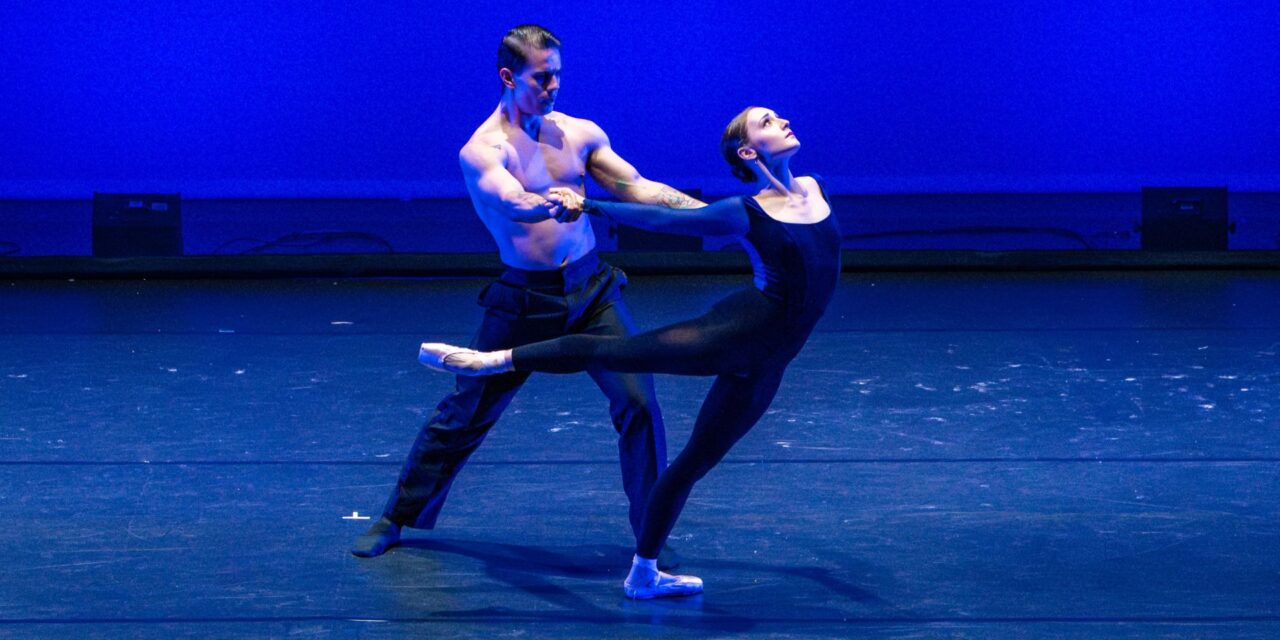
“We Become What We Behold” with choreography by Deanna Stanton was one of the highlights of the evening. This was a contemporary pas-de-deux performed very well by Luciano Perotto (courtesy of Ballet San Antonio) & Brenna Mulligan. His work here was excellent as his partnering was adept, strong, and perfectly at ease. There were many lifts that were made effortless by his attention and care in handling Mulligan. She was able to emote and relax in his partnering as well. The competency in handling such a pas-de-deux puts the audience at ease and lets us focus on the emotions and feelings made evident by the movement. When lowering her to the ground after an overhead press I was aware of her soft landing through her pointes and very much appreciated his effort in controlling that small aspect of a difficult move. Kudos to both of them! Music was String Quartet No.2 “Company”: I by Philip Glass.
“Seizing The Light” by the Nannette Brodie Dance Theatre with choreography by Nannette Brodie and Katelyn Potyondy. Music by Psychosonic and danced by Katelyn Potyondy. This was a solo to music that was hard-edge and percussive. Potyondy did an admirable job of keeping her movement and technique controlled which allowed for the choreography to read well. This solo was also on pointe and there were some difficult sections as the contemporary movement really put the pointe shoes to the test of durability. Potyondy is a dancer with very strong pointe-work. The costume for this piece was, what looked like to me, a sheer metallic work-out two-piece consisting of booty shorts and a bandolier top. All of this added to the virtuosity of the piece. The lighting however was a general wash that lit the entire stage from the beginning of the piece. As I described earlier, the stage has a vastness that should be taken into account, especially for a solo performer. What happens is that all of the negative space around the performer is lit and takes away from the focus on that solitary person. More specific controlled lighting would have helped this piece a great deal.

Balletfest2026 – Cayce Cavett, Demetrious Reed and Cassandra Thomas in “Blindsided” Choreography by Deanna Stanton – Photo by Scott Edwards.
“Precipice” by Ballet du Fou was another highlight of the evening. Choreographed by Misha Hill. Unfortunately, there was no biography of Hill on the “Participating Choreographers” list on the KWDP website. This piece had a very strong opening visual of seven women in funereal garb, black dresses, gloves and veils all surrounding a man in priestly robes. Off to the side there was a young man in light grey tights and top. The young man begins with a solo of lament. It is not clear if he is dying or dead or a spirit? The priestly character sees him however and goes to him to alleviate his suffering and there ensues a beautiful male pas-de-deux. All the while the funereal corps-de-ballet dance in unison and supply the punctuation to the drama unfolding between the priest and the young man. The partnering of the lifts as well as the acting between the two men was well done and tasteful representations of grief and lament. Dancers: Ian Roman, Ottavio Taddei, Morgan Davidson, Teresa Dietrich, Olivia Hamilton, Zooey Kraemer, Emma Sweeny, Brittany Yevoli, and Charlize Zavaleta. Music: Alessandro Marcello’s Oboe Concerto in D minor.
“Solas: Libertango,” with choreography by Robert Salas was a duet for two dancers: Catherine Fields and Brianna Turner set to the music LiberTango after Piazzola. As such the piece almost became something of a tango. It was not meant to be of course but only took that route in order to explore what contemporary movement could say about such a time-honored dance style. There were moments acknowledging the tango, but the point was something more subversive. The costumes were black with red sashes and accents with the back scrim bathed in red light. The black costumes against the red backdrop made the dancers pop from the background. The relationship between the two dancers developed throughout the piece making me wonder where it was going. The movement was contemporary with flashes of tango thrown in and this would have been enough were it not for the insistence of the music. At times, the choreography was overcome by the music in crescendo or heightened rhythm. At others, the dynamic was well-matched and accomplished.
“Razor’s Edge” with choreography by Gabriella Padilla ended the first half of the program. This, interestingly, was in line with “Solas: Libertango” in that the four dancers were costumed in black and red against a red backdrop and had an air of sultry sensuality to their movement. This one, however, was based in classical ballet vocabulary as all were wearing pointe shoes. Certainly “Razor’s Edge” could be a substitute for pointe work as you are either on or off your pointe, there is no in-between. Padilla’s “Razor’s Edge” served to showcase the various strengths between the four dancers: Antoinette Wood, Sterling Tu, Kassandra Vogel, and Gabriella Padilla. All have strong pointe work and used it to their advantage. Music by Martina Topley-Bird was contemporary and placed this work in more of a ‘music video’ category rather than concert dance.
“Blindsided” was a quartet choreographed by Deanna Stanton and featured the best pointe work of the evening. Dancers Iori Araya and Cassandra Thoms had beautifully executed pointe work and were confidently partnered by Cayce Cavett and Demetrious Reed. Costumes were light grey leotards for the women and light grey tights for the men with dark body-fitting shirts as well. It was an elegant piece of choreography which gradually build to the ending. The lighting was gorgeous and perfectly suited to the emotion of the work. Cassandra Thoms was a stand-out in this work through her subtle technical skill. Nothing was over done but my eye kept being pulled to her as she embodied the world of the ballet. She was quiet, measured, and absolute in her execution of the choreography also giving herself entirely to her partner on the many lifts and promenades. All four dancers were up to the task and performed with disciplined ease. Well done. Music was Violin Concerto No.1 by Philip Glass.
“Ashé Rising” choreography by Grace Maxwell and featuring dancer Andrew Alexander in a solo performance. I am going to go out on a limb here – “Ashé is a Yoruba term representing the divine life force, power, and authority to make things happen, often translated as “so be it” or “it definitely shall be so”. It signifies the ability to manifest intentions, functioning as an affirmation of spiritual power and a seal for prayers or commands. Affirmation: Used to agree with a statement or prayer, similar to “Amen” in Western traditions. Manifestation: Spoken to confirm that a desired outcome or intention will come to pass. Spiritual Energy: Refers to the vital, flowing energy that exists within all things, often compared to chi or prana. Cultural Context: Common in Yoruba, Lukumi, and various Afro-Caribbean/Latin American, and African American spiritual traditions to indicate “power,” “command,” and “authority” (Wikipedia). This was an exciting piece with a fantastic body suit for Alexander. Covered in yellow and black designs akin to tattoo markings, the suit was effective in conjuring the feeling of a tribal ritual. The choreography, so ably performed by Alexander, was riveting and commanded our attention at the outset. Alexander was focused and his face also betrayed the intensity of his concentration during the piece. This was another instance of the lighting creating a general wash with the entire stage being lit making the solo performer seem small or a bit lost in the vast space. I think the piece would benefit by more specific lighting, so our attention is focused more on the individual and not the negative space around him.

Balletfest 2026 – Andrew Alexander in “Ashé Rising” Choreography by Grace Maxwell – Photo by Scott Edwards.
“Advancing Giants” had technical problems at the beginning. Apparently, a different sound cue kept playing the wrong music and it was soon worked out by the booth. The dancers held their positions in a crouch while the issue was being fixed and it could not have been easy – then the correct music played and up they went into the piece. Kudos to them for maintaining their concentration and launching into their work. The beginning was a quartet in loose fitting clothes making it easy to move and kick high. There was a section of unison which was fine and then the couples broke up to separate partnering. At a few different intervals, a voice-over was heard and it did not add much to the piece as we were watching the formations of the dancers. After the first section of music concluded I thought it had ended as the lights faded, but then a new very vibrant music began, two more dancers entered in a frenzied array of kicks and flips and all hell broke loose onstage. This was fantastic! And crazy exciting. The pace was exhilarating and the choreography morphed into contemporary meets Capoeira. Choreography was by Vannia Ibarguen of VIDA (Vannia Ibarguen Dance Arts). Dancers: Ava DeJong, Alondra Perez, Fabian Zuñiga, Joel Tercero, Samuel Macias, and Vannia Ibarguen. Music by Hiroyuki Sawano and Linkend Horizon.
“Encuentro Angular” was choreographed by José Costas and danced by Nicolina Arellano, Janell Cobian, and Emma Manzaneras. This was an eccentric piece of idiosyncratic movement that featured architectural port-de-bras and angular motifs aligning itself more squarely with geometry than with any school of technical movement. It was very interesting in its absolute reliance on sharp cornered turns, elbows and legs, with all dancers equidistant from each other. It was a mathematical equation made manifest in physical form. The costumes were very effective as being made of black and white short Skirt dresses with differently colored long gloves and flowers in their hair, one blue, one green, one red. It became a sort of architects’ drawing come to life onstage. The work was very well rehearsed, and the unison sections performed with laser accuracy. It was a fabulous slap in the face to see differently and observe what others see more easily.
The next three dances were performed by the Kenneth Walker Dance Project. As producers of the festival, they were represented by these three pieces throughout the program. “Formerly Known As” choreographed by Kenneth Walker and performed by Andrew Alexander, Teresa Dietrich, Olivia Hamilton, Zooey Kraemer, Tracy Jones, Laura Mauldin, Rosita Rico, Hannah Sherp, and Aurore Stalder. This was a large group piece with all of the patterns and variations one would expect, and one movement motif that no one would expect. The piece opened with all of the dancers onstage standing with their feet apart and bent over with one hand on the floor in front of them. It was an awkward opening position as it looked as if all had simultaneously lost a contact at the same time and bent over to retrieve it and then the lights came on. The unison movement made this quirk comprehensible as a choreographic choice but one still wonders why? This walking with the hands on the floor also made for awkward entrances and exits from the stage. It was all too obvious when a group of four dancers proceeded to walk upstage on their hands and feet leaving the audience with the unenviable visual of the gluteus maximi all moving to and fro under the costume. All this could have been comical with a different set-up. At other times during the piece there was some solid ballet choreography at work.
Walker’s “Thinking of a place, Remembering a time” was performed by Zooey Kraemer, Hannah Scherp, Aurore Stalder, and Brittany Yevoli. The work was a light-hearted little romp with brightly colorful costumes and some silly variations in movement giving us the overall impression that this was whimsical fun on Walker’s part. It was playful and did not take itself too seriously so that the dancers and audience could smile and enjoy the dance.
“Savage Grace” choreographed by Kenneth Walker closed the program and as such was a large group piece with many movement patterns across the floor. There was also a fast-paced walk through the heels that was somewhat comical but not attached to any other telling steps to give it a conclusive humorous definition. It seemed at times that the piece had a tongue-in-cheek secret but unfortunately it remained a secret throughout the piece. There were involved lift sequences that commanded great effort but were not made smooth within the music of the piece. It was obvious that Walker was trying new ideas and movements with his dancers but that novelty of movement did not necessarily transfer to the audience watching.
Congratulations on the attempt, however. Dancers were: Andrew Alexander, Skylar Burson, Morgan Davison, Teresa Dietrich, Stella Guerrero, Olivia Hamilton, Misha Hill, Tracy Jones, Zooey Kraemer, Laura Mauldin, Rosita Rico, Hannah Sherp, Aurore Stalder, Emma Sweeny, Brittany Yevoli, and Charlize Zavaleta.
To learn more about the Kenneth Walker Dance Project, please visit their website.
Written by Brian Fretté for LA Dance Chronicle.
Featured image: Balletfest 2026 – Luciano Perotto and Brenna Mulligan in “We Become What We Behold” Choreography by Deanna Stanton – Photo by Scott Edwards.