The right hand loops near the chest and swoops down across the lower torso. The left hand does the same. The movement repeats. To most, this is considered the “Milly Rock,” but in the Epic Games franchise Fortnite, it is called “Swipe It.”
The “Milly Rock,” created by rapper 2 Milly (whose legal name is Terrence Furguson), is one of many moves in pop culture that have been co-opted and renamed by Fortnite in the form of emotes, or dance moves that players can buy for their characters for around $5 a pop. Movement creators who grew frustrated by the lack of credit and compensation for their choreography filed lawsuits against the gaming company, and all but one in 2024 (Kyle Hanagami) have been met with rejection. In Alfonso Ribeiro’s suit against Epic Games, the U.S. Copyright Office refused to copyright his iconic Carlton dance, which he made popular in “The Fresh Prince of Bel-Air,” because they classified it as a “simple dance routine” and an unprotectable element.

Jeremy Nedd’s ‘from rock to rock… aka how magnolia was taken for granite’ – Photo by Jason Williams.
Similarly, 2 Milly has attempted to register his move in October and December of 2018 with the U.S. Copyright Office but has continually been denied. The case has since been dropped. These lawsuits are more than a question of whether these moves are worth copyright protection. They represent a battle to protect Black cultural production against appropriation and unwarranted commodification. Brooklyn-born and Basel-based choreographer Jeremy Nedd addresses this distinction in “from rock to rock… aka how magnolia was taken for granite.” The performance at UCLA’s Freud Playhouse on March 28, 2026, deconstructs the “Milly Rock” to reveal its cultural importance and designation in the lineage of Black vernacular dance. By the end of the work, the ensemble of five dancers exposes the complexities and breadth of the dance move deemed unfit for credit and compensation by the U.S. Copyright Office, arguing that Black cultural production is more than a commodity, but a way of community building.

Jeremy Nedd’s ‘from rock to rock… aka how magnolia was taken for granite’ – Photo by Jason Williams.
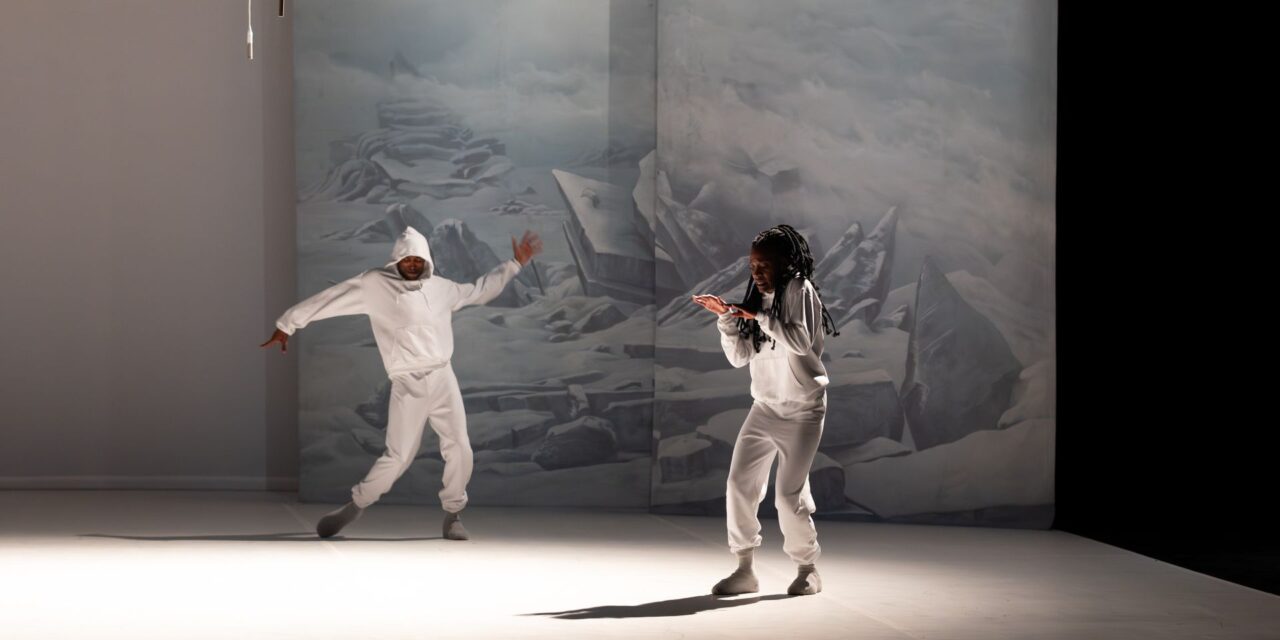
The performance begins slowly in a scenic design reminiscent of the Arctic, with a single rock hanging up high. The performers (Nedd, Nasheeka Nedsreal, Zen Jefferson, Brandy Butler and Jeremy De’jon Guyton) gather in a clump upstage, holding onto each other like a rock. They rise and “Milly Rock.” A rhythmic drum begins and evolves as the swoop of their arms gains momentum. Once they reach the dance’s full potential, the music stops. Four mics hanging from the ceiling capture the effort of their movement — the rustling of their clothes and the exhaled breaths with each swing. Here, Nedd asks people to witness the effort considered trivial in court. Behind the move is a body putting in energy to give it emotion and power. The effort of creation cannot be overlooked.

Jeremy Nedd’s ‘from rock to rock… aka how magnolia was taken for granite’ – Photo by Jason Williams.
The aspect of community building arises when a majority of the ensemble leaves the stage, leaving Jefferson and Guyton at the center. They continue to swing their arms in the “Milly Rock” until their hands connect and evolve into a dap up. The handshake grows more complex as they grasp each other’s forearms or embrace. Even when they separate, the handshake continues in the air. The moment speaks to the value of the “Milly Rock” as a tool for community building. It is a unifying step within Black culture. Nedd continues to riff on this concept by entering a more improvisational section, in which ensemble members create a cypher at the center. In duos, dancers bring their own style to the movement; one person does the Carleton while another performer adds the move to a balletic phrase. The section proposes that the “Milly Rock” is part of a larger diasporic movement language, complementing other popular dance forms.

Jeremy Nedd’s ‘from rock to rock… aka how magnolia was taken for granite’ – Photo by Jason Williams.
The work is disrupted by a performer in a helmet circling the stage on a hoverboard, signifying the dance move’s virality. This instance is followed by a performer trudging upstage with cement bricks attached to the bottom of their shoes. A mic picks up each thump. A shimmering silver piece of fabric hangs over their shoulder. The popularity comes with a price. Without the appropriate credit and compensation to Black dance creators, their creative output soars while the artist is pulled back from mainstream success.

Jeremy Nedd’s ‘from rock to rock… aka how magnolia was taken for granite’ – Photo by Jason Williams.
We witness the consequences of this common trope on social media as the dancers do the “Milly Rock” in isolation. The move feels soulless without the innate communication it fosters. On social media, this happens often. The best-known instance is the popularity of the “Renegade,” where Addison Rae received credit for Jalaiah Harmon’s move. As dances are appropriated on social media, they lose their cultural roots. The glacial environment holds a new meaning, turning the stage into an unknown, isolated purgatory for creative production.

Jeremy Nedd’s ‘from rock to rock… aka how magnolia was taken for granite’ – Photo by Jason Williams.
The ensemble then takes a breath, recognizes each other’s presence once again, and dances the electric slide, a popular line dance in the Black community. It’s joyous and alive. The steps turn into leaps. Smiles grow on the performers’ faces. Nedd draws a poignant comparison between the two dances to reveal that, at the end of the day, the “Milly Rock” is a social dance.

Jeremy Nedd’s ‘from rock to rock… aka how magnolia was taken for granite’ – Photo by Jason Williams.
The work concludes with absurdity. Jefferson enters with the same cement brick shoes and a blonde wig, singing and praising into a mic. Partially comedic, his words hold weight, saying, “I Milly Rock on every block” and “Don’t take me for granted.” Thus, the title comes into play. Magnolias, specifically the trees native to the South, refer to the Magnolia plantations that now represent a symbol for the history of American slavery and Black resilience. The latter half of the title, “aka how magnolia was taken for granite,” represents the ways Black culture, often developed as a form of survival, is appropriated and torn from its origins. Suddenly, it is no longer a rock, but granite, something shinier and more appealing to those unwilling to confront U.S. history and credit Black creation.

Jeremy Nedd’s ‘from rock to rock… aka how magnolia was taken for granite’ – Photo by Jason Williams.
Nedd argues that the “Milly Rock” is nothing without the Black community. “from rock to rock… aka how magnolia was taken for granite” is an ode against the commodification of Black cultural production, and a love letter to Black creativity. Black vernacular dance moves like the “Milly Rock” cannot be codified, packaged and sold. The U.S. Copyright Office fails to understand that the move, with all its cultural nuances, belongs to its community.
To learn more about Jeremy Nedd, please visit his website.
For more information about UCLA’s Freud Playhouse, please visit their website.
Written by Steven Vargas for LA Dance Chronicle.
Featured image: Jeremy Nedd’s ‘from rock to rock… aka how magnolia was taken for granite’ – Photo by Jason Williams.
Please follow us on Facebook, Instagram, BlueSky, and LinkedIn.