How does one live in a footlocker-sized cell, enduring deprivation, humiliation, and at times torture, for the simple act of existing?
On February 8, 2026 at the Odyssey Theatre, long known for presenting work that challenges relevance and conscience, Freedom Time offered an afternoon of story, poetry, music, and dance drawing directly from incarcerated authors around the globe. Curated by Suchi Branfman, choreographer, educator, activist, and Artistic Director of Dancing through Prison Walls, the program bridges art and lived experience, amplifying voices often silenced by confinement. These works emerged from prisons in California, New York, Puerto Rico, Palestine, Michigan, and beyond, transforming harsh environments into acts of creative resistance.
This gift was spare in staging yet rich in thought. The program unfolds as Branfman describes in her book Freedom Time, “an artifact, a letter, a conversation.” It is meant to be engaged with, and — it changes us.
The opening solo, un, dos, tres, quatro, seis / one two three four five six, by Franchesca Nadal Cruz (Bayamón Correctional Complex, Puerto Rico), uses a single chair and mirror that gives rise to isolation and endurance. Performed with emotional and physical clarity by Amy Oden, with narration by Denise Blasor, the work suggests both confinement and the imagination’s ability to transcend. A resonant soundscape by Sikiru Adepoju underscores the haunting refrain of waiting, counting days that blur one into another.
Then from Puerto Rico we move to Auburn Correctional Facility in New York for The Revolutionary Shuffle by Bartholomew. Interpreted by the outstanding tap artist Kenji Igus, the piece blends rhythm and poetry into a meditation on resistance. This late-night reverie conjures up revolutionary figures; Martin Luther King Jr., Malcolm X, Marcus Garvey, dancing through the mind of a man confined. Igus’ rhythmic precision gives muscle to the text’s wit and desires, transforming his tap virtuosity into both protest and prayer.
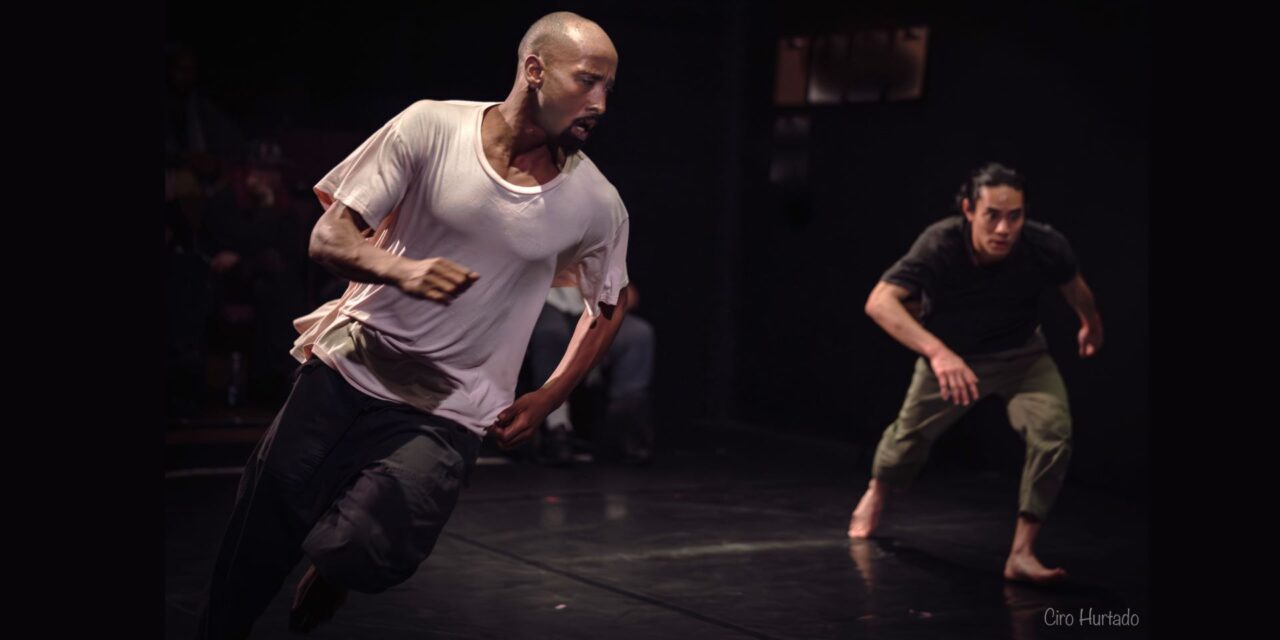
In Mu’taqala / Detainee, Motasem Abu Hasan of The Freedom Theatre in Nablus, Palestine structures eleven scenes tracing the psychological terrain of captivity: the cell, hallucination, bargaining, refusal, and survival. Choreographed and performed by Barges Smahneh and Tom Tsai, with narration by Romarilyn Ralston, the work makes visible the emotional negotiations between prisoner and guard. Their physical vocabulary, jerking, collapsing, reaching, smashing against walls, conveys what headlines often cannot: the human cost of domination.
After a short intermission, Lockdown Poetics by Justin Rovillos Monson (Central Michigan Correctional Facility) delivers one of the afternoon’s most visceral works. Jay Carlon’s performance incorporates wind machines, light stands, shadow boxes, and a transparent tarp that becomes both a membrane and a barrier. The poetry describes bodies starved of touch, and men “stringing together methods of living in the bareness of concrete.” Carlon’s physicality, with his body twisting and actively fighting the entrapment, finally ruptures through the plastic sheath in a raw act of emergence.
El Final / The End by Yarelys Rossy-Pérez (Bayamón Correctional) continues the struggle. Interpreted by Selina Ho with narration by Blasor and sound by Melanie Charles, the work pulsates with staccato defiance: falling, rising, failing, rising again. “I fight against all odds,” the text insists, until the final reclaiming of family and freedom brings hard-won resolution.
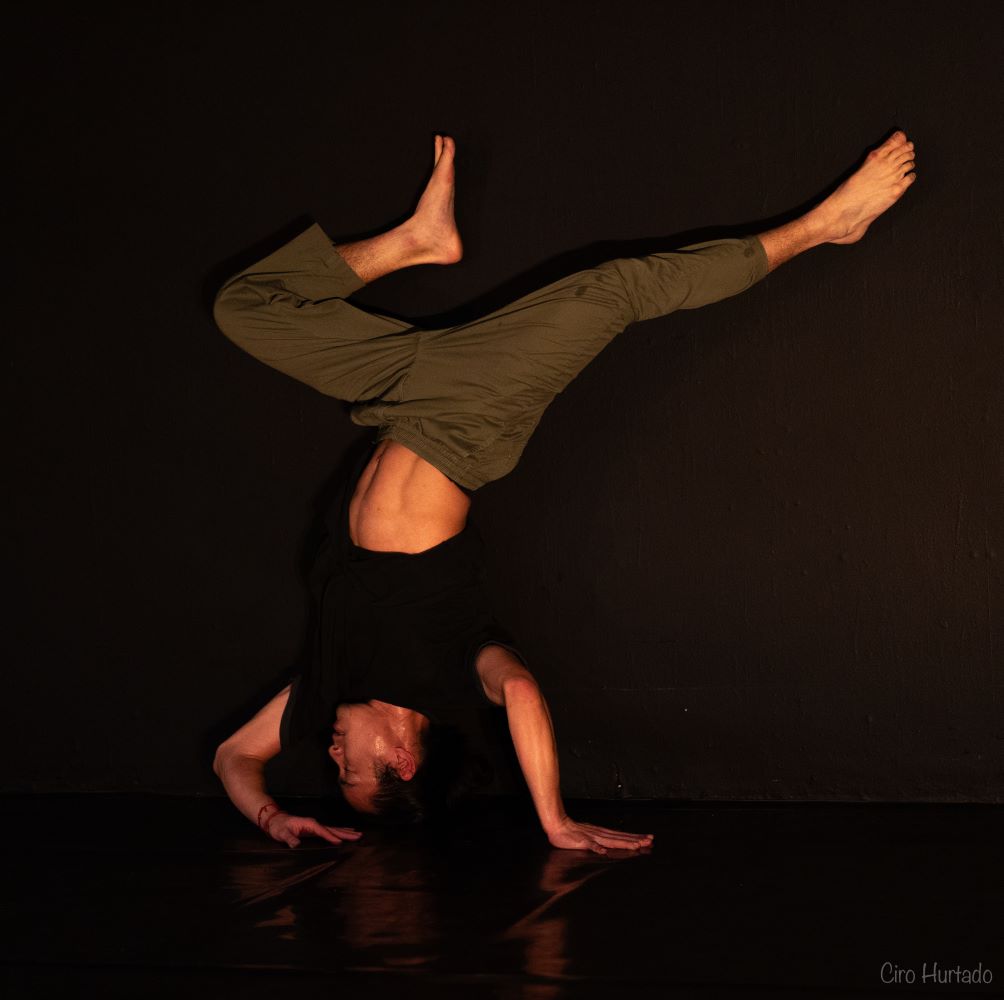
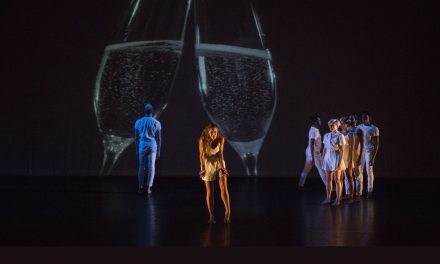
Dance at the Odyssey – Dance Through Prison Walls – “Freedom Time” – Photo by Ciro Hurtado.
In Breaking Chains for a Change, Ellis (Auburn Correctional Facility) weaves history and rhythm into cultural memory. Again, Kenji Igus’ command of tap and Juba, slapping out the essence of struggle underscores the Revolutionary Angela Davis’ words: “Freedom is a constant struggle.” The dance moves between despair and endurance, insisting that even within shackles, imagination remains sovereign.
The final piece, A Bailar al Río / To Dance by the River, created collectively by Amneris Manzano Diaz, Nellyann Rivera Rodriguez, and Sheyla Rosa (Bayamón Correctional Complex), shifts toward motherhood and longing. Performed by Mims, the work speaks of children, nature, memory, and the ache of separation. In envisioning her children’s futures, with the narrator offering the afternoon’s most poignant images of freedom, hope projects forward.
A post-performance discussion brought to mind, Philip Zimbardo’s highly controversial 1971 Stanford Prison Experiment, which exposed how quickly power dynamics can deform behavior and dehumanize both guard and prisoner. Freedom Time, in its full examination and depth, does not illustrate theory; it humanizes it. This work reminds us that confinement is not merely architectural or structural, it is psychological, social, political and spiritual.
What Branfman and her collaborators have curated appears deceptively simple: minimal sets, direct narration, embodied testimony and movement. Yet the cumulative effect is profound. Art here becomes survival, protest, memory, and prophetic. The afternoon does not romanticize incarceration; it confronts it. It insists that creativity persists even in the most restrictive environments.
Freedom Time is not spectacle. It is witness. And it is profoundly vital and necessary in today’s winds of change.
For more information about Dancing Through Prison Walls, please visit their website.
To learn more about the Odyssey Theatre Ensemble, please visit their website.
Written by Joanne DiVito for LA Dance Chronicle.
Featured image: Dance at the Odyssey – Dance Through Prison Walls – “Freedom Time” – Photo by Ciro Hurtado.