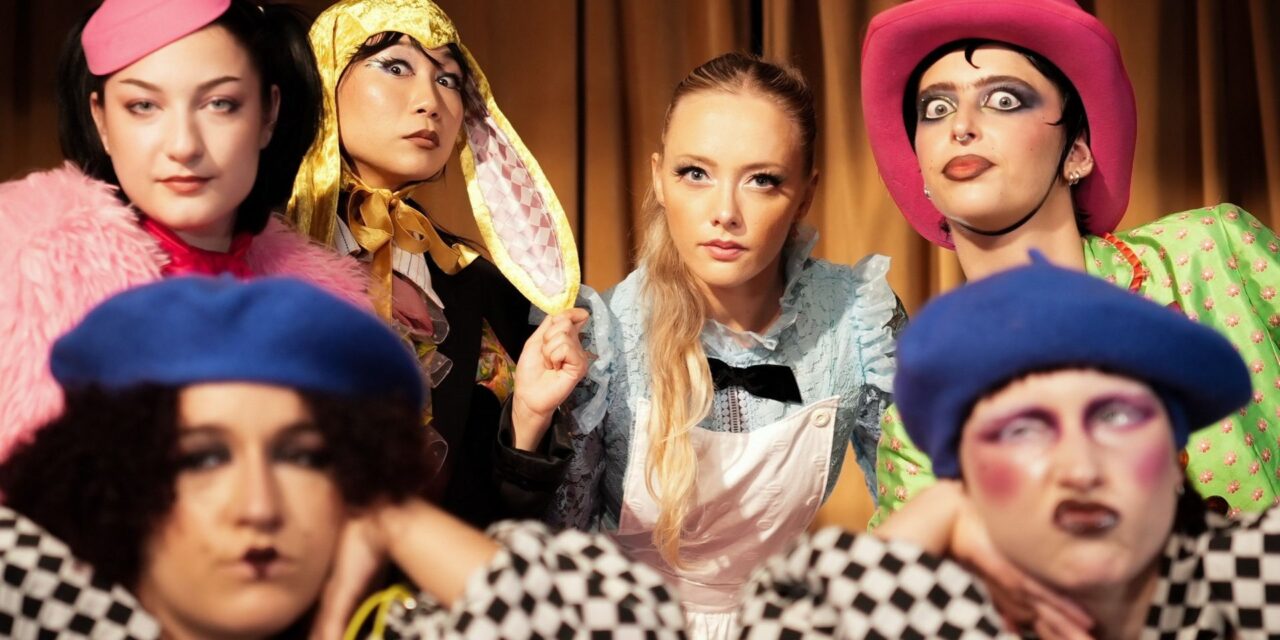
There are those who arrive in life with a plan, and others who arrive with instinct. Tracy Phillips seems born with both. What she has built in Los Angeles did not emerge from a single ambition or prescribed trajectory, but from something quieter—and perhaps more enduring: a compulsion to create.
I was introduced to Phillips by the formidable triple threat Sharon Ferguson, who urged me to see her show at the Roosevelt Hotel. It was my first encounter with Phillips’ work, and I was immediately struck by her ingenuity. Until then, I had no idea that a full-length, Vegas-style production existed in the heart of Hollywood. What unfolded was an immersive world—rich in theatricality, costuming, cinematic sensibility, and special effects.

“Down the Rabbit Hole” – Photo by Zak Agha.
The scope was striking. This was not simply choreography, but a fully realized narrative layered with invention and visual imagination. Her reimagining of Alice in Wonderland unfolded through a lens of variety, burlesque, and contemporary storytelling, revealing an artist with a distinctive voice and a clear command of spectacle.
Sitting across from her, there was no trace of self-importance. Phillips speaks with a grounded ease, almost understating the scope of her accomplishments. Only in the telling—piece by piece—does the architecture of her career emerge.
She began, as many dancers do, very young. “I started dancing when I was three,” she says, “and I knew even then that it was what I wanted to do.”

“Down the Rabbit Hole” – Photo by Zak Agha.
Her early life was defined by movement—not only in dance, but in geography. The daughter of an NFL coach, she grew up in a constantly shifting landscape: New Orleans, New Jersey, Colorado—each leaving a distinct aesthetic imprint. Ballet in New Orleans. The sharp, stylized influence of Fosse in New Jersey. A competition-driven, commercial sensibility in Colorado.
The result was an education shaped by multiplicity. This eclectic foundation would later surface in her work—fluid, stylized, narrative-driven, and resistant to easy categorization.
At eighteen, she moved to Los Angeles. Like so many dancers of that era, she entered through well-worn channels: scholarship programs, agency representation, commercial work. She trained at The Edge, secured representation with Bill Bohl, and began working steadily in music videos, commercials, and film.

“Down the Rabbit Hole” – Photo by Zak Agha.
But even as she moved through that system, something else was unfolding. “I was choreographing at the same time,” she says. “I didn’t really think of it as a career yet. I was just… doing it.”
Her earliest choreographic experiments began long before Los Angeles. As a teenager, she and a dance partner would remain after studio hours, waiting until the building emptied. Using the headlights of a parked car as their only source of light, they would create—two young dancers, illuminated by borrowed light, shaping movement in the dark.

Susan Ferguson as the Cheshire cat in “Down the Rabbit Hole” – Photo by Amy Ryerson.
The shift from instinct to opportunity came unexpectedly. A piece she created for the first Choreographers Carnival—set to Tom Waits’ Pasties and a G-String—caught the attention of choreographer Fatima Robinson, who approached her afterward and asked to work together.
It was a turning point, though Phillips resists framing it that way. “I wasn’t thinking, ‘I want to be a choreographer,’” she recalls. “I was just inspired to make something.”
That sense of organic evolution defines her career. Rather than waiting for permission within established structures, Phillips began creating her own. Early shows took place in clubs and nightlife venues—spaces not traditionally associated with concert dance, but rich with possibility. Drawing from burlesque, theater, and commercial dance vocabularies, she developed productions that were stylized, narrative-driven, and grounded in strong performers.

“Down the Rabbit Hole” – Photo by Zak Agha.
“I’ve been doing shows in L.A. for over twenty years,” she says. “I just felt compelled to create.”
What distinguishes her work is not only its aesthetic, but its integration of disciplines. Costume, film, choreography, direction—each element forms part of a unified vision. While she readily acknowledges her collaborators, the throughline remains distinctly hers.
“I try not to get complacent,” she explains. “Each show… I push a little further.”
That drive led her to the Roosevelt Hotel, where her productions found a more permanent home. But even that opportunity arrived in an indirect—and telling—way. She had long envisioned her work in that theater. The breakthrough came not through a formal pitch, but through an invitation to teach a burlesque class as part of a women’s workshop in the space. She accepted immediately.

“Down the Rabbit Hole” – Photo by Zak Agha.
“I think they offered me two hundred dollars,” she says, laughing. “But I knew—I just knew—I needed to be in that room.”
That decision led to an introduction to management and, ultimately, to a residency spanning multiple productions.
A pattern emerges in her story—not aggressive pursuit, but acute recognition. An ability to see the opening and step through it without hesitation. “I don’t always know how to go after something,” she admits. “But when the door opens—even a little—I walk through it.”
Her creative process reflects a similar balance of structure and openness. She arrives with a clear concept—music, narrative arc, and visual framework but allows choreography to emerge in collaboration with her dancers.

“Down the Rabbit Hole” – Photo by Zak Agha.
“I cast people for who they are,” she says. “Each character has its own movement language. I want to see what they bring.”
It is a method that requires trust—both in her performers and in the unknown. But it allows the work to breathe, to evolve beyond preconception.
As her productions have grown more complex, so too has her interest in storytelling. Increasingly, she is drawn toward larger narrative forms. “I think I’m moving toward directing a musical,” she says. “That feels like the next step.”

Tracy Phillips – Photo by Zak Agha.
There is also the question of scale. Her current work—particularly Down the Rabbit Hole—has the visual and theatrical vocabulary to expand beyond Los Angeles. Las Vegas, she notes, would be a natural fit. Perhaps beyond.
For now, she remains where she has built her foundation—continuing to create, refine, and imagine.
In a city notoriously unstable—where industries rise and fall and opportunities vanish as quickly as they appear—Phillips has done something quietly extraordinary. She has created continuity. Not by resisting change, but by absorbing it. Not by following a path, but by making one.
And perhaps most importantly, by holding fast to the thing that began it all: the simple, persistent urge to create something where nothing existed before.
Written by Joanne DiVito for LA Dance Chronicle.
Featured image: “Down the Rabbit Hole” – Photo by Zak Agha.