
Another year welcomes the 54th season of Pacific Northwest Ballet (PNB), a company that leads the way in excellence, eclectic taste and outstanding artistry in dance, music and design. With the brilliant leadership of Artistic and School Director-Peter Boal; Executive Director- Ellen Walker, and Associate Artistic Director- Kiyon Ross, and its donors, PNB has managed to thrive and grow a company that keeps adding to its illustrious accomplishments at a time when art is transitional, at best, throughout the U.S and around the world.
This evening began the season with the luminous prayer-like opening of George Balanchine’s Serenade. PNB delivered not only its technically well-rehearsed company of dancers, but a full orchestra led by Emil de Cou. With all this excellence it becomes an ethereal wonder. Equally the company adds a personality that runs through it and takes on a spirit and nature all its own. It is clear, experiencing Serenade changes dance artists in profound ways. To quote its artistic director, Peter Boal, “Serenade lives in dancers’ limbs, lines, and hearts.” A revealing statement that makes this ballet an exquisite reflection of the best of our world.
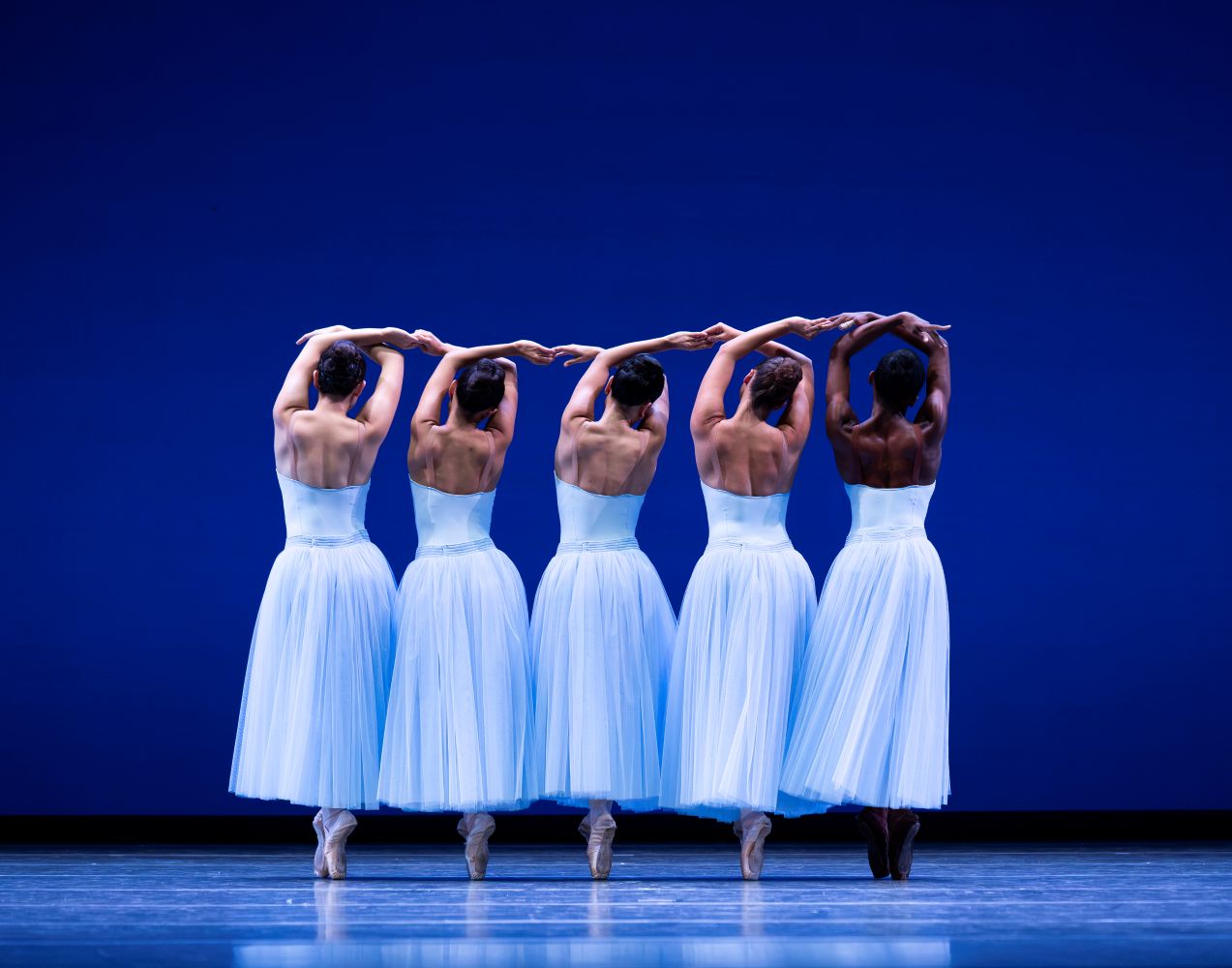
Pacific Northwest Ballet company dancers in “Serenade,” choreographed by George Balanchine © The George Balanchine Trust. PNB presents Serenade – Photo by Angela Sterling.
Serenade was premiered in June of 1934 for Balanchine’s fledgling students of School of American Ballet (SAB). His particular rehearsal process unfolded with a variety of challenges for the Master himself: latecomers, dancer’s emotional exhaustion and collapse, haunting stories that were built and secreted away as the narrative peeked out from the vision of his genius. With his artful flexibility, not only did he not resist these concerns, but decided to include what may have been considered “failings” to the less discerning eye, making the human imperfections a part of the whole vision. This then became the design we know today.
Francia Russell restaged the ballet in 1978 for PNB and it became a favorite, distinguishing itself clearly as a Balanchine architype. It now lives on as the collective history of a work of art. Balanchine and those who have been chosen to restage his legacy pieces, with his playful willingness for movement, design and musicality, have preserved the integrity of his work to share with companies across the world.
PNB, itself has also grown into a mixture of looks, training and dynamics that appear to fold effortlessly into the beauty of Balanchine‘s artful construction. On first view, it is clear the corps and soloist have been rehearsed within an inch of perfection, all legs extend at same heights in à la seconde and arabesque. Even its classic Karinska sky-colored romantic tutus, reimagined by PNB’s costumers, manage to cascade and flow in similar trajectories, sparkling through the exquisite Lighting Design of Randall G. Chiarelli.
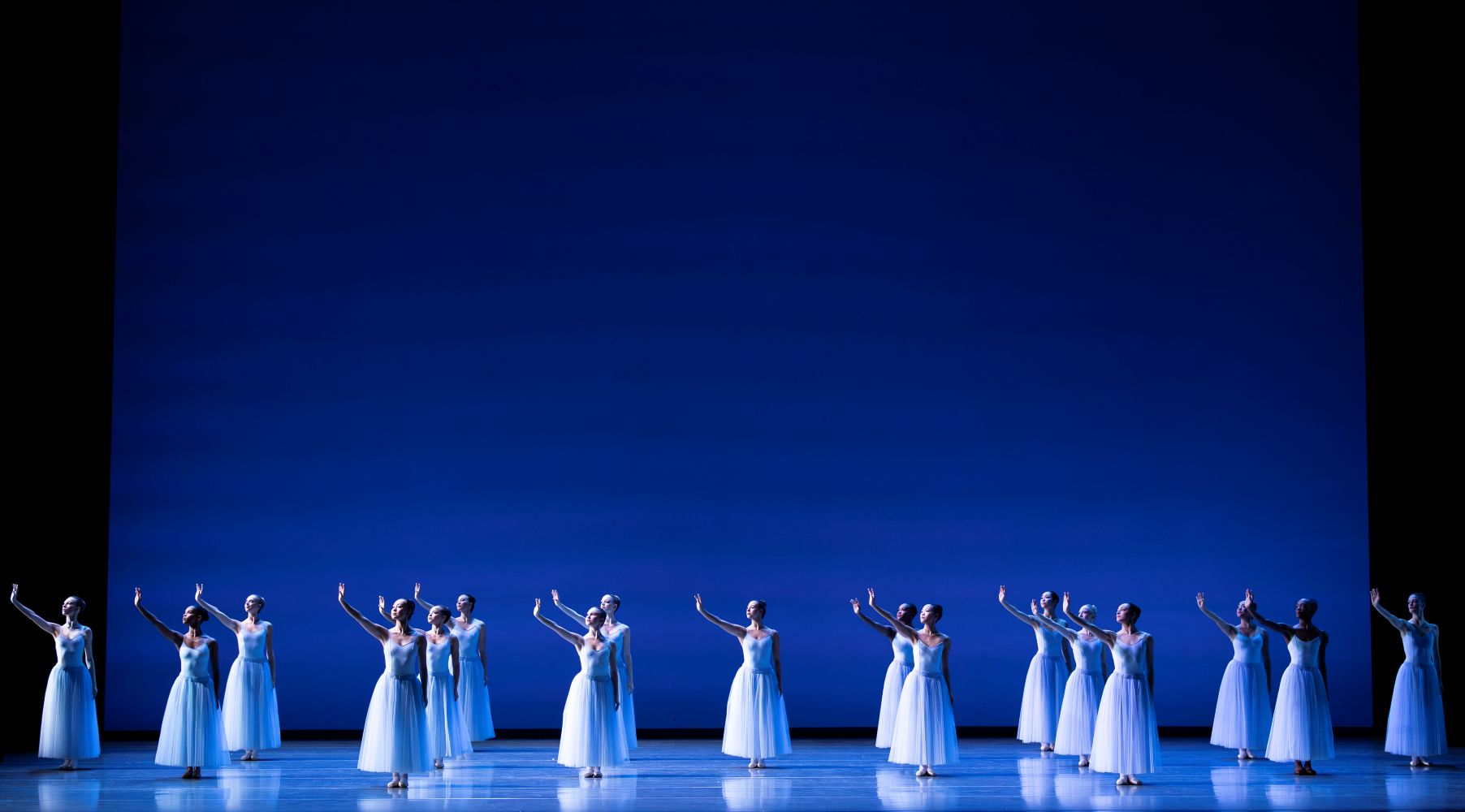
Pacific Northwest Ballet company dancers in “Serenade”, choreographed by George Balanchine © The George Balanchine Trust. PNB presents Serenade – Photo by Angela Sterling.
Peter Ilyich Tchaikovsky’s resplendent music in four movements; Sonatina, Valse, with Balanchine trading the Russian movement with the Elegy. This is an effective repositioning to end the ballet with the Dark Angel’s poignant ascendency in blue tulle atop the nearly invisible shoulders of capable male partners.
The dynamic melding of the diminutive artist, Leta Biasucci with her strength and lyricism has become a fully noteworthy ballerina along with the princely beauty of Christopher D’Ariano, who are both in the turning of their own mastery. The Strength and lyricism of Biasucci and D’Ariano follows the exceptional legacy of Lucien Postlewaite and Leslie Rausch and their ancestral line that have lit the path to what is now one of our finest companies. The corps dedication and commitment cannot be dismissed nor Angelica Generosa in the Russian section, with partnering by Dammiel Cruz-Garrido. Leah Terada as the Dark Angel is stunning. As her vision disappears into the night, the image manages to end the ballet and lift us beyond this earth.
PAGES, on the other hand, choreographed by the eclectic Jessica Lang, is a reverie with dreamlike whisperings interspersed through the intricate musical designs of composer David Lang (no relation). Jessica’s work in Pages personifies the dream and nightmare states of the creative mind. The shifting phrases to self, “When I am alone” … I close my eyes …sit and float above…” This partnership of music and murmurings appear as a character itself leading the fantastical moments of ghostly appearances, at first floating, then disappearing, creating a curious and wondrous fantasy.
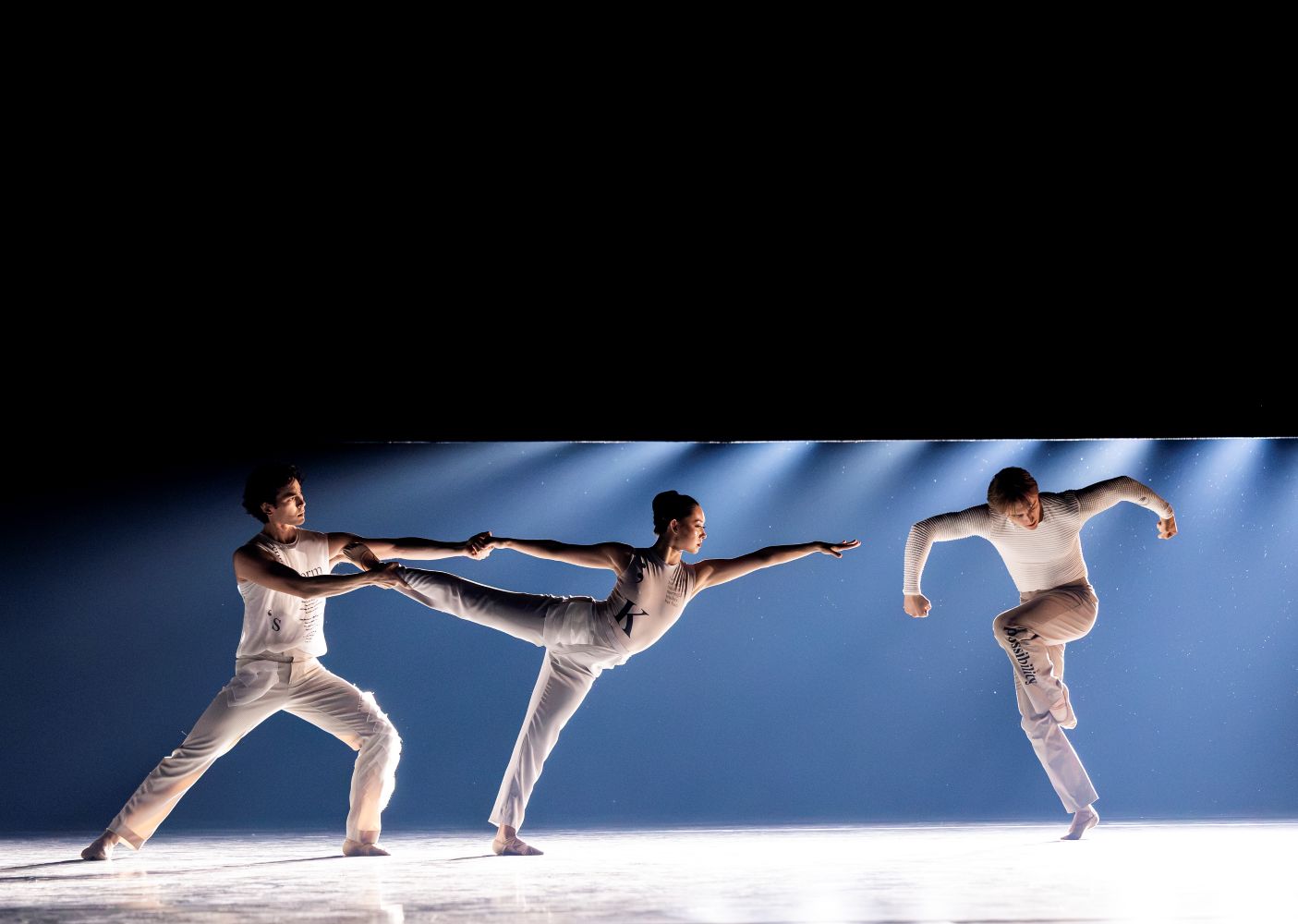
L-R Pacific Northwest Ballet company dancers Christopher D’Ariano, Melisa Guilliams, and Dylan Wald in the world premiere of Jessica Lang’s “Pages” – Photo by Angela Sterling.
The dancers in shades of white, females in diaphanous skirts and body suits, males in white T’s and pants designed by Jillian Lewis assists in creating a sensual and ever-evolving mystery of movement —languorous, percussive and complicated. The ins and out of magical flying, conflicts of relationships, the changing of locations and configurations create wonder. These happenings appear on multi-use sets designed by Lang herself; a white cubed object on its side becomes a wall, leading to a roll-out walkway lit with strokes of light on the dim stage by Brandon Stirling. All keep the spectral encounters surprising and interesting.
Dancers, Melisa Guilliams, Dylan Wald, Leah Terada, Christopher D’Ariano, Sarah-Gabrielle Ryan, Genevieve Waldorf, Madison Rayn Abeo, Mark Cuddihee, and Ashton Edwards leap, turn, lift, and lie on disappearing grounds as they become a kind of clay to mold, catch, float and roll in a mixture of classical movement, modern and contemporary.
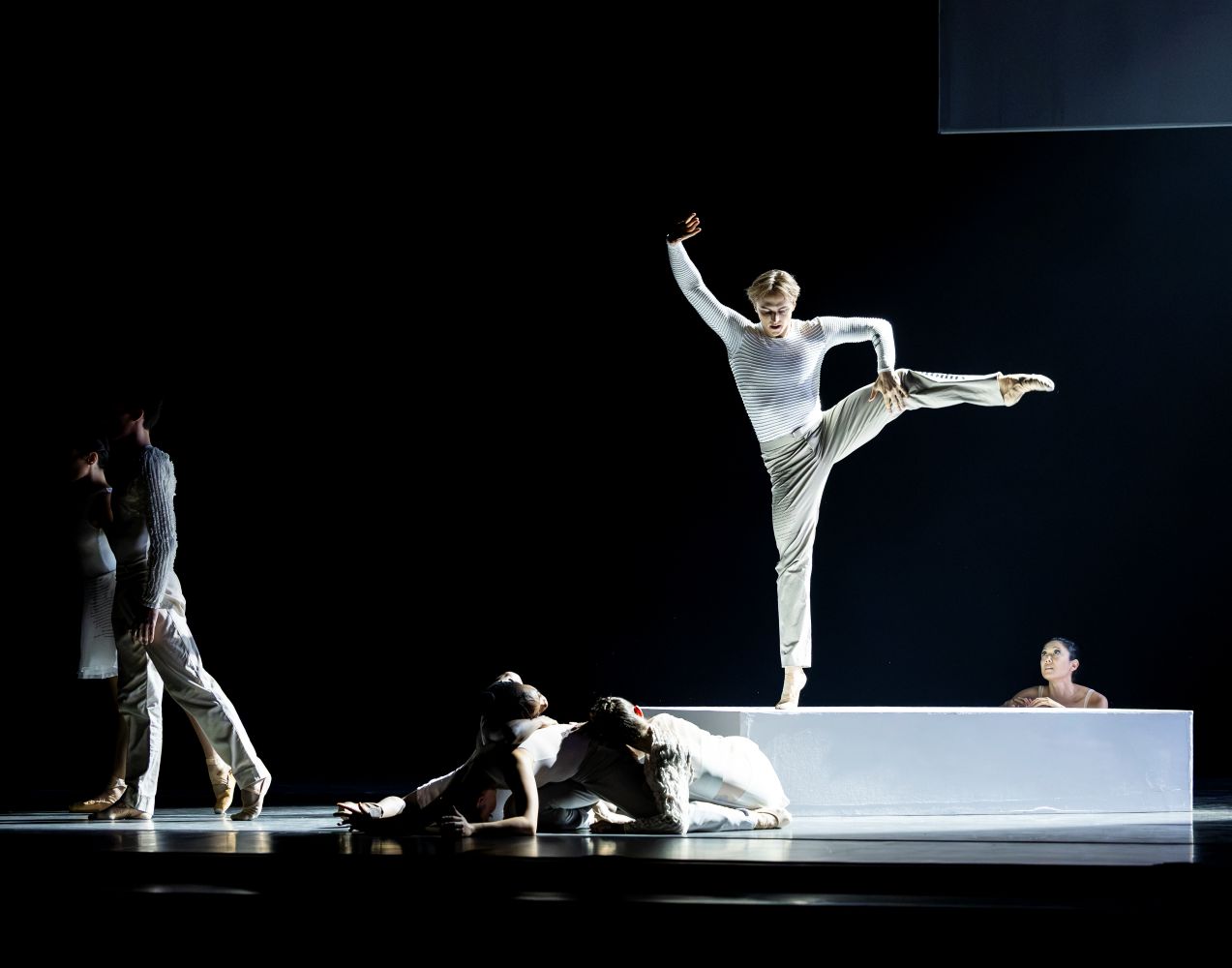
Pacific Northwest Ballet principal dancer Dylan Wald with PNB company dancers in the world premiere of Jessica Lang’s “Pages” – Photo by Angela Sterling.
Some exquisite moments of note were D’Ariano and Wald lifting their partner Leah Terado magically into midair to give a surprise sense of floating without their help. Then a fascinating unreality awash in magical relationships that allow fantasies in the mind of the beholders. It is Dylan Wald’s powerful presence atop a lit cube that beautifully utilizes both character and intelligence whilst floating Terado into a chance encounter with D’Ariano. Together it appeared to mark a menage or pas de trois to create a fascinating and technically awe-inspiring encounter.
Terada, Gabriele Ryan, Waldorf and Rayn Abeo, fly and float on land and air, appearing and disappearing whilst the amazing Chaîné turns of Ashton Edwards breaks the spell and transitions us onto the next phase. And not to be left out is the gorgeous pas de deux with Gabriele Ryan and Cuddihee in the recognition of each other. And with a final insurgency, Leah Terada breaks the dream, tearing away paper atop the set piece …and with large strokes of her pen, writes one word that pulls it all together.
Last but definitely not least comes the Russian-born Alexei Ratmansky’s aptly reflective piece Pictures at an Exhibition by Modest Mussorsky. The sparse and schematic music written in 1874, was choreographed to honor the memory of friend Viktor Harmann, artist, architect and designer who died suddenly of an Aneurism.
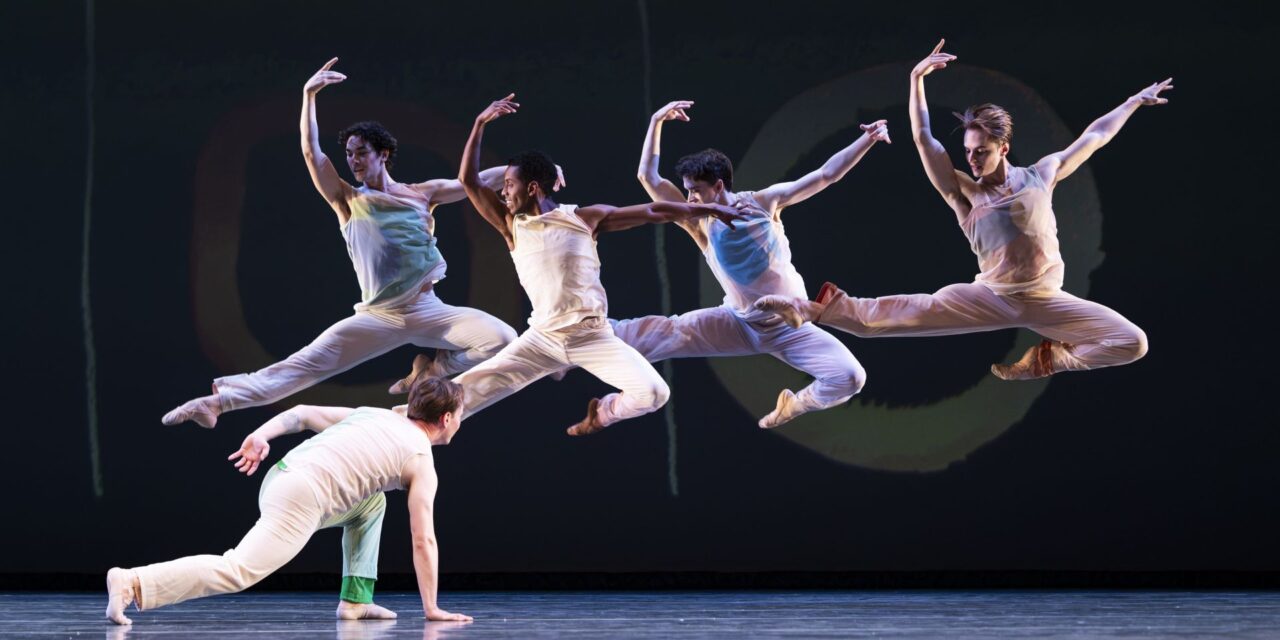
The outstanding pianist Christina Siemens played with the spirit reminiscent of the vast tundra of the snowy Russian Steppes. Ratmansky chose to place this piece honoring Harmann appropriately in a gallery showing artist Wassily Kandinsky’s Color Study Squares and Concentric Circles, rendered by Wendall K. Harrington’s projections. It echoed and inspired the costume design’s muted, yet colorful, shapes on iridescent smocks for the female dancers, with neutral T’s and pants for the males, rendered by Fashion designer Adeline Andrés. All brushed with the lighting of Mark Stanley’s expert hand.
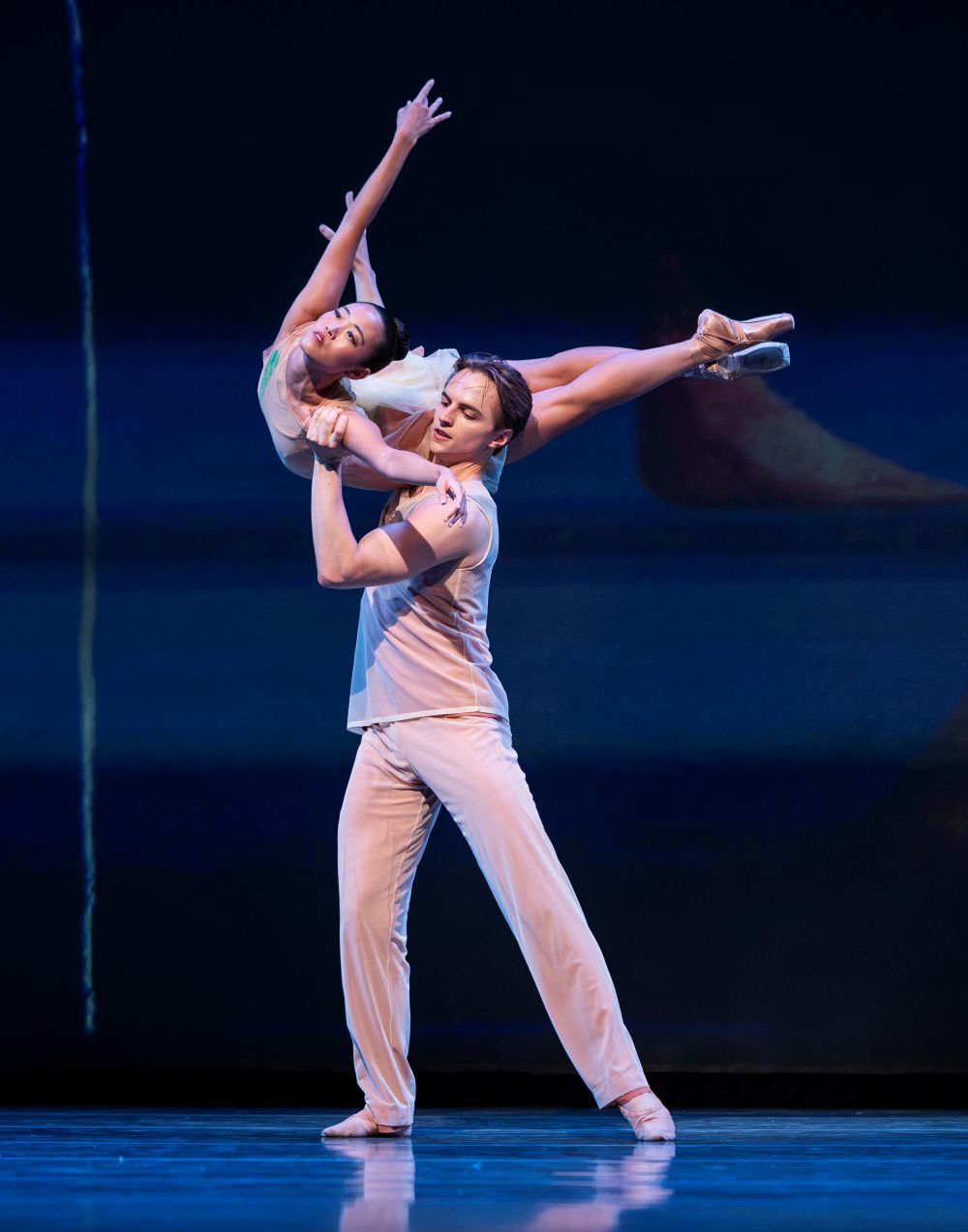
Pacific Northwest Ballet soloist Yuki Takahashi and principal dancer Dylan Wald in Alexei Ratmansky’s “Pictures at an Exhibition” – Photo by Angela Sterling.
This delight melds artfully together to support Ratmansky’s lilting, humorous and adventurous choreography into a joyful potpourri of solos, duets, trios and full-on playful company work.
The Opening is a delight and gives an opportunity to get to know single dancer’s, their technique and personalities. It melds the group from competitive solos to friendly gatherings of the coterie for a journey thru Ratmansky and Kandinsky’s artful mind.
The difficult solo by Melisa Guilliams sets a powerful mourning, leading to a momentum of explosive dance in a joyous Pas de six with the always wonderful Jonathan Batista, with Sara-Gabrielle Ryan, Christopher D’Ariano, Amanda Morgan, Jory Luther with Angelica Generosa.
Among the most transfixing of Picture’s movements was the gorgeous Pas de deux performed effortless and soulful by Dylan Wald and Yuki Takahashi. Takahashi becomes weightless in his arms and their effortless transitions flows like butter. They take our collective breath away all the way to the end with Wald balancing Talahashi’s lithe figure standing arched on one leg against his body like a masthead. With such power and generosity it gives way to a moment of awe and transformation.
The Pas de quatre with all men was memorable in its joyful romp with clean effortless lines and technique that entertain and surprise, leading the way to the foursome of Morgan, Generosa, Gabrielle Ryan, and Guilliams. Ratmansky’s Pictures at an Exhibition puts an artful period on a transformative evening of dance and dreams. A joyful season that leaps into Fall of 2026 to Spring 2027. Such a treat for the eye and the spirit.
To learn more about the Pacific Northwest Ballet, please visit their website.
Written by Joanne DiVito for LA Dance Chronicle.
Featured image: Pacific Northwest Ballet company dancers in Alexei Ratmansky’s “Pictures at an Exhibition” – Photo by Angela Sterling.