I didn’t view Deborah Rosen and Dancers’ work from the comfort of my front row chair but crouched along the curb beside the ramp with much of the audience on May 9, 2026. Chairs continued to gather around the small outdoor venue as friends, family, and dance enthusiasts pressed forward hoping for a better view of the performance. Still too young to not, in good conscience, take a curb seat, I joined the crowd watching from wherever space allowed: standing, crouching, sitting along the perimeter of the performance area. The overflowing audience became its own testament to the care people hold for the Los Angeles dance community and another successful evening curated by the Brand Library & Art Center’s Jamie Nichols.
The show began with two solos back to back, the first an excerpt from a longer work and the second a prelude to a full length group piece. Although the dancers differed greatly in texture and movement quality, both pieces rested neatly, like a pot of water not quite boiling but far from cold either. A passerby from the park might have stopped briefly to admire the dancers’ physicality and detailed gestural movement before continuing on with their day.

Deborah Rosen & Dancers – Sara Scrimshaw in “Gaia” by Deborah Rosen – Photo by Jamie Nichols.
Gaia, the first solo was danced by Sara Scrimshaw, who looked stunning in a flowing sheer dress with cloth butterflies, whose wings moved with the wind. Her hair was loose and I imagined how easy it would be for her to continue to dance right down the stairs and into the grass only a few feet away. Instead she stayed contained to the rolled out Marley in front of the Brand Center. Gestures were repeated but not built upon and several ideas were presented but didn’t fully accumulate into anything larger. The music was also overpowering and loud, clearly building up to something while the choreography remained largely within the same dynamic range. At one point, Scrimshaw dropped to all fours and I thought maybe she was finally breaking free from this image of a composed Goddess and into something more attuned to the earth, more animalistic, but instead she stood back up, abandoning the image.

Deborah Rosen and Dancers – Robert Huera in “Atzmi” by Deborah Rosen – Photo by Jamie Nichols.
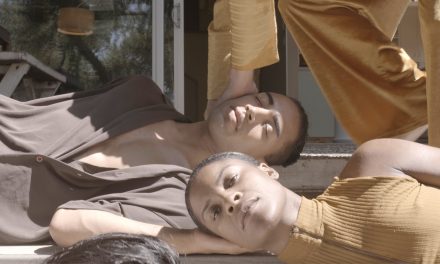
The second piece, Atzmi, began with another solo this time by Robert Huerta. Huerta had some lovely moments of spiral and collapse into the floor. Natalie Bojorquez, Thomas Ng, and Sara Scrimshaw eventually join in and gestures appeared briefly before dissolving into the next idea. Overall the piece holds onto a sustained movement quality in a way that makes moments of stillness or change in speed feel increasingly absent. I felt like I was maybe watching a round of improvisation in a rehearsal (although technically beautiful) that had been cleaned and rehearsed until it lost some of the rawness of its original sense of discovery. The program describes this piece as a physical meditation on identity. Meditation is perhaps the right word for the piece, and in that sense it succeeds. However, the program also describes an inner landscape of individuality, with moments of tension, listening, release, and surrender.

Deborah Rosen and Dancers – Sara Scrimshaw and Thomas Ng in Rosen’s “Atzmi” – Photo by Jamie Nichols.
During intermission Rosen demonstrated one dancer’s intended clumsiness by suddenly stumbling forward herself. The sharp movement shifted the air around her in a way that I did not see in the piece and wish I had. What would happen if someone actually did trip? Or reached so far for a truth within themselves that they hovered for a second before collapsing. Or tried so hard not to move that the tension becomes evident in a shaking hand, so that when it finally releases, we feel that same sense of abandon.

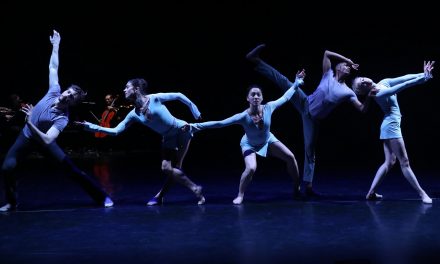
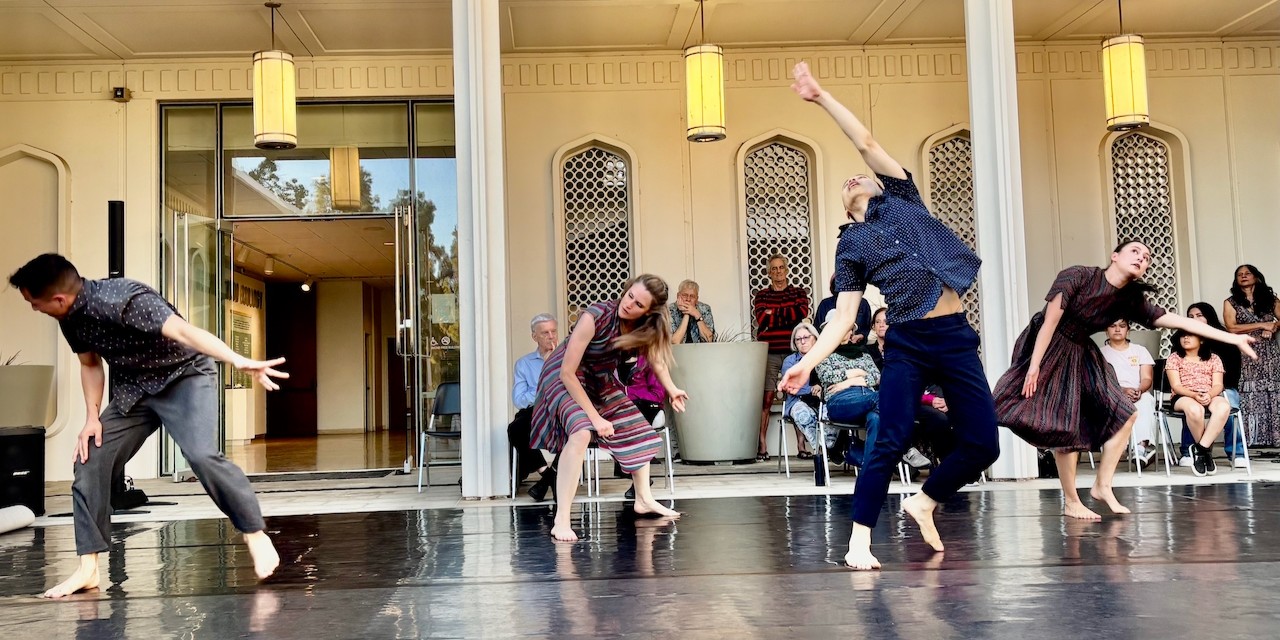
Deborah Rosen and Dancers in Rosen’s “Rimonim” – Photo by Jamie Nichols.
The final work of the day Rimonim was rooted in symbolism and drew inspiration from the ceremonial ornaments of the Sefer Torah. The dark jewel tones of the costumes added an immediate visual depth and suggested a heavier work was to come. This piece was the most compelling of the evening, although it opened slowly. The program describes bodies restrained beneath invisible weight, yet I never fully felt that heaviness register in the performers as they stood lightly observing Robert Huerta perform a solo similar in texture to the previous work. At one point 3 of the dancers were standing in a straight line facing Natalie Bojorquez as she began a solo. The still image of the line compared to her weighted, near frantic movement was a powerful image. I was excited to see where this tension might lead but after only a few seconds the dancers in the line dispersed and the moment was gone.
Although vastly different in tone from the previous weekend’s performances, Deborah Rosen and Dancers fit naturally within the Brand Library’s outdoor series. While much of the evening remained emotionally restrained for me, Jamie Nichols continues to thoughtfully curate programs that highlight the wide diversity of styles and artistic voices present within the Los Angeles dance community.
For more information about the Brand Associates Dance Series, Please visit their website.
For more information about Deborah Rosen and Dancers, please visit their website.
For more information about the Brand Library & Art Center, please visit their website.
Written by Denali Huff for LA Dance Chronicle.
Featured image: Deborah Rosen and Dancers in Rosen’s “Rimonim” – Photo by Jamie Nichols.