“A powerhouse of artistic excellence, Alvin Ailey American Dance Theater carries forward a legacy of African American strength, resilience and joy through the power of movement.” —Glorya Kaufman Presents Dance at The Music Center

Alvin Ailey American Dance Theater – Dandara Veiga in Medhi Walerskis’ “Blink of An Eye” – Photo by Christopher Duggan.
Opening night, Wednesday, March 25, 2026, at 7:30p.m., Alvin Ailey American Dance Theater demonstrated all of this and more!!!!!! The program opened with Blink of An Eye, choreographed by Medhi Walerski, staged by Valentina Scaglia to music by Johan Sebastian Bach, performed by Itzhak Perlman. The curtains open to a bare stage with a bar of lights providing minimal lighting. Suddenly the dancers appear. The female dancers are costumed in leotards; the men are clothed in black pants and all wear flesh-colored socks. The lighting slowly brightens and seems to capture and highlight the muscles of each dancer. Their bare torsos, arms, and legs seem to glisten. The sheer athleticism of the movement is remarkable and provokes a chorus of oohs, aahs, and gasps from the audience. They run, jump, slip, slide, turn, and, from time to time, they appear to be skating. Whatever they are doing it is apparent that they are ALWAYS in complete control and able to immediately stop, in the blink of an eye. The movement, music, and dancers merge to create a story of endless coming together and moving apart at breakneck speed. When these dancers run, they run like track stars continually covering the entire stage. When they stop, they often stop in a straight line and before you know it, they are suddenly scattered across the stage into frozen sculptures that seem to melt into long, languid movements or jumps that create an allusion of flying in midair. I am sure that Miranda Quinn performed the slowest and lowest fourth position plie I have ever seen, bending all the way down to hell and slowly rising to heaven without so much as a wobble, shake, or stutter. It was magnificent. Dancers performed attitude turns done amid elaborate movement phrases while holding the ankle of the foot in attitude. Several dancers executed a variation on barrel turns to the floor with the backs of artists appearing to literally wrap around the movement. In the blink of an eye dancers moved between perfect unison and a cacophony of unique shapes and movements made even more interesting with nuanced arms and hand movements accenting beginnings and endings of phrases. Intricate duets and solos with lifts that seem to come from nowhere fast, slow, precise, difficult all performed with total abandon and perfection. The end came, in the blink of an eye, as the dancers seemed to all lean back, chests to the heavens, falling into darkness.

Alvin Ailey American Dance Theater – Alicia Graf Mack and Jamar Roberts in Judith Jamisons’ “A Case of You” (excerpt) – Photo by Paul Kolnik.
After a brief pause, A Case of You began in silence. It is an excerpt from Judith Jamison’s 2005 Reminiscin’ and danced to Diana Krall’s rendition of the classic Joni Mitchell song. Sometimes an excerpt of a larger piece does not have the gravitas to stand alone but A Case of You certainly proved otherwise. The choreography performed in silence was sensuality steeped in longing. The silence merely emphasized the deep connection between the two dancers that existed far beyond music. Passion and intimacy characterized their every movement. Transitions between lifts are seamless. The audience gasps as the woman runs into a lift wrapping her legs around her man as if stuck to him by Velcro. No preparation, no plie, no help from her man…just unbridled strength and determination to be as close as possible to her man.
The music seemed to creep onto the stage with the luscious velvety vocals of Diana Krall filling the stage. “Oh, you are in my blood like holy wine. You taste so bitter and so sweet. Oh, I could drink a case of you, darling and I would still be on my feet.” These lyrics capture the very essence of the movements in this dance drama. For Joni Mitchell, this song was an attempt to capture her feelings after a tumultuous breakup with fellow artist, Graham Nash from Crosby, Stills, Nash and Young). It is described as the “tender sound of someone who’s lost love but still believes in its beauty.” As Samantha Figgins and Isaiah Day danced, they clearly demonstrated a belief and commitment to loving one another. Their long sinewy bodies and expressive hands never stop moving. This was not a breakup but a reconciliation, a uniting of two souls deeply in love. When Samantha literally runs to stand on the thighs of Isaiah only to caress, and be caressed, once again she does it without his assistance. She simply stands facing him, determined to be as close as she can be to him. The audience once again audibly gasps. The two immediately swirl into a series of movements reaching, contracting around one another, and then away, touching, stretching, caressing and finally embracing.

Alvin Ailey American Dance Theater in Matthew Neenan’s “Difference Between” – Photo by Paul Kolnik.
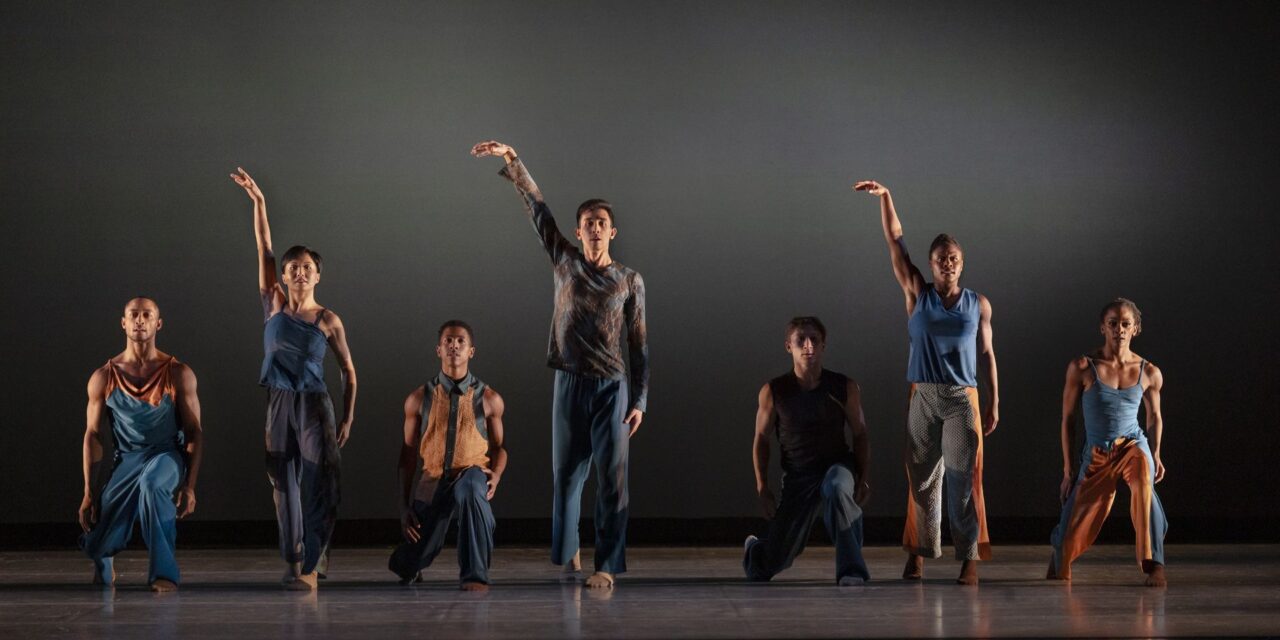
This was a wonderfully curated program exploring the emotional and technical prowess of the company. Each dance seemed to explore a different facet of the company and at intermission you could hear the audience excitedly anticipating the Los Angeles premiere of Difference Between. Choreography by Matthew Neenan performed to music written and performed by Heather Christian and the Arbornauts in costumes designed by Karen Young., this piece did not disappoint. The costumes use a color pallet that is reminiscent of water and land. No two dancers are dressed alike. This contributes to the individuality and uniqueness that is integral to the piece. As choreographer Neenan states, “…because we have different casts, I always ask each of them to bring something new to it so if there’s a solo with someone or they might change it up a little bit and I prefer to see that, so it’s not always the same …”. There is an abandonment that characterizes the way the seven dancers run, jump and cover the entire stage. From the very beginning you get a sense of community. Movement in unison is extremely powerful because this community is moving in perfect togetherness with each swing of the arm and turn of the head or change in focus. The community effortlessly lifts members as they reach away and out into space. It is as if they are flying and the dancers seem to pause in midair when silence unexpectedly arises in the musical accompaniment. The concepts and ideas throughout the ballet seem to stem from the music and the libretto. “Difference between. Deference, reverence, sever its shoots on the bean. Sanity, brevity, bravery, levity— these are the virtues are any restored or recorded or pored over once the romance of it leaves?” -excerpt from the Heather Christian lyrics . The stage is never empty as the dancers come and go with a whimsical pas de chat high in the air or a turn sequence quickly followed by movements that embrace the floor. Multiple duets, two men, two women, trios, solos, never stop coming and going, all done with precision and a huge range of emotions from sheer joy to deep reflection, sadness, longing, loving caresses, a playful touch, head-to-head, hand to hand, and heart to heart. Too soon the community moves on and away and the dance ends with the audience loudly applauding and wanting more!

Alvin Ailey American Dance Theater in Alvin Ailey’s “Revelations” – Photo by Danica Paulos.
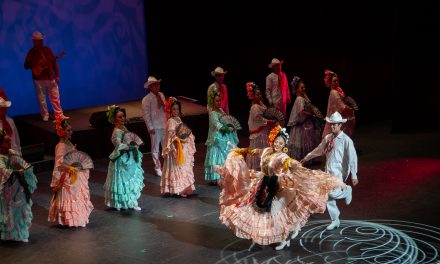
The curtains open and lights slowly come up to reveal the company in the opening tableau of the beloved, iconic Revelations by Alvin Ailey. The audience immediately erupts into applause. I have had the pleasure of seeing this suite more times than I can count with casts that included such dance luminaries as Warren Spears, Judith Jamison, Miguel Godreau, Gary DeLoatch, Sarita Allen, Stephen Smith, Mari Kajiwara, Dudley Williams, Tina Yuan, Shirley Black Brown, Keith McDaniel, Donna Wood, Marilyn Banks, Linda Kent, Kelvin Rotardier, George Faison, Neisha Folkes, Clive Thompson, Nasha Thomas, and Michihiko Oka. This list is just a beginning and by no means meant to be exhaustive. These are the people I first saw perform this moving suite to African American spirituals, song-sermons, gospel songs, and holy blues choreographed by Alvin Ailey. My memories are instantly shoved aside as the soul stirring vocal arrangements, by Howard Roberts, soar carrying the audience straight to church. The music sounds as if the choir is standing on the stage. Revelations is described as a “cultural treasure” loved by audiences all over the world. It tells the story of a people confronting and transcending barriers that seem insurmountable. It is Horton technique wrapped around perseverance, pain, sorrow, suffering, trials, tribulations, peace, hope, and a deep rewarding happiness. It has an undeniable appeal to universal emotions that go beyond nationality, language, faith, and racial differences. The pain of a difficult life is captured from the beginning of “I Been Buked” with the dancers’ deep plies reaching to the earth as they hold their sides. As if in pain. They are a community holding on to one another as they pull away and come together in a wedge that reaches out and then up to the heavens. The shapes they make are filled with angles that communicate angst and pain. The pace picks up with the trio in “Didn’t My Lord Deliver Daniel”. The dancers embrace the floor and move with an abandon and commitment to praying that is remarkable. “Fix Me Jesus”, a slow plaintive, reflective pas de deux that requires control from both dancers to hinge, developé, slowly contract to the floor, rise to relevé, and end with a woman poised in a long arabesque on the thighs of her partner reaching to the heavens. Both “Processional/Honor” and “Wade in The Water” brought another change of pace and the audience could be heard singing along. Yanvolou, a dance with Haitian origins, never looked so good. The dancers were at a baptismal that ended with the holy ghost taking over one of the women. “I Wanna Be Ready”, a reflective male solo closes the Take Me To The Water section. The last section, “Move, Members, Move”, is a series of fast moving, jubilant, celebratory, dances reminiscent of being in a rural Texas Baptist church. It opens with “Sinner Man, a tour de force trio of men who jump, turn, tilt, and run as if they are trying to escape Satan. By the end, the audience is loudly cheering. The remainder of this section finds the dancers in church meeting, greeting, gossiping, and having good time. The women in church dresses with full circle skirts, church hats, and fans, effortlessly lift their legs to the ceiling while the men, in crisp white shirts, vests, and black pants grandly step, duckwalk, turn and jump. The movements, done with abundant joy and abandonment captured by the holy spirit reaches beyond the stage to the audience that is clapping, singing along, rocking, swaying, and wildly applauding.
Alvin Ailey, Judith Jamison, and so many dancers who have passed on are smiling because the legacy is clearly intact! Bravo Alicia Graf Mack, new Artistic Director of Alvin Ailey American Dance Theater, and Matthew Rushing, Associate Artistic Director for a wonderfully curated program that brings a fresh perspective but maintains the vision of Mr. Ailey and Ms. Jamison. Finally, Clifton Brown and Kanji Segawa bare to be applauded as rehearsal directors who have done a phenomenal job keeping the work precise, clean, and pristine yet overflowing with emotion and intention. The company is in good hands !!!!
Alvin Ailey American Dance Theater can be seen at the Zellerbach Hall, Berkley, California, April 7-12 and then in Davis, CA at the Mondavi Center, April 14 & 15. They are definitely worth a road trip from Los Angeles.
To learn more about the Alvin Ailey American Dance Theater, please visit their website.
For more information about the Glorya Kaufman Presents Dance at The Music Center, please visit their website.
Written by Leah Bass-Baylis for LA Dance Chronicle.
Featured image: Alvin Ailey American Dance Theater in Matthew Neenan’s “Difference Between” – Photo by Paul Kolnik.
Please follow us on Facebook, Instagram, BlueSky, and LinkedIn.