First of all I wish to say Kudos to the Odyssey’s Dance Festival curator, Barbara Müller-Wittmann. This is an excellent avenue for the presentation and support of Dance in all its many forms. The opportunity for performance and being seen that the Odyssey’s Festival provides is very important for local Choreographers and smaller Dance Companies alike.
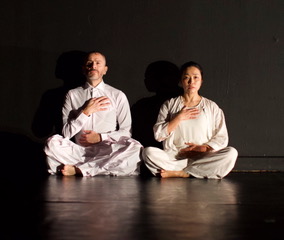
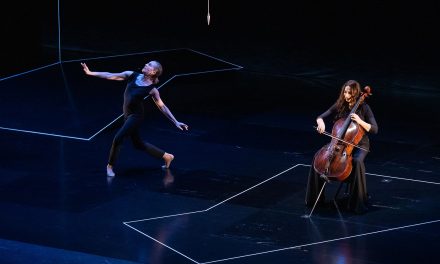
Dance at the Odyssey – Efrén Olson-Sanchez and Chie Saito in “LlamadoKodo” – Photo by Chiharu Uchida.
First on this shared program I saw LlamadoKodo. According to the program notes: “… is a movement project exploring grief and relief, reclaiming the land, and the empowerment that arises from embodied connection”. Grief and relief were certainly present and not always in the form the performers intended. In the opening sequence we see two people standing upstage right, a single light fades up and they take their time moving their heads in unison seemingly taking in the totality of their environment. This was a long moment and set to silence. It would have commanded the attention of the audience and made for a powerful readjustment of focus were it not for one woman in the audience who, after the announcement to silence cell phones – did not. Sure enough, in the middle of extreme focus and silence her phone goes off on a piercing ring tone. While most ignore it, I turned to see who it was that fully ignored the announcement. She held her phone and instead of turning it off, proceeded to scroll through numerous windows while I witnessed. Truly I couldn’t help but witness as the theater is small and with only one light onstage dimly lit, the phone illuminated a great deal of the audience. As she finally turned it dark, she fumbled it and dropped it with a crash to the ground where it bounced and thudded. So much for the focus and attention of the audience. Dear reader you are correct that I was there to review the show and not the audience, however when the audience (or certain members thereof) do not know or care to follow the simplest requisites of etiquette that ensure a pleasant experience for everyone, then I must address it. These performers rehearsed a great deal and spent a large amount of time and energy in choosing just how their work should be perceived. The interruption was jarring and unnecessary. She should have just turned her phone off when the announcement was made at the top of the show.
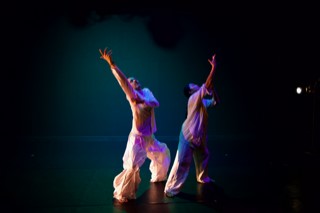
Dance at the Odyssey – Efrén Olson-Sanchez and Chie Saito in “LlamadoKodo” – Photo by Chiharu Uchida.
Continuing with Efrén Olson-Sanchez and Chie Saito who concentrated past this beautifully. The moment of stillness in silence was repeated a few times throughout and was a powerful break in the action. It made us, as audience members, more aware of the time around us and the detail our senses take in when no outside distraction is working on us. There was a floor section where the grief was palpable and expressed through contractions of the body. As the performers were wearing all white costumes against the black floor, it was visually strong, like a black and white slide show.
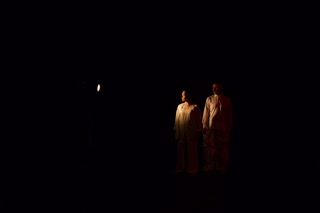
Dance at the Odyssey – Efrén Olson-Sanchez and Chie Saito in “LlamadoKodo” – Photo by Chiharu Uchida.
At times, the duo sat on their heels with folded knees which somehow reminded me of ancient Egyptian Gods or that picture of Woman and Man which was etched onto Voyager One even now hurtling past our own galactic sphere. There was something of the mythological in it.
In this position they began a finger tapping on the floor that developed into a full port-de-bras as if taking the daily task of tapping into a computer keyboard or, dare I say it – a phone and elevating it into the syntax of our civilization – which I suppose it is. The work led to surprising thought as it was very lean and uncomplicated. The gestures were sometimes broad and the energy expended only made the stillness more rife with possibility. The Art of immobility coupled with bouts of movement made for an interesting excursion into the emotions of grief and relief, however they are felt in this day and age.
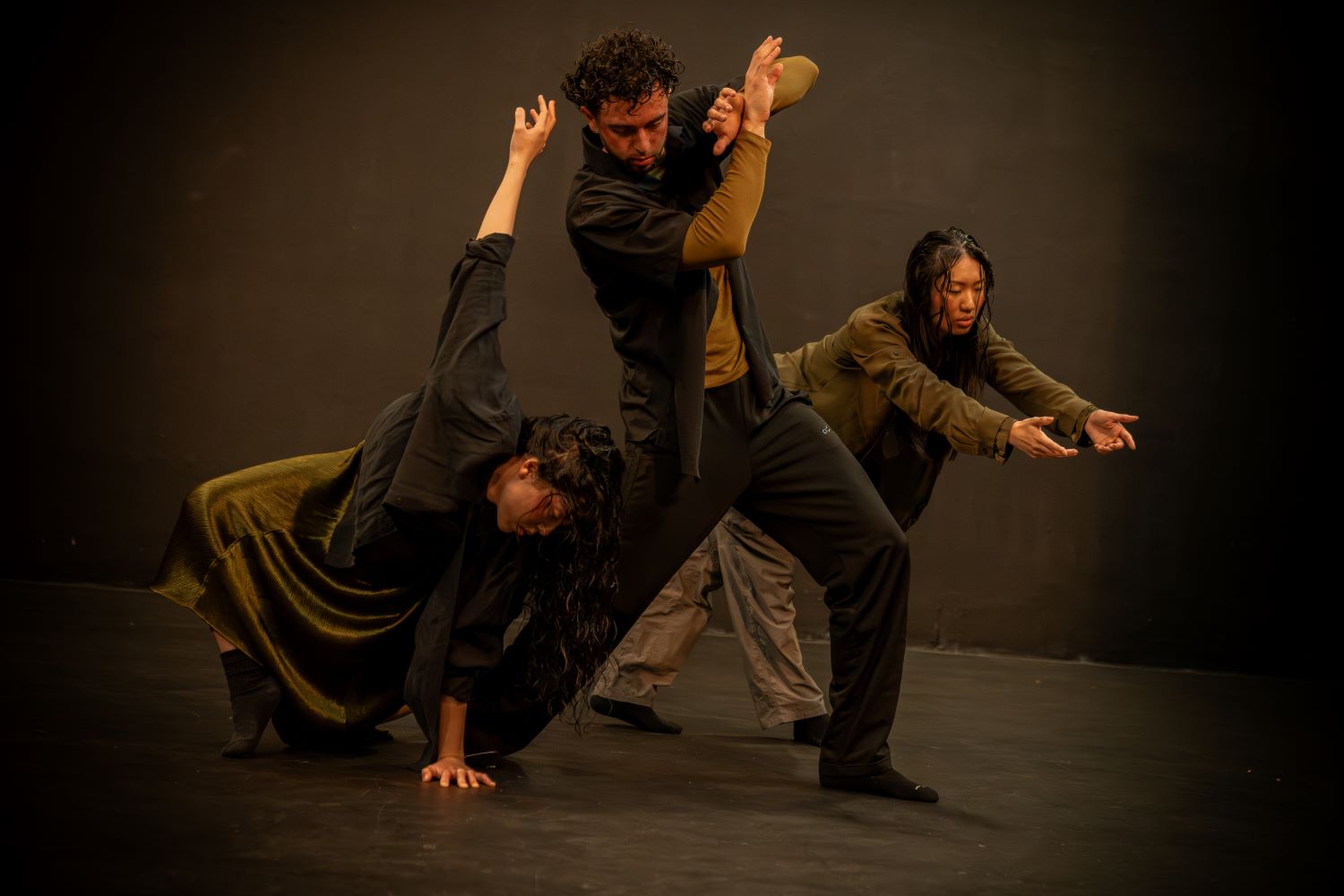
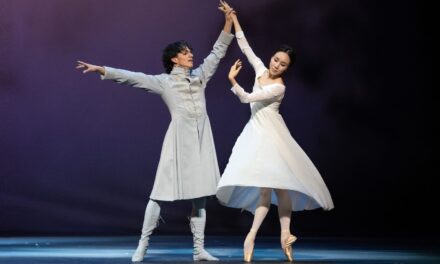
Dance at the Odyssey – Maya Peterson, Tyler Law, and Simon Chernow in “Default:Joy” by Marianna Varviani – Photo by Preston Project.
Interestingly, the second company on the program also wrestled with grief and relief in the form of a supposition: “What if everything collapses, what is your default setting?”. Marianna Varviani as Choreographer and Artistic Director of Selcouth Dance Theater Company puts this forward in the program notes and by this question I am assuming they mean the collapse of normalcy and caring for our fellow human beings as evidenced in the everyday news feeds of the U.S. They go on: “Set as a response to what is happening in the world…., the work unfolds as a collective search for joy”. Hear, hear! Is all I have to say to that. Yes, let us find joy wherever we may!
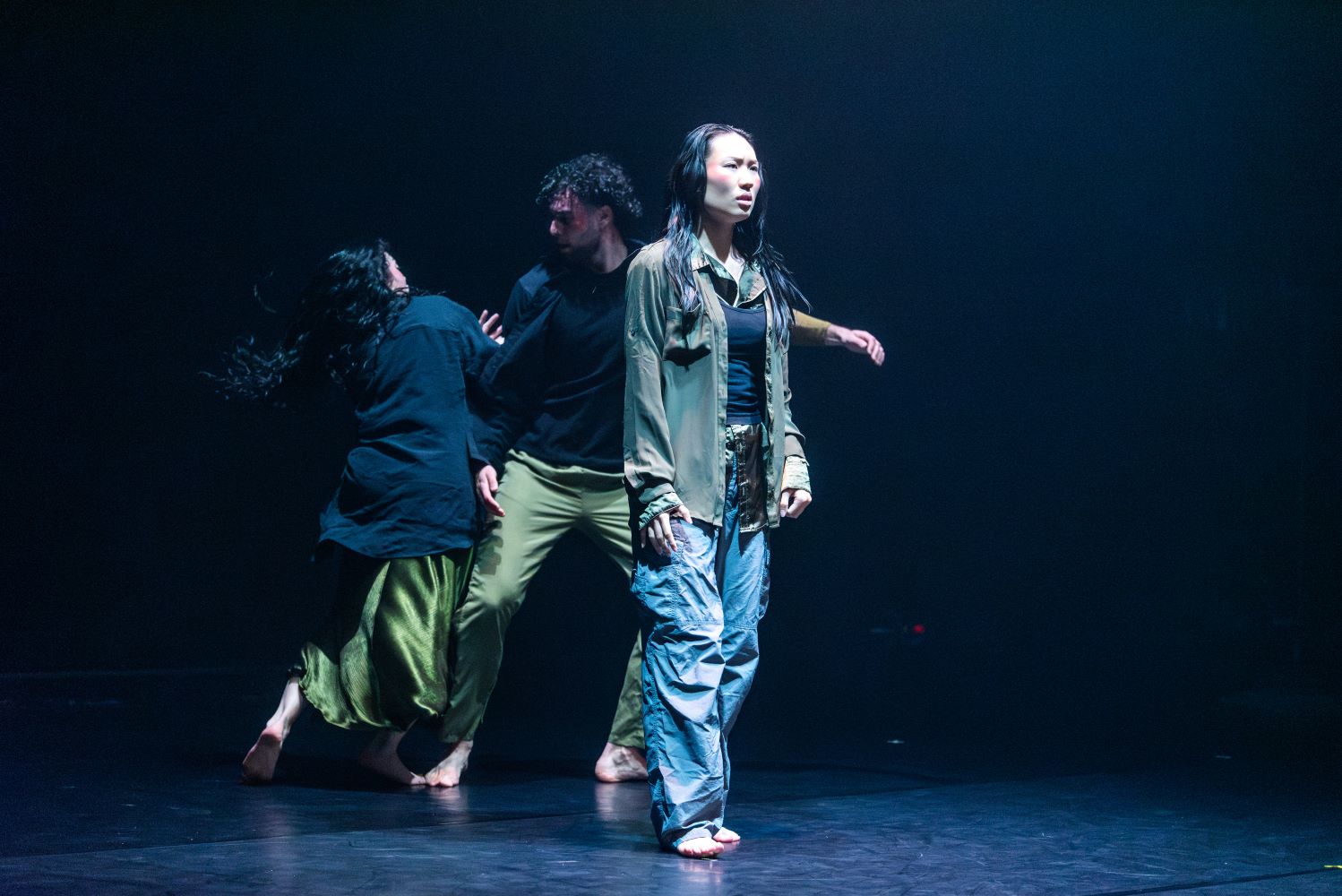
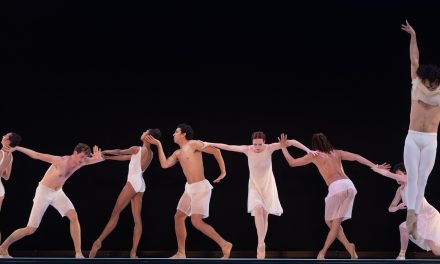
Dance at the Odyssey – Maya Peterson, Tyler Law, and Simon Chernow in “Default:Joy” by Marianna Varviani – Photo by Preston Project.
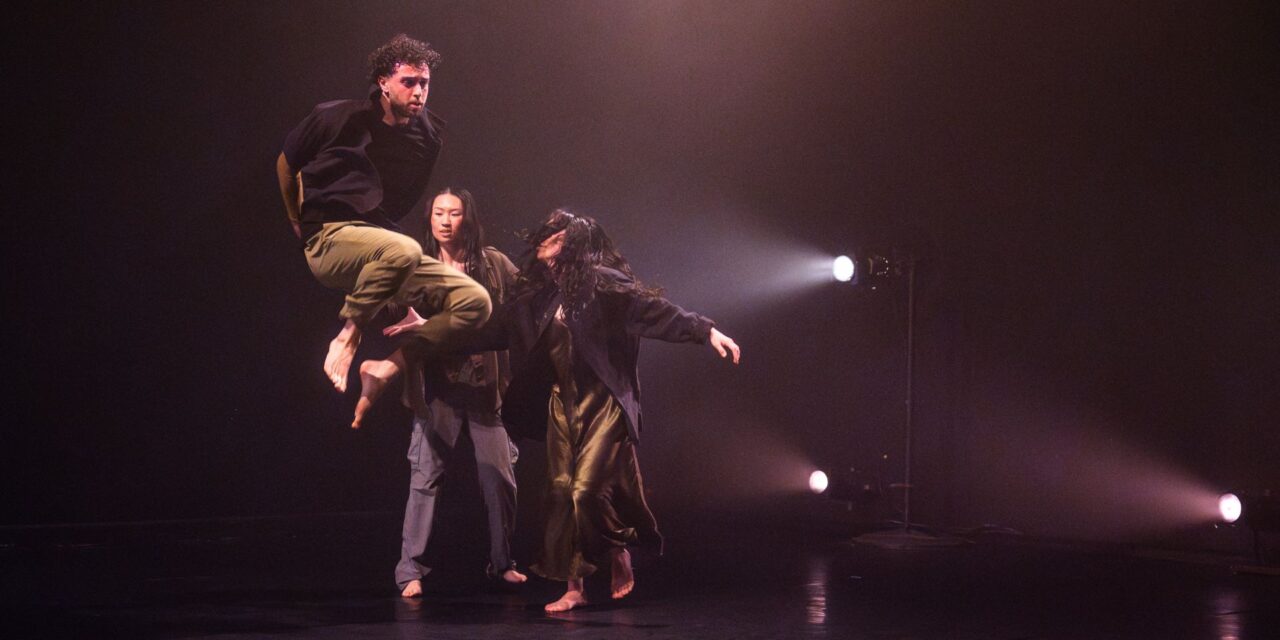
The performers Maya Peterson, Tyler Law, and Simon Chernow were involved with the creation of the piece and transitioned beautifully between the intense movement sequences and the parts calling for acting and character work. The Lighting design by Alex Bennett was moody and worked very well in the square box of Odyssey three theater space. The addition of a fog machine made the specific focus of lighting powerful, Once a person stepped out of the downspot spill, they disappeared entirely into the darkness.
There was a section shared by both companies which utilized the performers walking slowly downstage towards the audience and then, at a certain point, becoming frightened, shocked, or galvanized due to some horror in front of them and they then ran back upstage to the back wall of the space to repeat the process. How did this motif make it into both pieces independently? There must be an instinct common to humanity inherent in the activity.
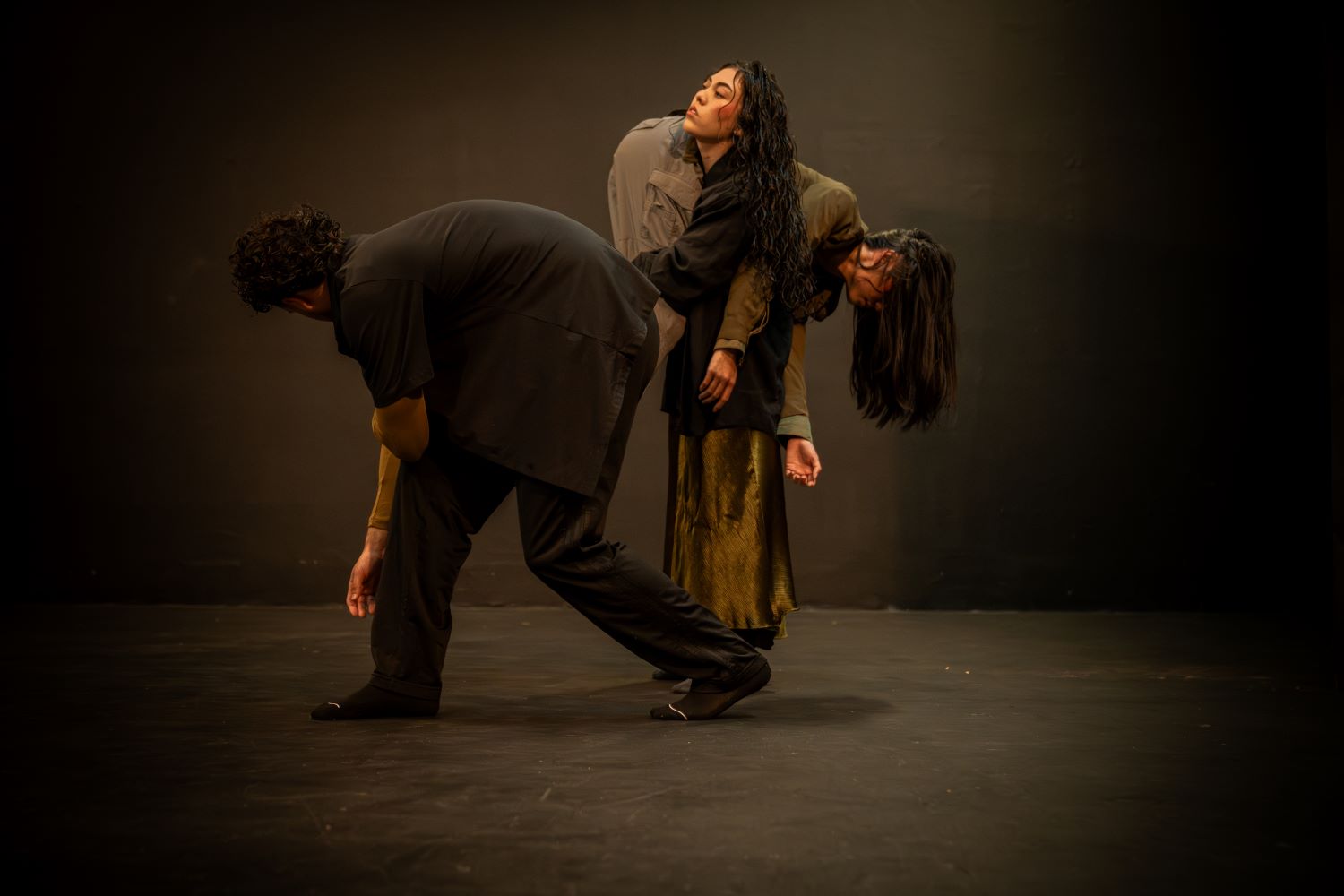
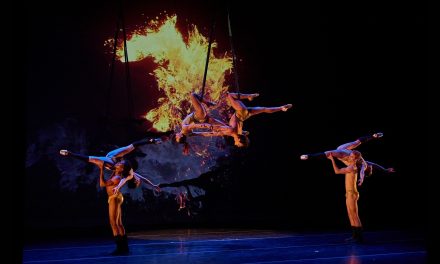
Dance at the Odyssey – Maya Peterson, Tyler Law, and Simon Chernow in “Default:Joy” by Marianna Varviani – Photo by Preston Project.
“Default:Joy” is categorized as “a dystopian dance-theater work”. “Dystopian: relating to or denoting an imagined state or society where there is great suffering or injustice” (Oxford Dictionary). I do not think we have to imagine any great suffering or injustice other than what we are seeing on a daily basis transpire in this country. Also, when one includes the world in that scenario the capacity for indulging that suffering or injustice wears thin. This piece brought us three individuals representing us reacting to and overcoming that onslaught. There was great sorrow and pain through many sections followed by the social bond of coming together and dancing. Much of the choreography had to do with simple folk dance developed and extrapolated as an antidote for what is wrong in the world. Movement is joy. It always has been. Watch any child for more than a minute and they will have to move, explore, see. Feeling joy is not going to combat all of the world’s problems. It is a larger equation of feeling joy in each other and by doing so recognizing that no human is less than another.
For more information and to purchase tickets, please visit the Odyssey Theatre Ensemble website.
Written by Brian Fretté for LA Dance Chronicle.
Featured image: Dance at the Odyssey – Maya Peterson, Tyler Law, and Simon Chernow in “Default:Joy” by Marianna Varviani – Photo by Scott Edwards.