
After a week in the snow of New York and another week in the snow of Montreal, France-based Compagnie Hervé Koubi was happy to be in Santa Barbara and enjoying sunshine. The company brought its distinctive blend of urban street dance, Capoeira, and polished contemporary movement before moving on to three more SoCal venues, concluding at Beverly Hills’ Wallis Theatre February 19-20, 2026.
Originally established in 2000 by choreographer Hervé Koubi and producer Guillaume Gabriel, in recent years the company has become almost an annual U.S. visitor. Previous visits brought Koubi’s What the Day Was to the Night and The Barbarians, receiving both popular and critical acclaim. Koubi’s signature style has been described in reviews as moving between hip-hop physicality and the polish of classical dance.
This visit, the calling card is Sol Invictus, described by the choreographer “as a celebration of hope in dark times that comes from antiquity, celebrating bonds that unite intertwined with the cycle of the seasons.”
Gabriel, who multi-tasks as music arranger and costume designer as well as producer and co-founder, spoke by phone from Santa Barbara with writer Ann Haskins, about Sol Invictus, the attention-getting gold fabric that is integral to the newest work, and the choreographer’s long-hidden personal history that shifted the company from a French company rooted in classical ballet into a meeting place in the dance landscape where North African street dance meets polished contemporary dance. (The interview has been edited for space and continuity.)
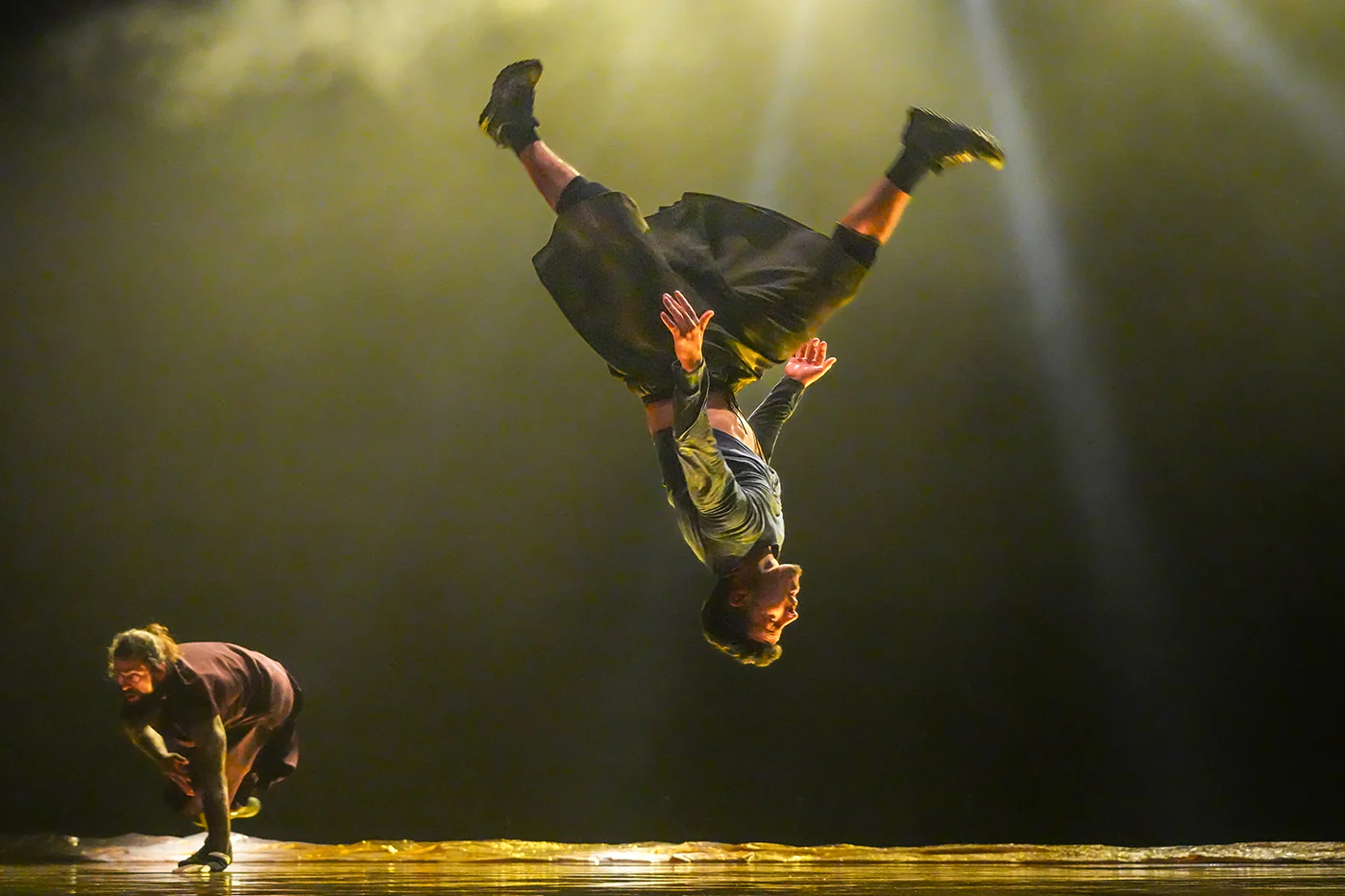
Compagnie Hervé Koubi – “SOL INVICTUS” – Photo by Steven Pisano.
Haskins: I have seen several different English translations for Sol Invictus. How do you translate Sol Invictus?
Gabriel: It could be translated as “invincible sun.” We kept it in the original Latin. Sol Invictus was an old pagan celebration, the ancestor of Christmas. During the Roman period it was a celebration that took place in the middle of the winter to hope for brighter days in the darkest days of the year, to hope for life and light to come back again. The name says that even if it’s dark, and even if, in these moments, the situation, even the political situation, even the relationship between the people, is tense and a bit dark, we hope for better days in our everyday lives.
Haskins: The moment shown in videos and that people talk about has a dancer spinning on his head, then a large swath of gold fabric is released and he gets swirled up in it. Was that dramatic effect intentional?
Gabriel: It was. This golden fabric is a dramaturgic element that allows us to shape time and space throughout the work. It is something which is visual, but also something that is useful to express rebirth, part of the celebration hoping that the sun comes back. We focused on the circle of life, of the seasons, of ritual, and something that appears and disappears, dies and is reborn. That golden fabric comes on at different moments in the piece, and you can imagine several things. It is something that expresses different moments and helped us to develop the dramaturgic elements.
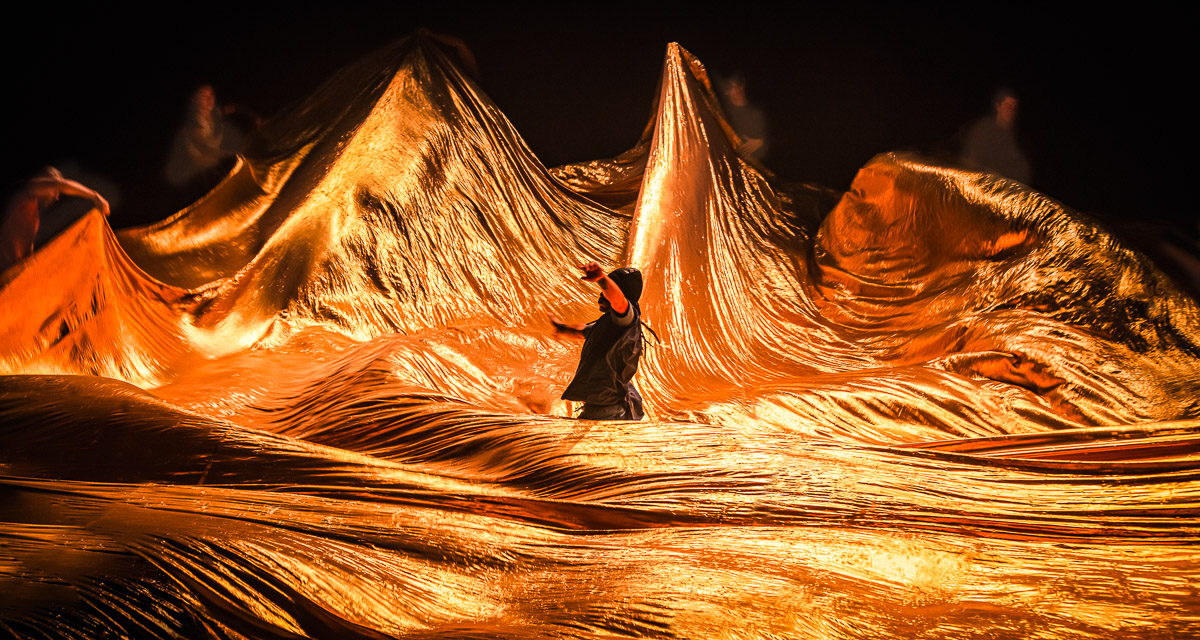
Compagnie Hervé Koubi – “SOL INVICTUS – Photo by Daniel Roblin.
Haskins: Hervé’s choreography and the company today suggests significant change. How did his choreography and the company shift from a classic ballet background to this contemporary street dance infused genre we’ve come to know?
Gabriel: Well, it came out of this meeting with Algerian dancers. Hervé was trained as a ballet dancer, but it was training in the Rosella Hightower dance school in Cannes. She was American, and her way of thinking is deeply American, different from France. In France, we like to put people in boxes–you are a ballet dancer or you are a conceptual dancer, or whatever. And with Rosella Hightower, Hervé took the advantage of an approach to dance, where it can be anything, as long as it’s made with heart and purpose and skills. His background prepared him inside to welcome that porosity between different kinds of dances when we went to Algeria.
Haskins: It sounds like you have known Hervé for a long time. How did you meet?
Gabriel: I created the company with Hervé. We met 30 years ago and created the company 27 years ago.
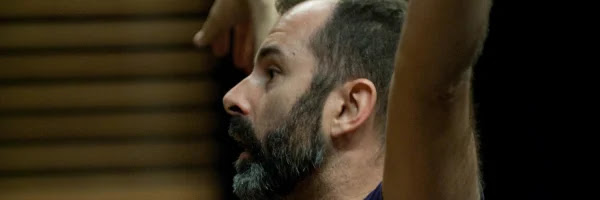
Guillaume Gabriel of Compagnie Hervé Koubi – Photo courtesy of the artist.
Haskins: Did you meet dancing?
Gabriel: No. We were friends. I was not dancing. I was working in a bank and Hervé was doing his studies as a student of pharmacy. And I remember one day I made a movement, and he said, “Oh, you should try to make that move.” I made the move again, and he said, “You should take a ballet class.” So I took one ballet class. I was 23 and my first ballet class was with little girls of seven years old. And then I took another one and another one, and then I decided to take one year without going to the bank. I applied for a sabbatical holiday and never went back to the bank. Then, we created the company and everything started at that moment. At first, I did not tell my parents. Only later did I let them know that I was not working in the bank anymore and that we created a dance company. They said, “Okay, if you do what you like, it’s good.”
Haskins: What happened in Algeria?
Gabriel: After Hervé learned that he had Algerian roots, we decided to go to Algeria, and we wanted to meet dancers from there, maybe for a project. The French Institute is the cultural center in Algeria and I asked for their support to help me to find dancers in Algeria. They said, “There are no dancers in Algeria. You can go and good luck, but there are no dancers.” I managed to have five email addresses in Algeria. I wrote to these guys that we would like to meet dancers. We didn’t care what techniques or where they were coming from. We just wanted to meet dancers.
The day of the casting, there were 250 people in the street. They were dancers, but they were not coming from ballet or contemporary dance. They were coming from the streets–urban dance, acrobats, circus. What was great is with those dancers, we did a path toward them, and they did a path toward us, and we met in an in-between space never explored before in dance. We met those dancers and the strength of that porosity, of that ability to work with different techniques was the beginning of Hervé’s reflection about what could be a contemporary ballet, a ballet of the 21st century that would leave space to those popular dances of today. If you look at the ballet of the 18th century, for example, you had steps coming from popular dances. The mazurka and the waltz were rooted in 18th century popular dances. For us, a ballet of the 21st Century would also leave space for dances of today, such as hip hop or Capoeira or break dance or different street dance.
Haskins: Once you met these Algerian dancers halfway, did that half way space involve some additional training for them beyond street dance.
Gabriel: They were only dancing. They had no other background. For most of them the experience with us was the first time they put feet on stage. It was totally something new. But they were ready in their brain, they were open to discover new things. And I think this is what you really need when you are a dancer, never to say, Okay, I know what I do, and I will do only that. This is my technique. No, you have to stay always aware, open to new things. And thanks to that, we managed to start a new way of doing things, of choreographing.]
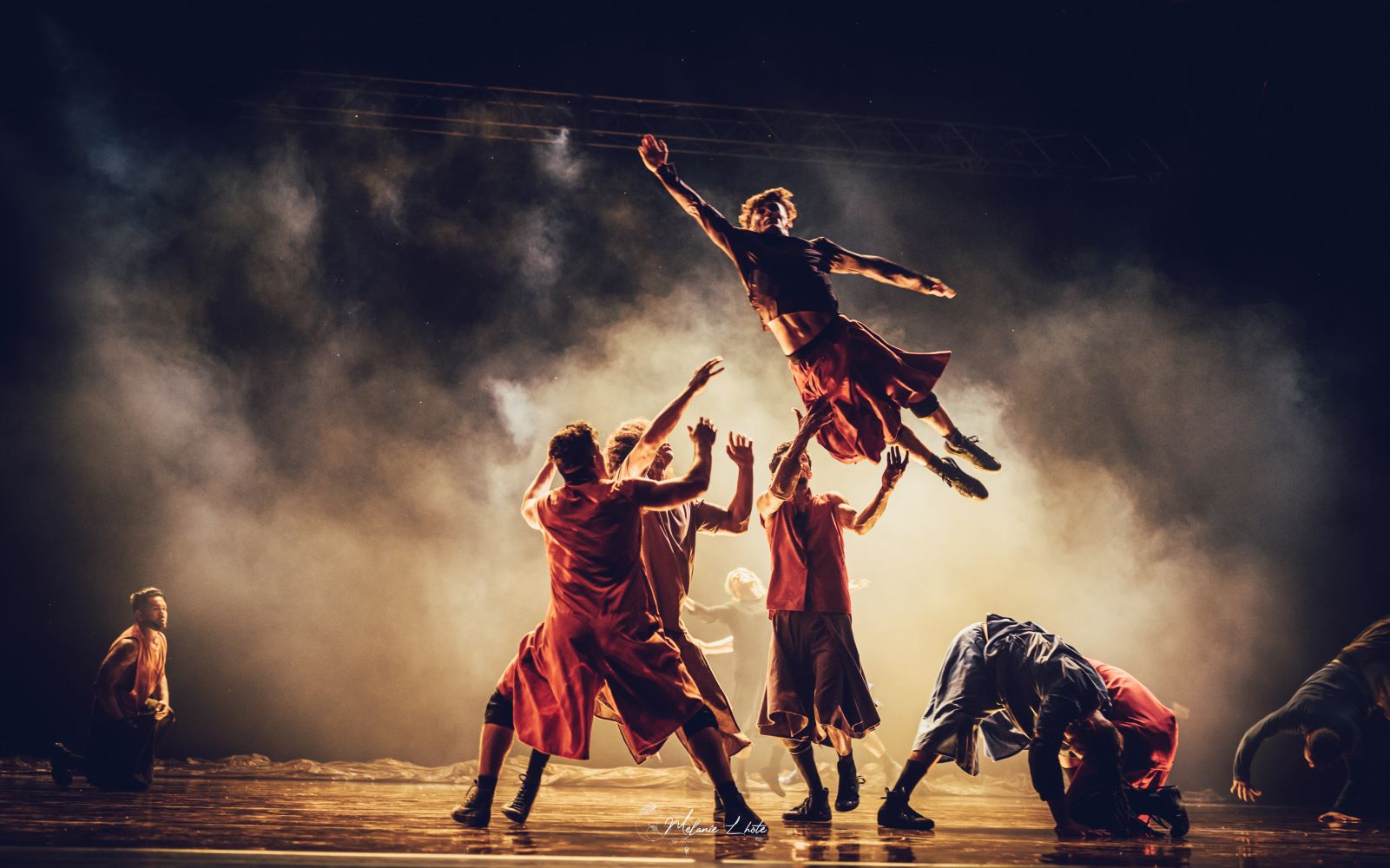
Compagnie Hervé Koubi “SOL INVICTUS” – Photo by Mélanie Lhôte.
Haskins: The company evolved from its beginning. How and why did it change?
Gabriel: There was a turn in the company in 2010 when we met those dancers in Algeria, but the company already had 10 years of existence in France and there were male and female dancers. In the very beginning, for the first creation there were 13 dancers on stage, eleven girls, and two boys, Hervé and me. During those first ten years, we always worked with a lot of people on stage, men and women. As we developed the project in France and a bit abroad, I think everything was prepared to let the project develop itself with Algerian dancers, with that unique thing in the kind of hybrid place between ballet and hip hop and Capoeira and acrobatics. Over the first ten years, the company laid the groundwork, and then, with a seismic personal event and going to Algeria, discovering the wealth of street and other urban dancers, it just made sense to pivot the company focus to what has drawn international attention and praise.
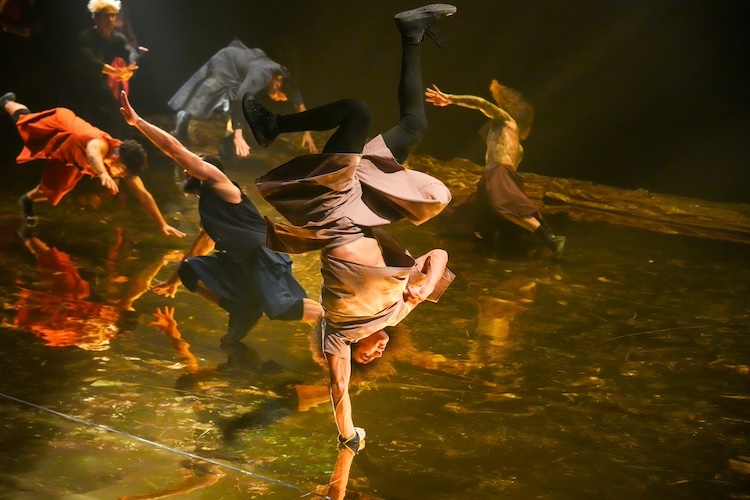
Compagnie Hervé Koubi – “SOL INVICTUS” – Photo by Steven Pisano.
Haskins: Can you talk about the seismic personal event?
Gabriel: Hervé thought that he was French, but no, he was Algerian. I think every family, everyone has these little secrets. Hervé put them on the stage, but I think this is something that could be shared with a lot of people in the audience.
Haskins: Many Americans might not know much about the relationship of Algeria and France. What was so shocking to someone who thought he was French to find out he was Algerian?
Gabriel: Hervé was born and raised in France. Growing up, he knew there was a long and troubled history between France and Algeria, and that his parents had been born in Algeria, but understood that his grandparents were from France, had gone to Algeria as part of France’s colonization of Algeria, and that his parents came back to France in the 1960s because of the decolonization war and the aftermath. He thought Hervé was a tribute to his great grandparents from Brittany. He was raised in a way that was very French, not at all North African, and with light skin and freckles, he did not look at all North African. However, Koubi did not sound like a French last name. Hervé was 25 when he asked his father about the last name. His father showed him a photo of an old man in traditional Arabic dress and said “This is your grandfather. He was not French. He did not speak French. Arabic was spoken from your mother’s side and your father’s side.” It was a shock. Hervé had no idea.
Haskins: Why did they hide it from Hervé?
Gabriel: When they came to France after the Algerian independence war, his parents thought that with the decision to come to France rather than be in Algeria, they would be welcomed with open arms. But that was not how it was. His mother told a story describing one example of how she encountered the widespread prejudice and subhuman regard by the French hold toward Algerians. When they came back to France, she went to the butcher and asked for some marguez, a North African sausage. The butcher replied, “But Madam, you are not in a savage place, you are in France.” She realized that if she wanted to integrate, not be stigmatized and discriminated against, she had to be more French than the French. They raised Hervé as if he were French, and his true history was put under the cover, in the closet.
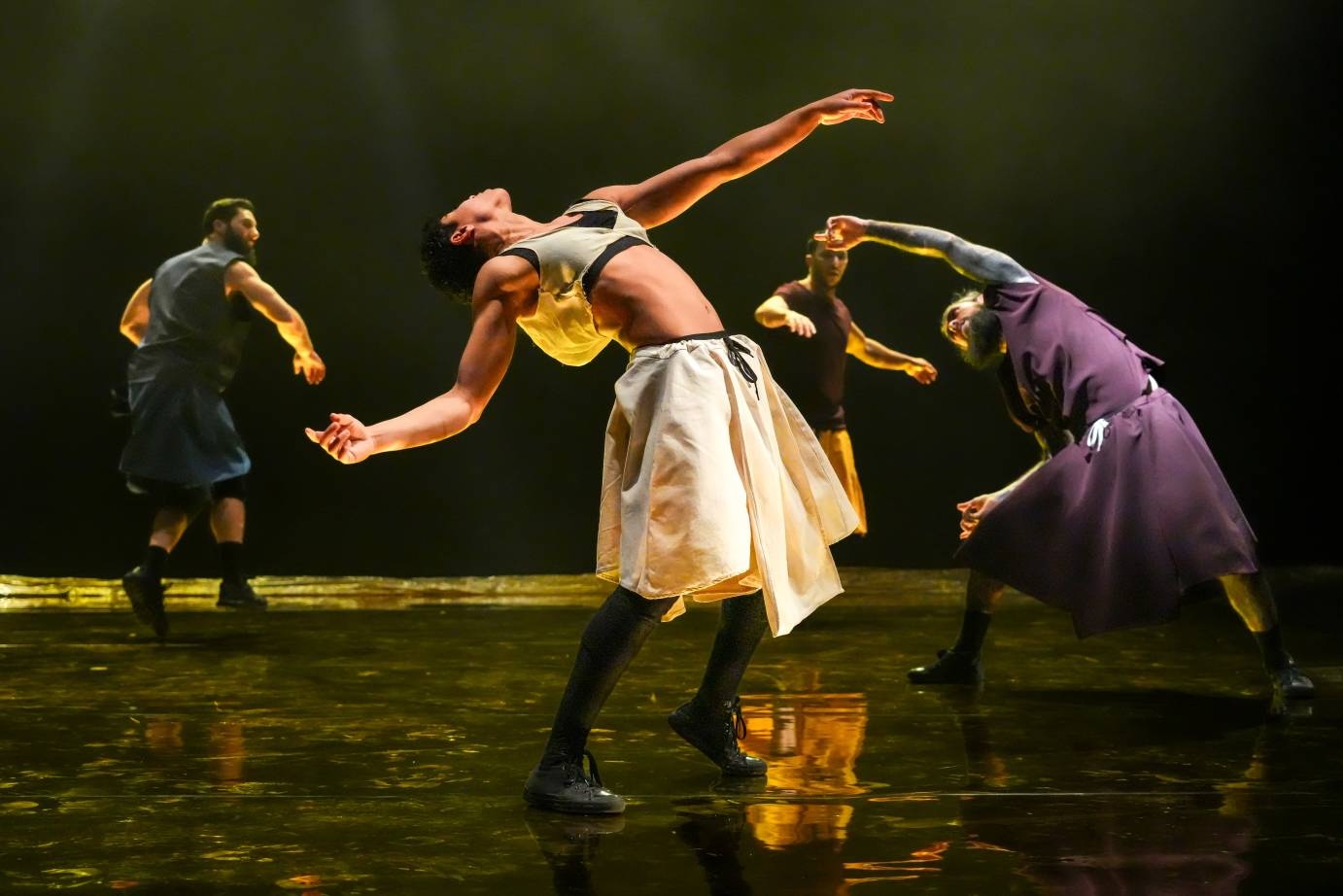
Compagnie Hervé Koubi – “SOL INVICTUS” – Photo by Steven Pisano.
Haskins: The early visits had only male dancers. Sol Invictus has male and female dancers. What was that about?
Gabriel: When we went to Algeria and there were 250 people in the street for the casting, there were 249 boys and one girl. So when we did this creation that became What the Day Was to the Night with those male dancers, that was not really a choice to have only male dancers. In a way, the work asked the question who Hervé was and became about his Algerian roots and how he found a sense of brotherhood.
Then for the second creation, The Barbarian Nights, we wanted to focus on the bigger history of the Mediterranean basin, where we paid tribute to all the cultures that gave foundation to the global Mediterranean basin culture. The question for that piece was what is a barbarian? Most of the time, people will say barbarians are the people who kill others and take the culture. But if you look at the etymological sense of what a barbarian is, it is just someone who doesn’t have the same culture as you. For the Romans, the Greeks were barbarians, and this word ‘barbarians’ comes from the Roman people listening to the Greeks speaking, and they only heard “baa, baa, baa, baa, baa.” So the Romans named the Greeks ‘barbarians’ out of this sound. For that piece, we wanted to go with the same team of dancers, because the question was conflict, which usually comes from men. For us, The Barbarians was an opportunity to recall that no matter whether you come from France, Algeria, Italy, Morocco, Spain, we all have roots in those many cultures, a belonging which is much older than borders and boundaries of nations.
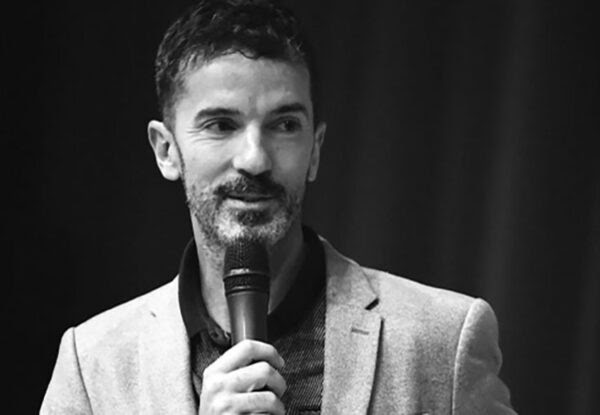
Compagnie Hervé Koubi – Photo courtesy of the artist.
Haskins: Was there also a question that triggered Sol Invictus?
Gabriel: For Sol Invictus, the question was in another place, to pay tribute to all the dances that shaped Hervé’s choreographic creations and to show that very different people coming from very different cultures, very different nationalities, regardless what differences there are, we can dance together and we can live together. This is where our hope is, and this is where Sol Invictus is. This is our declaration of love to dance and also a declaration of hope. So, for this piece, we wanted boys, girls, every kind of people, that brought us back to mixed company.
Compagnie Hervé Koubi in Sol Invictus
Choreographer: Hervé Koubi
Assistant Choreographer: Faycal Hamlat
Music: Mikael Karlsson, Maxime Bodson, Steve Reich, Ludwig van Beethoven
Arrangements: Guillaume Gabriel
Lighting: Lionel Buzonie
Costumes: Guillaume Gabriel
Artistic Advisor: Bérengère Alfort
External Advisors: Odile Cougoule, Mohamed Zerouali
Dancers: Ilnur Bashirov, Francesca Bazzucchi, Badr Benr Guibi, Joy Isabella Brown, Denis Chernykh, Samuel da Silveira Lima, Youssef El Kanfoudi, Mauricio Farias da Silva, Abdelghani Ferradji, Elder Matheus Freitas Fernandes Oliveira, Hsuan-Hung Hsu, Pavel Krupa, Ismail Oubbajaddi, Ediomar Pinherio de Queiroz, Allan Sobral dos Santos, Anderson Vitor Santos, Karn Steiner, El Houssaini Zahid
San Diego Balboa Theatre, Fri., Jan. 30, 7:30 pm, $45-$112. Ticketmaster. Also at McCallum Theatre, 73000 Fred Waring Dr., Palm Desert; Sun., Feb. 1, 3 pm, $47-$107. McCallum Theatre Palm Desert. Also at The Wallis, 9390 N. Santa Monica Blvd., Beverly Hills; Thurs.-Fri., Feb. 19-20, 7:30 pm, Sat., Feb. 21, 2 pm, The Wallis
Written by Ann Haskins for LA Dance Chronicle.
Featured image: