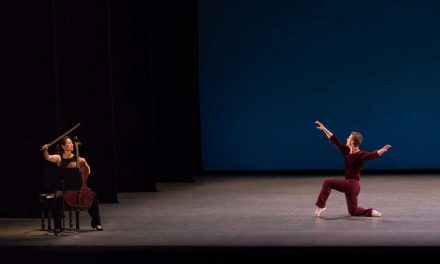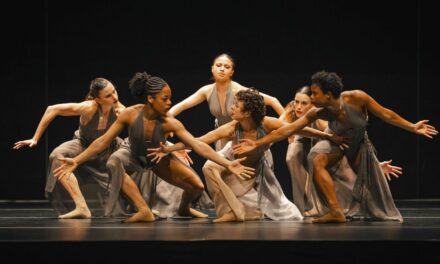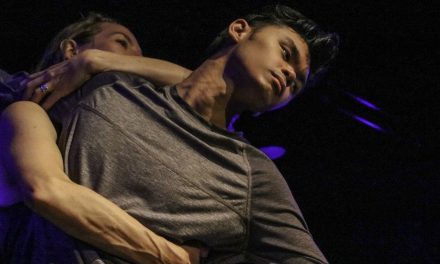
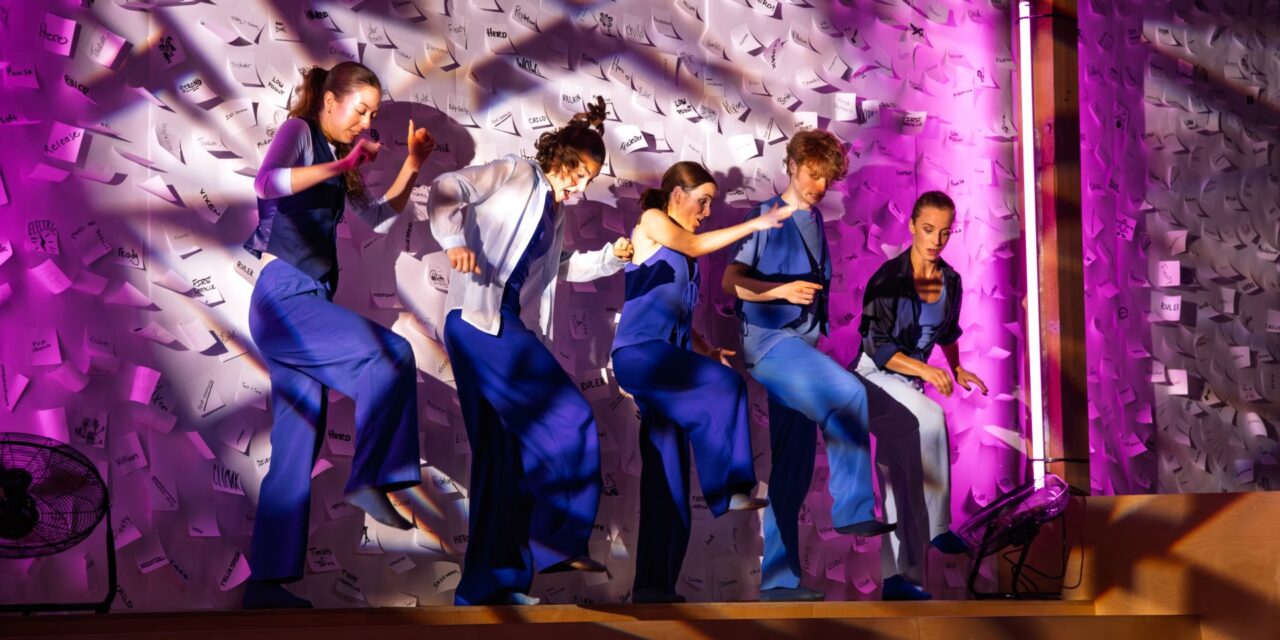
The dancers inhale together, walking forward in synchronized step. They try a few different beginnings (“once upon a time,” etc.) that spiral them into movement threads, play pathways, through lines. The dancers are weaving new patterns, coloring in between the lines of their given structure. The dancers are trying new ideas on and abandoning old ones.
The dancers are the company members of Los Angeles Contemporary Dance Company, performing Jillian Meyers’ “Story (Un)Structured” at L.A. Dance Project. Their stage is reversed from the usual LADP setup: we are seated on the back half of the Marley, facing them as they dance on the front half, in the bleachers, around the sides, and through the middle of the seats.
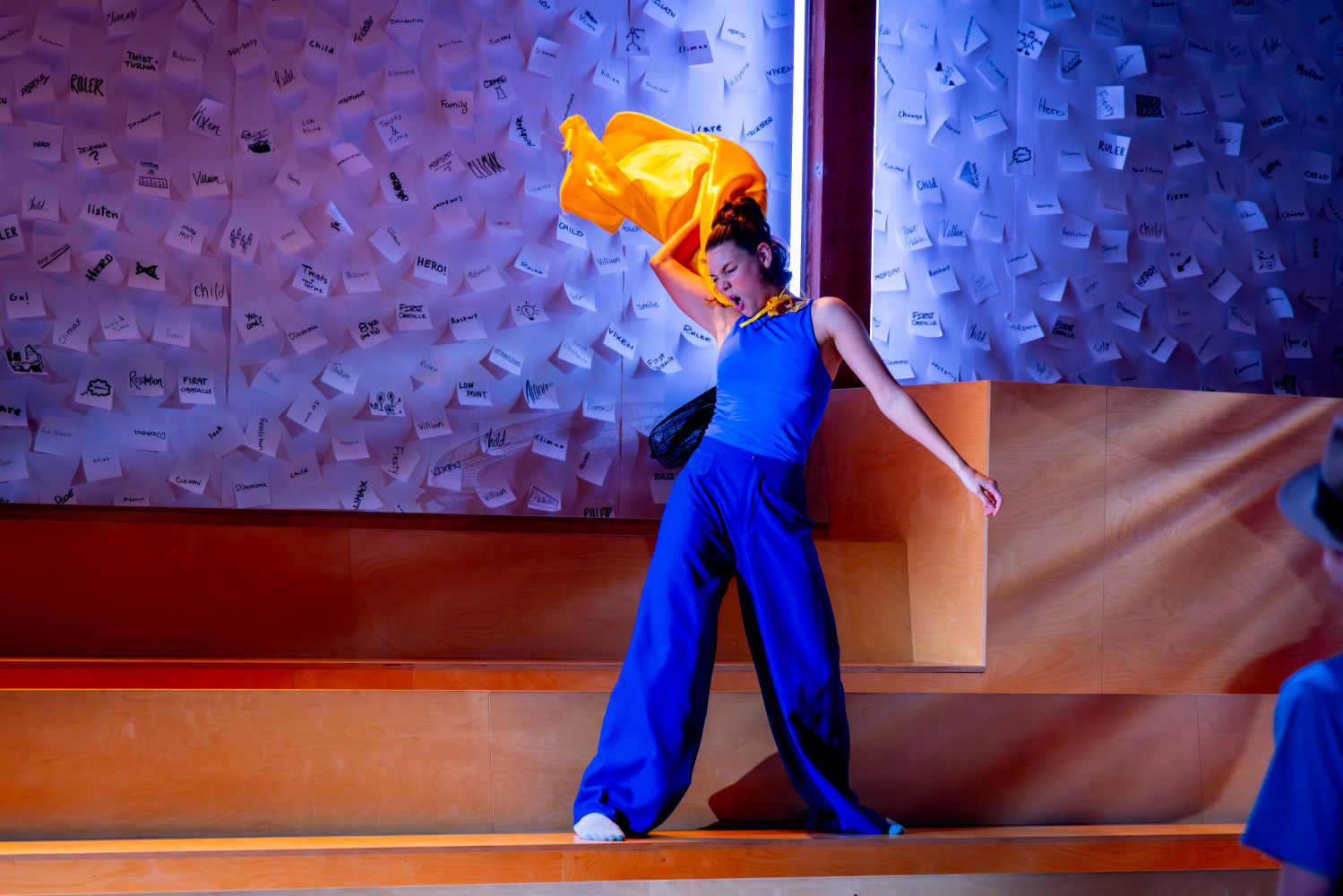
LACDC in “Story (Un)Structured” by Jillian Meyers – Photo by Taso Papadakis.
On entering, we (the audience) were encouraged to write a verb on one sticky note and a feeling on another, then to place them on the wall stage left. The wall above the bleachers is covered with more, all set in motion by a fan that has their shadows dancing in the wind. Every corner has been accounted for, every prop set with purpose in mind. I wondered how long they were able to rehearse here, because their use of space was so explicitly functional: just one of Meyers’ many marks of intentionality, dusted throughout the work and imparted to the dancers.
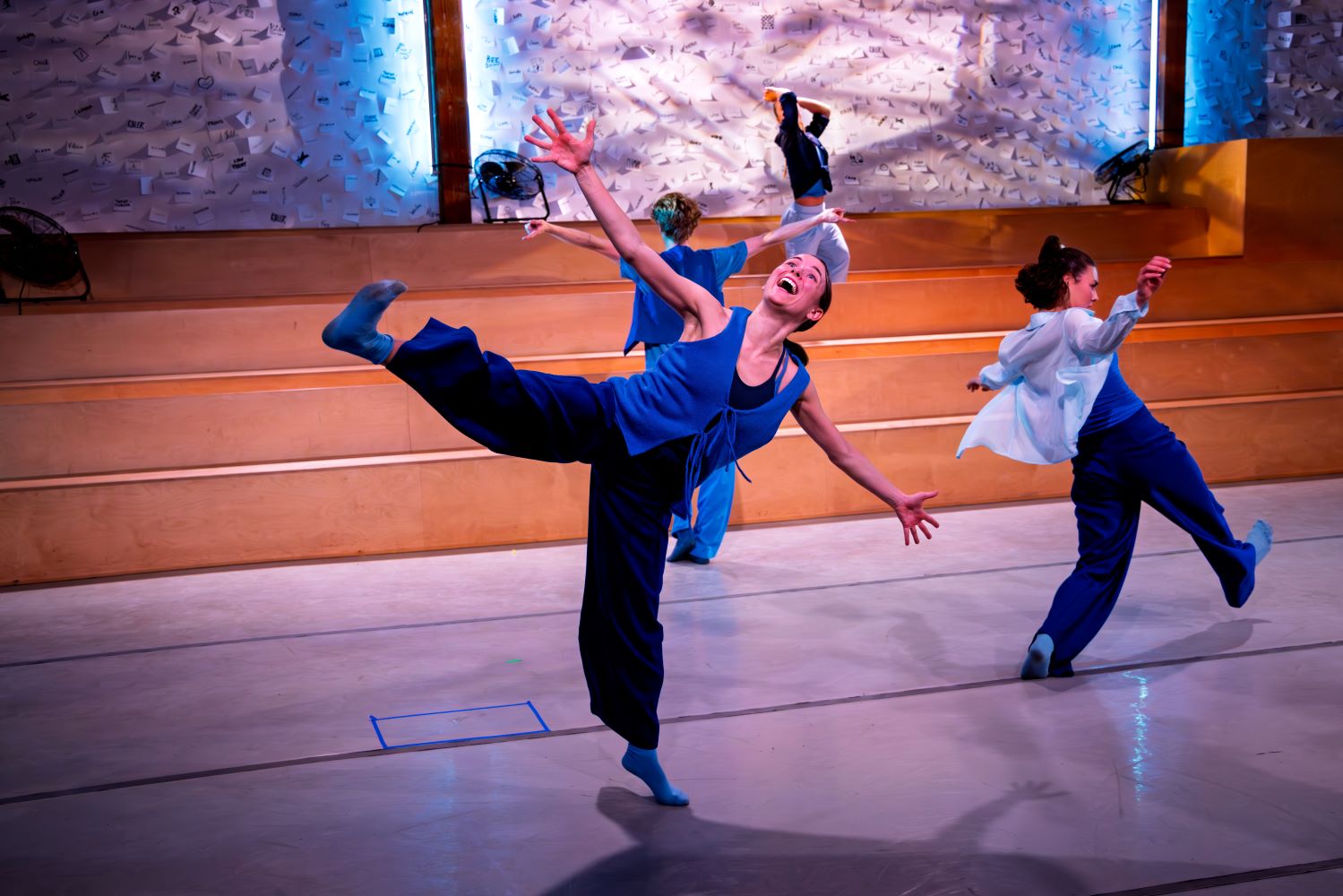
LACDC in “Story (Un)Structured” by Jillian Meyers – Photo by Taso Papadakis.
The dancers are Colleen Loverde, Lily Massie, Kelle Meschede, Jonacy Montero, Melody Morrow, and Dawson Walker, and they are walking us through a story as they go. The story itself is undefined so far, but Meyers has mapped a structure for the artists to investigate each component of a tale.
The dancers are draped in varying shades of blue designed by Ashley Kayombo, trying on costume accessories and swapping them until they find what fits them best. They spend some time deep in characterization, building and discovering their roles with true curiosity. Loverde is ebullient, emphatic — fully committed to everything she does. Massie is slinky, sultry and soft, her limbs draping over effortless lines. Meschede commands a defined specificity, assertive about each step. As Montero steps up to unplug the fan blowing across the back wall, his cheekiness gives way to a rooted buoyancy. Morrow is engaged in a never-ending push and pull, made pliable by her own control. And Walker’s steady willingness makes his comedic timing all the more effective.
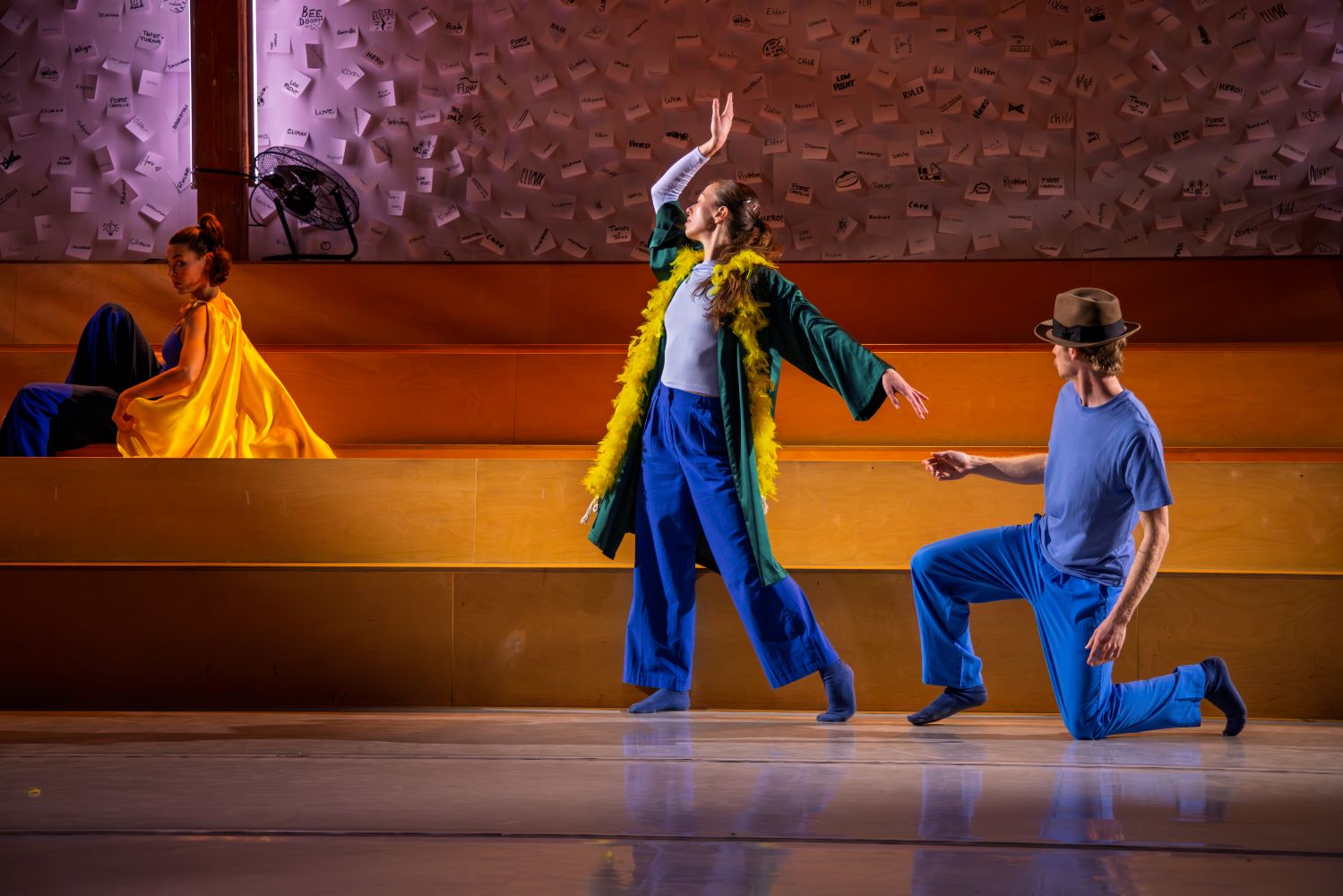
LACDC in “Story (Un)Structured” by Jillian Meyers – Photo by Taso Papadakis.
I can’t quite articulate the satisfaction of seeing a dancer explore a character, settling into the frame, playing with how far to lean in — but I’ll tell you I was deeply invested in each of their characters by the time Loverde gasped, “do you have the keys?!”
This is the first obstacle: the dancers facing individual conflicts. They shed their accessories, each repeating their own dilemma with new inflection, and filing into an obstacle course made of their fallen costume pieces. They invent new ways to traverse the course each time, locking and shimmying and changement-ing through the aisle. I think it’s because of this initial time spent investing in the dancers as dynamic characters — a slow build, but not tedious — that the work takes off so smoothly. They have won us over.
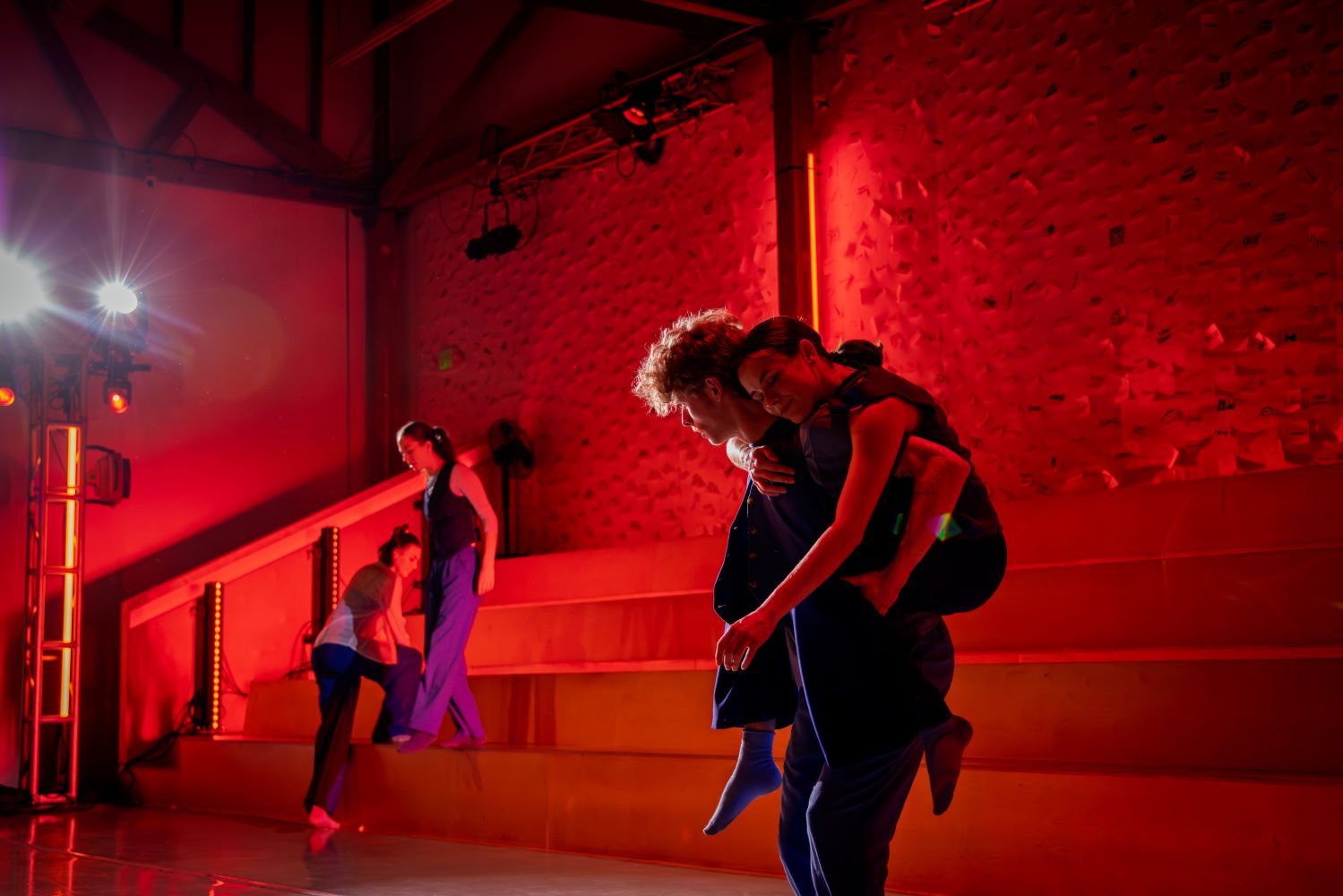
LACDC in “Story (Un)Structured” by Jillian Meyers – Photo by Taso Papadakis.
The dancers find our sticky notes on the wall, then plug them into a sort of mad-lib movement prompt for each other: “I felt ___ when I ___-ed around the corner.” The bleachers become a playground of sliding and skipping and slinking, each artist fearlessly jumping into new prompts before our eyes. The mad-libs lead into a contemplative solo by Morrow, who shows us where every movement is initiated and follows carefully through until each thread has been pulled.
The dancers drop in, trading eights into a final section built on duets. One pair leads us through the components of a classic story, interpreting each element in movements. One pair completes a narrative by trading phrases, all while sharing weight and risk with each other. They cycle through roles a few times, perhaps a little longer than I’d like but not long enough to lose my attention. As the piece culminates with a beautifully contrapuntal finale, there is this feeling of mutual accomplishment. We have all shared the drafting process of a story.
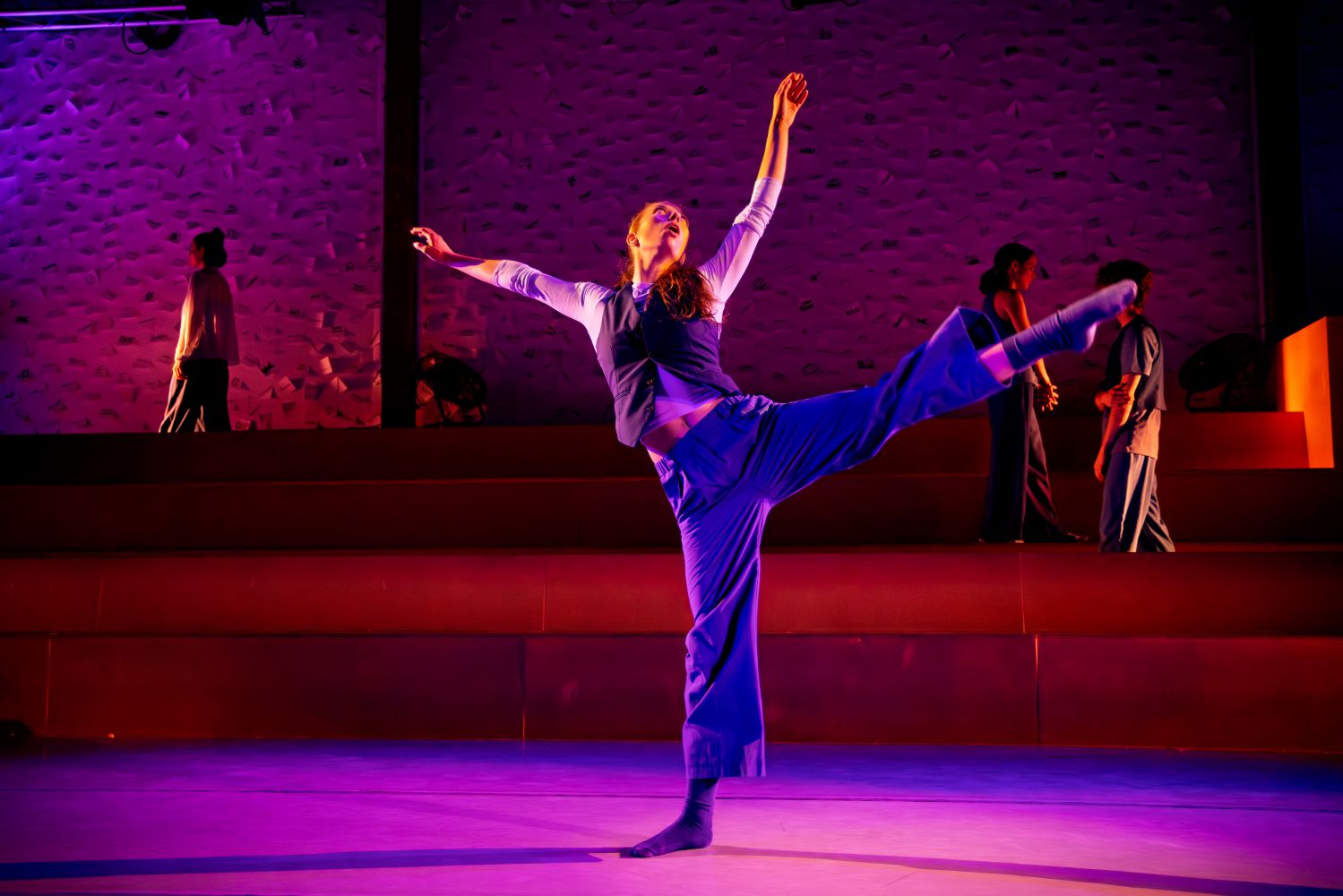
LACDC in “Story (Un)Structured” by Jillian Meyers – Photo by Taso Papadakis.
The artists in this work are not just dancers. They are making critical, informed choices within a structure that supports them to do just that. Their improvisations are smart and stunning — and it is heartening to see their skills used in this way.
Meyers’ signature choreographic style was of course present: quirky and masterfully musical, set to compositions by Miles Davis, Thelonius Monk, Joss Moog & Around7, and Theo Parrish. Her emphasis on clarity stood strong throughout, balanced with curiosity to create the perfect conditions for visual interest. Dramaturgy by Jamila Glass, rehearsal direction by Ayesha Orange, and production management by Kate Hutter Mason held this vision up, as did scenic design by Meschede in collaboration with Meyers and lighting design by Casey Cowan Gale and Brian Gale.
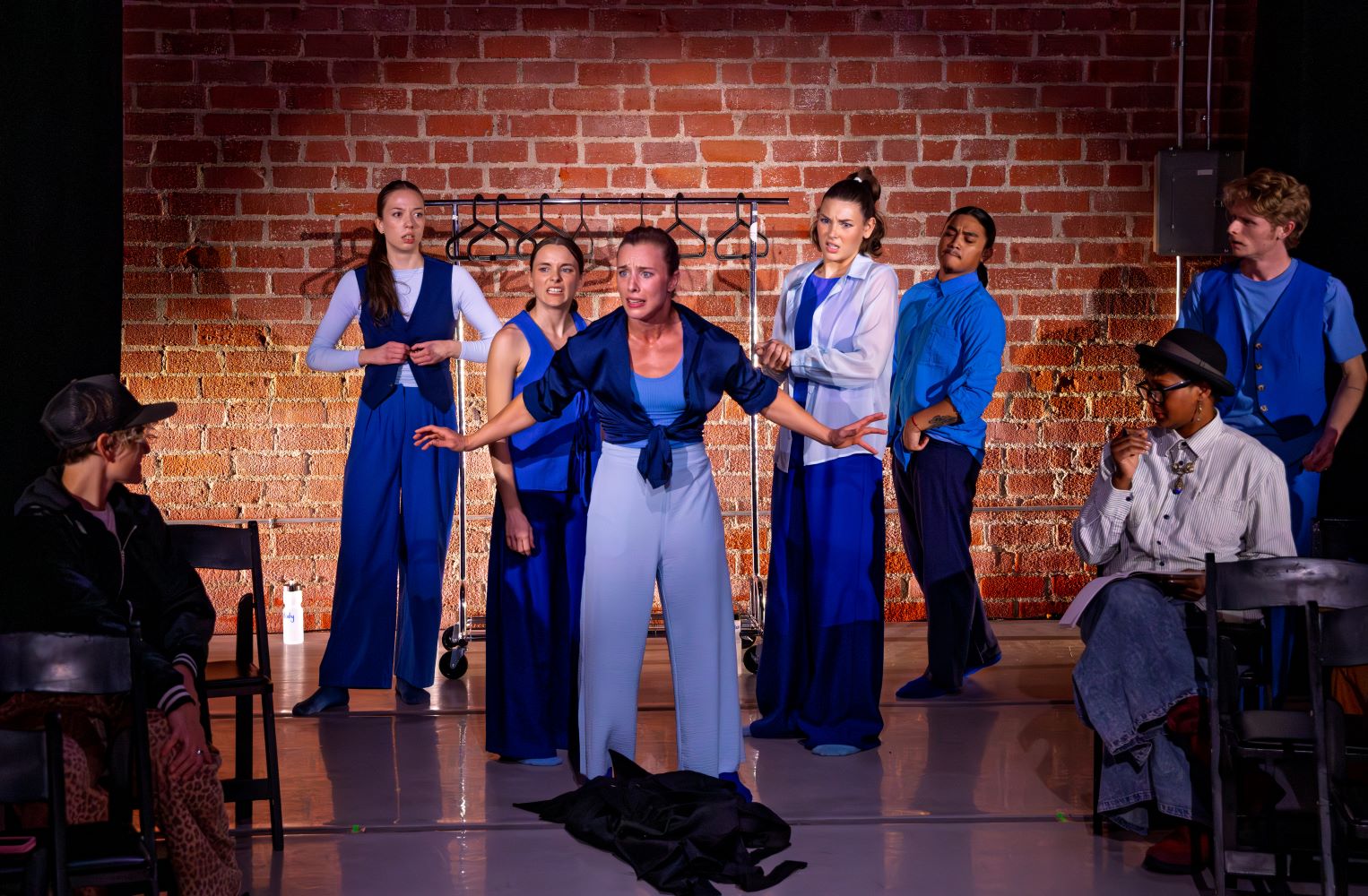
LACDC in “Story (Un)Structured” by Jillian Meyers – Photo by Taso Papadakis.
The evening was consistently structured to let the artists play; to let them make live decisions that would drive the work. While I think there is a lot of this type of freedom in Los Angeles dance, it sometimes comes at the cost of virtuosity. Building individuality and choice into the choreography while also sustaining unison, technique, musicality and general togetherness is a tall order. But Meyers and the artists of LACDC accomplished both with precision and flair. It’s evidence of a long career playing on both stage and screen: professionalism that cultivates growth, exploration, play. And it speaks to a lack of ego, an ability to let go of the work at a certain point and trust the capability of the dancers, who really committed their entire selves and made the story come alive.
For more information about the Los Angeles Contemporary Dance Company, please visit their website.
Written by Celine Kiner for LA Dance Chronicle.
Featured image: LACDC in “Story (Un)Structured” by Jillian Meyers – Photo by Taso Papadakis.